Showing posts with label Spanish. Show all posts

Wednesday, 3 May 2017

Living in a Multilingual World (The One About Adjectives and their Order)

Read the two sentences below and tell me which is the correct one:

He is an ugly little fellow.

He is a little ugly fellow.

You guessed right. The first one is the correct one. That is, if we are to go by a paragraph, gone viral last autumn, from a book called The Elements of Eloquence. The extract dealt chiefly with the order in which adjectives in English should appear (only applicable if you’re using more than one adjective per noun): opinion, size, age, shape, colour, origin, material, purpose. That is why “ugly” (my opinion), comes before “little” (size).

But I bet that you, native English speaker, knew that without bothering to read the why. That is because you “felt” it was the right way. It is a strange phenomenon, this “feeling”. I began to experience it when I started to think in English halfway through my uni years.

This is a life-changing event that does not announce itself. I am not exaggerating with the life bit. Just think of someone having to translate internally every single word and phrase that is said in a conversation before voicing them. It would be exhausting. The way the mind goes from translation-based communication to a native-speaker-level, sentence-building mindset is almost magical. It just happens. One minute you are consulting your grammar book, the next you “feel” that this is the way these adjectives ought to be arranged if you want your sentence to make sense.


Ugly or little? Which one comes first?
English is not a language famous for its rules, yet, there are plenty. The fact that not many people care about enforcing them doesn’t mean that we should ignore them. For instance, I would never think of placing and adjective after a noun in English, the way we generally do in Spanish and other romance languages (in the case of English, since it is a Germanic lexicon, the adjective+noun structure makes sense). It is just a rule we learn by rote and apply it without any second thoughts.

I am not aware that adjectives in Spanish must be ranked following a pre-arranged order. The sentence above could well be “Él es un hombre feo y pequeño” or “Él es un hombre pequeño y feo” (notice the conjunction “y” [and]. That’s another difference between the two languages). Perhaps there is a similar rule that I have not yet discovered but I doubt it. We have far too many linguistic precepts to deal with already to even contemplate adding a new one.

Without blowing my own trumpet, I am pretty sure that I have, unconsciously, placed adjectives in the correct order most of the time since I became a fluent English speaker. But it is always gratifying when we are validated by hitherto unknown laws of grammar or syntax.

© 2017

Next Post: “Thoughts in Progress”, to be published on Saturday 6th May at 6pm (GMT)

Tuesday, 23 February 2016

Living in a Multilingual World (The One About Socially Awkward Linguistic Situations)

Learning a foreign language is not just about skills and dedication; it is also about context. Determining one’s context is as important as decoding complex grammar structures or incomprehensible syntax. I learnt this lesson the hard way as a newly-graduate English language teacher more than twenty years ago. There I was, fresh from uni, talking about phonetics and phonology to my students, when all some of them were interested in was to find out how to say “your rent-car is ready, sir”.

It is this contextual aspect that came to mind recently when I read the now-customary section in The Economist called “Johnson”. This was a regular feature years ago that has made a much-desired come-back.

The phases one goes through foreign-language-learning are not dissimilar to the ones one undergoes when taking the first steps in one’s native tongue. There is much to decipher, digest and interpret. The difference is that when presented with a vessel of new words the foreign-language learner will immediately hang on to primary meanings. They are the equivalent of a life-saving piece of wood in a shipwreck.

It takes a while for second-, third- and multiple-meanings of a word to take hold. I always knew that “baby” was an infant or very young child. But the “baby” who just cares for Nina Simone is of a different variety. Same with the “baby” whom (repeatedly) Robert Plant is gonna leave in Led Zeppelin’s monster hit. That baby had nothing to do with youth (even if she was young).

Thus, from primary-meaning acquisition the learner moves to a nuanced zone where the context defines the meaning of the word. We, those of us who have studied a foreign language, begin to think in that target lingo. It happened tome halfway through uni and it is one of the reasons why I am able to write a blog in English despite the fact I am a native Spanish-speaker. At some point, through hard work and skills-building, I managed to create a personal structure based on the English syntax, semantics and grammar.

I mentioned semantics in that paragraph. Semantics can be misleading sometimes. When we are learning a foreign language we not only adapt to unusual patterns (and make them familiar to us) but also we adopt linguistic tics in the same way a native speaker would. How many times have I not heard a fellow Cuban nowadays start a sentence with the word “like”, just like a US or – come to think of it – a British teenager?

In the same way, we, non-native speakers, sometimes appropriate language we rarely give a second thought to. Some of this language could come across as socially awkward. The Economist’s “Johnson” section had a wide selection of words that describe men and women but that tend to favour mainly the former over the latter. For instance, I am guilty as charged of using the word “chatty” for women whilst for men is, “says a lot”. I used to use the word “bossy” to describe a woman I knew until I realised that I was unconsciously patronising her and boxing her in. It also works the other way around. I have been called “articulate” on a few occasions, which used to bring a smile to my face until I noticed that it was usually accompanied by a look of surprise on my interlocutor’s face. At a higher level, our Prime Minister, David Cameron, used a put-down in Parliament a few years ago that no one has forgotten about. In addressing a female colleague, he told her to “calm down, dear”. Well, at least, I have the excuse of being a foreign-born non-native speaker. Oxford-based Cameron has no such excuse. He knew exactly what he was doing.


Who are you calling bossy?

Which brings me back to the start of this column tonight. Learning a foreign language does not depend on innate skills (believe me, I was not born with an MFL gene), but on hard work and dedication. It also depends on the context the learner decides for themselves. Is it communication they are after? Is it specialist translation they need? Is it the whole shebang? In more than twenty years I still have not found the answer. I’m still learning.

© 2016

Next Post: “Urban Diary”, to be published on Friday 26th February at 6pm (GMT)

Thursday, 24 October 2013

Living in a Multilingual World (The One ABout Twitter and the Spanish Language)

Going through my Twitter feed the other day, it struck me how strange my mother tongue, Spanish, has become. There were words and phrases in my co-Twitterers’ pages that I could not recognise. Sometimes, it was only after the third or fourth attempt that I was able to decipher what had been written.

Because English is so dynamic, fluid and adaptable I no longer bat an eyelid when I see a LOL or ROTF. I expect that. After all, social networking sites’ roots are mainly Anglophone. But that such an austere language like Spanish dares to use a verb like “Twitear” (literally, “to tweet), is taking the biscuit.
Yo twiteo, nosotros twiteamos...
And that’s where the challenges lie. You could say that the Anglicisation of Spanish was foreseeable. An irony, really, as in the real world Spanish is overtaking English in the US and could be the official language of the largest English-speaking country on Earth in a generation from now. But online, English still holds the triumphant card. In our cyber-world we speak Spanglish. The second challenge is that social media’s spontaneity invites grammatical sloppiness and typos. Lots of them, in fact.

Because of the Spanish language’s structure – long, three or four-line paragraphs can easily be made up of one single sentence with many subordinate ones – Twitter would be the last place where you would find fluent and articulate Spanish speakers. Which logically poses a hurdle to us. And where there is a hurdle, there exists the desire to overcome it. That’s how we come up with aberrations like “ke” (“que”, “what” or “that”).

Is there a way back from this situation? There has certainly been a backlash. Unfortunately it has been led by academics and language specialists for whom even my Cuban accent would be an anomaly. That, to me, is taking it too far. I would dare to ask Twitter to increase its word limit, just for the sake of Hispanics. But having read recently that he media giant is planning to float in the New York Stock Exchange in November, I thought that maybe Jack Dorsey would be too occupied to answer my phone calls. Or my tweets.

The linguistic fate of the Spanish language on most social media, especially Twitter, is one of those topics that becomes like the annoying fly that drives you mad at dinnertime. Very rarely you will be able to swat it and when you least expect it, it will alight on your food. “Twiteando” to the whole world.

© 2013

Next Post: “Sunday Mornings: Coffee, Reflections and Music”, to be published on Sunday 27th October at 10am (GMT)

Wednesday, 5 June 2013

Living in a Multilingual World (The One About Words and Their Meanings)

The word “radical” has an interesting history. It’s a term that, in the political sense, is the equivalent of “reform” or “reformist”. Hence when you say “radical reforms”, you’re indulging in a bit of pleonasm. However, whether you’re being redundant or not, “radical” is one of those words we need nowadays, especially to separate the wheat from the chaff at Westminster. Michael Gove’s educational reforms are not radical, whether they are a pleonasm or not, they’re stupid.

The reason why I have been musing over the term “radical” is that it’s one of those words whose meaning used to evoke images of someone advocating deep economic, political and social transformation. Very rarely did it refer to extremists, even if some radicals did make use of non-conventional, unorthodox methods to achieve their aims. I don’t mean to sound conservative (small “c”) or precious about language – English or Spanish, or both. Languages change, that’s what they do. They evolve over time. But sometimes I am puzzled as to how some terms lose some of their meaning.

Take the word “gay”, for instance. No longer does this word mean “having or showing a merry, lively mood”. No, it either means “homosexual”, or – and this is the coup de grâce – “lame, rubbish”. It was former Radio 1 DJ and misogynist-in-chief at the BBC, Chris Moyles, who made use of the latter meaning more often. Why? How do you go from being cheerful to being stupid? At the moment I am about to finish Jerusalem, a wonderful, doorstopper of a book about the history and culture of that beautiful city. One I would like to visit someday. The text is full of quotes and references to times and people gone by. Some of the passages talk about “gay this” and “gay that”, always conveying a sense of joy and happiness. It’s hard to read these sentences without feeling annoyed at the glib use of the word “gay” nowadays.

Of course, sometimes linguistic developments do have a deep social effect. In Cuba the equivalent of the word “millionaire” – “millonario” - was given a revamp after the triumph of the Revolution. It no longer meant a person who had millions stashed away in the bank, but someone who went the extra mile on the sugar cane field and whose labour resulted in "millions" of tonnes of Cuba's former main economic staple. The impact this change had on our collective psyche was that in a very short time we began to see farmers and other country folk in a different light and as a consequence accorded them more respect.

Back to the word “radical” and one of the ways it has been used recently is as an adjective to describe the actions of the two men who killed Drummer Lee Rigby in Woolwich, London a fortnight ago. Whilst I agree with the noun to which the word “radical” has been annexed, “fundamentalist”, I think it’s misleading to think that these two murderers had social, economic and political reforms in mind. To me a radical person is s/he who seeks a thorough reorganisation of society, the wo/man who wants to eliminate privilege and inequality. I am all for linguistic evolution and forward-thinking when it comes to languages. Sometimes, though, it is better to call a spade a spade. What those two men did in the streets of London was not radical. It was savage, cruel and inhuman.

© 2013

Next Post: “Sunday Mornings: Coffee, Reflections and Music”, to be published on Sunday 9th June at 10am (GMT)

Wednesday, 20 February 2013

Living in a Multilingual World (The One About Formality and Informality)

One of my favourite poems by the late Uruguayan writer Mario Benedetti is Sery Estar. Although heavily political the piece also has a nice combination of humour and didacticism. The latter is illustrated by the author’s poetic explanation of the difference between the verbs ser and estar (hence the title) in Spanish to an imaginary US marine. This is always confusing for people learning Spanish. In English, there’s only to be. Or not, as Shakespeare put it. In French, there’s être and in German there’s sein. But in Spanish we have two verbs, one of which denotes identity (ser) and another one that infers condition (estar). Confusing, uh? You bet.

Yet, Anglo speakers can occasionally indulge in the pleasure of hanging a sign outside their houses that reads “Schadenfreude” (or epicaricacy, in English) and watch us, speakers of other languages, struggling to come to terms with modern linguistic currents. For instance, when to be formal and when to be informal.

Spanish has a common trait with French and German, the other two languages I speak (although not as fluently as I used to). They all have formal ways of addressing someone according to age or social status. For instance, if I were in Spain or any other country from the Diaspora, it would never occur to me to use the “tú” with a new acquaintance unless he or she was my age or younger. Anyone over fifty would be given the “usted” treatment straight away. Same with French and “vous” and the German “Sie”. Besides, in the case of German, one of the reasons why I usually stay with the formal is that it makes it easier for me to conjugate verbs. They usually keep the infinitive form – with the exception of “sein”, methinks. Even when my interlocutor assures me that "Wir sagen doch du, ja?", I still sometimes use the "Sie". Which is just as rude as "Du-ing" someone without his or her consent.

I can hear Anglophones laughing their heads off now. But we only have “you” for both singular and plural, they’re probably shouting out. And they’re right. What makes matters more confusing is that nowadays the distinction between “tú/usted”, “tu/vous” and “du/Sie” is fading away rapidly. Part of it is technology. There are five letters in “usted” and 140 characters to contend with in Twitter. Guess which of the two addresses is handier? Well done for figuring that one out. Another reason for this linguistic shift might be the drive to turn less dynamic languages (Spanish and French come to mind) into lexica more attuned to the times we’re living, like English has done for the past few decades. Readers of this blog know that I’ve neither time nor patience, for the Real Academia Española, the body tasked with looking after the correct use of our grammar and syntax. The overhaul of the “tú/usted” division might be a way of reacting against centuries-old, traditional dogma which made even relatives observe formality when addressing each other. In fact, I know that in some countries in South America (Ecuador and Peru, for instance) children still address their parents as “usted”.

There is a third reason why the confusion about when “se tutoyer” and when “se vouvoyer”, or when to “du” or “Sie” someone, has come to the surface in recent years. There are countries, mainly in Europe, that are still resistant to the Americanisation of their culture. They see US influence as detrimental to their heritage. I’ve no truck with this attitude, but it was interesting to see a few years ago the short shrift the British ex-Prime Minister Tony Blair was given when he was presumably addressed as “Yo, Blair!” by ex-White House dweller, George W. Bush. Never mind the lack of a formal second person singular in English, this chumminess was a step too far. Especially on the back of the ill-fated invasion of Iraq a few years before and the too-close-for-comfort relationship between Downing Street and Washington during that period. In these circumstances, maybe keeping our “tú/usted”, “tu/vous” and “du/Sie” dichotomy is a sign of showing respect to people we meet for the first time. It also creates a space between individuals to get to know each other progressively. In the same way I wouldn’t dream of calling my former line-manager (a headteacher) “mate” in public, I wouldn’t “du” anyone just because it’s cool to do so. Surely a question for the marine boy of Benedetti’s poem to ask the Uruguayan master. After all, the poet uses “tú” al the way through.

© 2013

Next Post: “Sunday Mornings: “Coffee, Music and Reflections”, to be published on Sunday 24th February at 10am (GMT)

Wednesday, 5 December 2012

Living in a Bilingual World

It baffles me somewhat that I have left this section unattended for so long. I love writing about the wonderful world of languages. After all that’s what I majored in at university. And “Living in a Bilingual World” has always had an appreciative and receptive audience on this blog. In fact, my regular linguistic outing was included in a book a couple of years ago, “Multilinguals are…?” by educator and scholar Maddalena Cruz-Ferreira. It was a recent essay in Prospect magazine that made me bring Living in a Bilingual World back. Under the title Let them learn English, the article focused on the division that exists in the teaching of the English language in India and how the poorest are, as usual, the ones faring worse.

That the language of Shakespeare, Alice Munro and James Baldwin remains the lingua franca worldwide should come as no surprise to anyone. I’ve written here before about English natural ability to adapt to the modern world. Its malleability means that anyone can learn the language; even if its phonetic and spelling systems remain a mystery (there are twenty-six letters in the English alphabet to represent its forty-four phonemes!). And I’m talking from the point of view of someone who taught the language for a number of years as both as an undergraduate student and teacher.

 
This resilience and flexibility benefit people in countries like India where, according to Zareer Massani, the author of the Prospect piece, there’s no truly national language. He states that “Hindi, the central government’s official language, is an artificial, 20th century construct created by purging Hindustani, the colloquial language of the north, of most of its Islam-derived Persian and Arabic words. Now, 65 years after independence, Hindi is still a little spoken officialese one grapples with government forms.”

If Zareer is right and this is the linguistic panorama in India, it then makes sense to default to a language with which the rest of the world is at least acquainted. But of course, there is the small problem of the British Empire. India was a prized possession of it. And not everyone agrees that the imperial legacy was benign and beneficial. In fact opinions have always been divided on the matter. This is the reason why many in the Asian nation are opposed to English becoming the de facto language. Plus, English apparently carries with it a whiff of privilege and elitism in the subcontinent. It’s still mainly used by those occupying the upper echelons of education, media and the judiciary. By contrast outside this mini-world, there’s a whole Babel of dialects nationwide that merit as much attention as or maybe more attention than the language of the former conquistadores.

It’s a dilemma with which I can sympathise from a personal perspective, even if it is to a lesser degree. When I moved to the UK my accent was still heavily American, with a North-eastern lilt. This was the consequence of having had three or four postgraduate teachers hailing from or living in Boston and New York. Over here in the UK, people were at a loss as to why a Cuban would choose to speak like an American when we were supposed to be at loggerheads with them.

The answer is that first of all, it’s our two governments that have locked horns for more than five decades. When it comes to common, ordinary folk from both the US and Cuba, we leave our political differences aside and get on pretty well most of the time. And the second element is that most schools, further and higher education institutions in Cuba teach American English as opposed to the British standard. The latter is seen as distant, not just geographically, but also practically. But what is non-practical for a Cuban can become very useful to an Indian. So, when our compadres and comadres from the subcontinent use (chiefly British) English as a way out of poverty and deprivation, they’re being neither anti-nationalist nor pro-empire, but resourceful. In order to explain this approach, Massani quotes Mumbai-based businessman and journalist Jerry Rao: “Even if you flunk your schools finals, if you can speak decent English, today you can get a nice job. But even if you have a master’s degree and your English is poor, you’re likely to end up in a labour market where salaries are significantly lower.”

I witnessed a similar situation in Cuba in the early to mid-90s when many professionals, including doctors and teachers, defected to the tourism sector. Their motivation? The green Yankee dollar. Whilst their hard-earned salaries in Cuban pesos were getting more and more devalued, those working at hotels and tourist resorts were minting it. And that was just from tips. There was a problem, however. Many of these highly trained professionals had been educated either in the old socialist bloc or in Cuba but with socialist ideals. The language they’d learnt, used and were used to, was Russian. Russian. In a globalised world trading in English. Yes, you can imagine the rest. Scrapheap doesn’t even begin to cover it.

That’s how in my first paid job as a teacher I faced a classroom full of people coming from a wide variety of professional backgrounds. There were mechanics, lawyers, journalists, ballet dancers (in fact, Lorna Feijóo, prima ballerina at the National Ballet of Cuba, was one of my students). You name it; they were there, trying to do the same thing their Indian counterparts are doing now: getting at least one foot on the first rung of the social and economic ladder.

The irony is that despite the strong presence the Brits had on Indian soil, the influence the empire had on Indian life and the ubiquity and usefulness of the English language in the world, Gandhi’s sons and daughters are headed in the wrong direction. It is said that in ten or fifteen years’ time Hispanics will be the largest minority ethnic group in the US, replacing African-American in the process. And in probably ten more years after that, Spanish will replace English as the official language of the States. And where the US goes, the UK oftentimes follows. Spanish is, then, the way to go, my lovely Indian chums. And here’s the first word for you to learn: ¡Bienvenidos!

2012

Next Post: “Sunday Mornings: Coffee, Reflections and Music”, to be published on Sunday 9th December at 10am (GMT)

Wednesday, 25 May 2011

Living in a Bilingual World (The One About the Song)

Arrorró mi niño/arrorró mi amor/arrorró pedazo de mi corazón..." (Hush, my child, hush, my love/hush, piece of my heart)

And that's how I learnt how to roll my R's. Or at least the romantic in me would like to believe that the sound of my mother singing this famous Spanish lullaby whilst holding me close to her chest was what made my tongue vibrate at such an early age.

However, according to a book recently published by a child's development expert, there could be other reasons why my preciousness should not be seen as an oddity, but rather as the rule.

Parents who sing to their children, argues Sally Goddard Blythe, author of the book, 'The Genius of Natural Childhood', are equipping their progeny with a linguistic arsenal from the time they're born. For the writer, our globalised world should never be too modern that it can''t accommodate nursery rhymes and lullabies. It's not just the linguistic factor that is at stake, but also the emotional one. Children who are serenaded by their parents or carers develop very strong affectionate bonds with those surrounding them.

This is particularly important when dealing with foreign languages. Lullabies, or canciones de cuna, as we call them in Spanish, carry the melodies and inflections of a mother tongue. I still remember when Son was born and Wife decided to speak to him in Spanish. After all, we had decided to stay in the UK and he was going to learn English anyway. Yet, after a couple of months, Wife realised that she would have to switch back to her maternal lingo as she found it hard to express her emotions and feelings in a language that was still alien to her, fluency notwithstanding. Part of her argument centred also on the children's songs with which she had grown up and which she now wanted to share with Son. I couldn't agree more with her decision.

Traditional melodies help children discover, use and develop a new vocabulary. They will very often make up their own phrases, based on the songs they listen to. What I've also noticed, too, from singing to my own children when they were little (although Daughter still asks me to serenade her before going to bed sometimes) is that they're more responsive to a parent's voice than a tape or CD. It's a two-way system.

Maybe it's just a wacky idea, but if I was to take a leaf out of Sally's book, I would suggest creating a similar environment for learners of foreign languages to the one babies and toddlers experience. A soothing room for adolescents and adults where they're sung what would be the equivalent of lullabies. Imagine that. Not just a more linguistically proficient world, but one where people would be more in touch with their inner emotions. It's enough to make me post the rest of the canción de cuna with which I opened tonight's column: este niño lindo que nació de día/quiere que lo lleve a la dulcería/este niño lindo que nació de noche/quiere que lo lleve a pasear en coche/Duérmete mi niño/duérmete pedazo de mi corazón (this pretty child who was born at daytime/wants me to take him to the candy shop/this pretty child who was born at night/wants me to take him out for a ride in the car/sleep, my child sleep, piece of my heart)

© 2011

Next Post: ‘Sunday Mornings: Coffee, Reflections and Music’, to be published on Sunday 29th May at 10am (GMT)

Sunday, 28 November 2010

Sunday Mornings: Coffee, Linguistic Reflections and Music

I once met a woman who was trilingual: she was born in Switzerland, in the French part, and lived there the first few years of her life, thus, she spoke the Gallic language fluently. Her family then moved to Spain, where she was raised, therefore she had an excellent command of the Iberian lexicon. As an adult she settled in the UK with her Canadian partner - later husband -, picking up English in the process. What was curious about this person was how she deployed her linguistic arsenal. She used French for basic conversations, the what, who, where, when, how, so to speak; Spanish for deep talks, from the state of the economy to politics. English, then, was left for chats about children and education (especially home education, as none of her three children went to school). You could say then that this woman was a 'natural' for languages; she was 'hardwired' to become fluent in any lingo.

Nonsense.

This is a different post today, in that issues to do with language are usually addressed in my 'Living in a Bilingual World' columns. But today I will use linguistics as an excuse to discuss with you, fellow bloggers and readers, a hot topic, one that has caused many a controversy for a long time and which will continue to polarise people all over the world. Are men really from Mars and women from Venus?


The reason why I'm using this woman as an example for my post today is that the response she often got to her excellent linguistic skills was similar to the feedback women (and men) get when they are involved in activities that are outside their alleged gender remit. Many people oohed and aahed at how this woman was able to switch from French to Spanish to English. But why did she elicit such a strong response? Because her audience was seldom multilingual themselves. Same with the people who claim that females are better at communicating and males better at playing the Action Man role. What a lot of horlicks (as former home secretary Jack Straw would put it. There, another example of male articulacy). Look at a group photo of the latest G20 meeting and tell me how many men and women there are in the line-up. And what do you think they do all day in this once-a-year meetings? Play cops and robbers? Hmmm... I just realised that I might have inserted an (unintentional) pun in that question. To clarify, any similarity to real actions or events is pure coincidence

But you know what I mean. When the G20 meet, they normally talk. A lot. For a long time. Usually behind closed doors. And as this group is male-dominated, we can safely assume that not a lot of 'it' or 'tag' games are being executed (the image of Berlusconi chasing after Merkel is enough to put me off my breakfast, although apparently he hasn't got any problems giving chase to seventeen-year-old girls).

Then, how is it that we still allow our - obvious - biological differences to rule our social interaction and our contribution to modern society? Why is it still OK to ascribe certain rigid mores to each gender without double checking first that, hey! they are interchangeable and don't you know that women can drive buses and men change nappies?

The 'Martian Man vs Venusian Woman' is a far too rich industry to execute a U-turn like Pope Benedict has done in relation to the use of condoms. And even the Pontiff's statement was not very radical. Anyone expecting to see a headline reading: "Pope Benedict: Jesus did not die on the cross, he died of a severe case of micturition, hence his crossed legs", will have to wait. The Pontifex Maximus has merely accepted what everyone else has been saying all these years: that the use of condoms reduces the risk of infection from Aids. Still, can you hear the gritting of teeth? Likewise, anyone expecting the advocates of biological determinism to come out and say that, actually, the differences between men and women are more often than not caused by social conditioning than innate distinctions, should sit down and wait patiently... and wait patiently... and wait patiently...

That's why I am opening up my blog for another debate (I've already done it once. Remember the discussion about feminism? Click here, here and here so that you have an idea about how it works). On this occasion we will be talking about the issue of nature vs nurture from a gender point of view. If you want to be part of this debate, e-mail me at my address (it's in my profile). I have drafted up three questions for the first three bloggers who contact me. Once I have received the confirmation from the three contributors that they want to take part in this discussion, I will then respond to all of you at the same time. I will be using the Bcc field to avoid disclosing your e-mail addresses. All replies will be unabridged. What you write is what I will post. I would really appreciate it if you could forward a very short bio, maybe just a couple of lines. Pics are optional, as I know some bloggers prefer to remain anonymous. If you do send a photo, please, do it in jpeg, tiff, giff or bitmap format, blogger doesn't accept pdfs. Your blogs will be linked at the beginning of each biography. If you want to reproduce the content of my piece in your own blogs, please, feel free to do so.

The follow-up to this column should come out next week, as long as I get the replies in time. I do have an alternative post to publish, just in case (always have a plan B), but I would really love it if we could segue from today's column to next week's instalment smoothly.

So, get writing! I'm already looking forward to your contributions.

In other news, the Theatre Royal Stratford East was the perfect setting for an amazing concert by the Creole Choir of Cuba last Thursday 18th November. Desandann (meaning 'descendents'), as the vocal troupe is more widely known, blew the audience away with their passionate songs, passed down by their parents and grandparents. The melodies, sung in Creole and supported occasionally by drums, highlighted the influence that Haitians have had on Cuban culture for centuries. I would like to thank Joe, Rebecca and Lucinda from Serious for giving me the opportunity to attend and review this concert. The choir will be on tour next year. For full details of their upcoming performances, click here. And for you readers/fellow bloggers, here's a taste of what my beautiful Cuba has to offer.

© 2010

Next Post: 'Sunday Mornings: Coffee, Reflections and Music', to be published on Sunday 5th December at 10am (GMT)


Sunday, 1 August 2010

Greatest Hits - Track 7

Whilst I am away on holidays I will be posting (or re-posting, as some people might prefer to call it) articles that first saw the light many moons ago. In blog years, that makes this column ancient since it first came out in December 2007. Part of my 'Living in a Bilingual World' series.

To swear or not to swear? Esa es la pregunta (That's the question)

And what a question! Especially for someone like me brought up in a family where cursing was frowned upon and my limited childhood vocabulary included the two notions 'palabras feas' (ugly words) and 'malas palabras' (swear words). At age five or six I experienced my late Nana's wrath when I dared say the word 'jodi'ó' as in 'la bicicleta se jodi'ó' (the bike broke down). I cannot remember whether it was a clip round the ear or a 'tapaboca' (a slap in my mouth) but I got smacked pretty hard.

So, with these thoughts in my mind I ventured into unknown waters recently when I explained to Son the meaning behind a particular track he'd been humming to lately. It was 'Ciudad de Pobres Corazones' by the Rosarino musician Fito Páez. Son was already familiar with the Argentinian's music as I play his hits regularly at home, but this particular track has an intoxicating melody and beat that make it stand out from the rest of the songs that appear in the album.

- Do you know what he says in the song? I asked him whilst I was driving.
- No, what is it?
- I think he's talking about Buenos Aires, and the times when the military was in power. He's feeling despondent and angry.
- Uhhh...
- And he's using a word that is actually a four-letter word in that context.
- What do you mean?
- Well, the word 'puta' is used to convey the level of disatisfaction he feels towards the incumbent government.
- What's the equivalent in English?
- The f-word.
- (Gasps).

Did I do right or wrong? My intention was not to become 'Papi Cool', but merely illustrate to him how some of the songs in Spanish he listens to contain 'bad words' (a caveat, though, the Latin pop, rock and salsa I play at home is heavily sanitised). However, Wife and I have yet to have that important 'talk' about the use of certain words, especially as Son is fast moving forward to adolescence. He was nonchalant about the whole 'p' word but I was left restless. Have I opened a can of worms? Have I brought upon myself Claudius curse 'When sorrows come, they come not single spies, but in battalions' by opening this Pandora's box? As a Cuban I admit that swearing still stuns me, especially when it is done gratuitously. Some Spanish-speaking cultures are more expletives-prone, not least, the Spanish culture. Many years ago, Juan Echanove, a popular Spanish actor, went on the now defunct live television show 'Contacto' with the then presenter Hilda Rabilero. This was a programme which thousands, if not hundreds of thousands of people tuned into at 6pm every Saturday evening. Imagine people's reaction when Echanove innocently uttered the 'c' word (that's 'cojones' by the way and I apologise profusely to anyone who feels offended by the epithet, just writing it makes me squirm) and Hilda went silent. Ten seconds elapsed. And then Juan, realising his error, asked the now famous question: 'Oh, is it because I said 'c...'? Cue embarrassment, shame and Hilda's nervous smile. Other cultures in Latin America are more cautious about their cursing. In Cuba, words even like 'carajo' are scorned and the person uttering them admonished.

Yet, there is another side of me that would like to see Son, and Daughter, too, use these words constructively. I guess it is to do with pride and amor propio. Or just with the desire to see them using words that, although high in the cringe factor, are part of their own linguistic DNA.

And I hope they learn when, where and with whom to use them, too.

© 2007

Next Post: 'Greatest Hits - Track 8', to be published on Sunday 8th August at 10am (GMT)

Tuesday, 2 March 2010

Living in a Bilingual World (The One About 'La Mujer Lobo')

She might currently be in disguise 'Coming out, coming out, coming out' and the talk of lycanthropy might slightly confuse listeners at first, but when it comes to raising awareness of the Spanish language the Colombian pop singer Shakira rightly deserves the kudos she's earned.

It turns out that a record number of students will have the option of doing Spanish GCSE this year, the result of more secondary schools teaching the romance language as opposed to, for instance, German. And the key to that switch? A Barranquilla-born popstress whose introduction to performing was via a group of belly dancers at a Middle eastern restaurant.

But it's not just Shakira who has caused this volte-face. Over the last decade Spain has gone from being just a holiday destination to becoming permanent residence for many British people. And as the government from that Iberian country continues to clamp down on illegal settlements (villas, chalets and the like), the newly arrived sons and daughters of Albion have had to pull up their socks and learn the language in order to fit in quickly.

Another factor is students' gap year. Many youngsters prefer to volunteer overseas before starting university. And Latin America features highly on their list.

However, this explanation is not meant to take the gloss off Shakira's achievement. She has made a difference. And no, I'm not stupid. It's the Colombian singer who has made Spanish popular by singing in English. For some reason 'Una loba en el armario/Tiene ganas de salir/Deja que se coma el barrio/Antes de irte a dormir' doesn't sound as cool as the version in English. And also, let's not forget one of the reasons why la Colombianita has captured the imagination of teenagers and adults alike: she is one of pop's pinups (albeit with a good voice, as demonstrated in the clip below) whose 'hips don't lie' and who is lucky 'that my breasts are small and humble/So you don't confuse them with mountains'. Still, a victory for the bilingual world. I await Germany's response. Wölfin, wo sind Sie, bitte?

About the clip tonight: This song is a classic in the Ibero-Latin Diaspora originally written and performed by the Cuban singer-songwriter Silvio Rodríguez Domínguez. In this video you have the Argentinian Mercedes Sosa, who sadly died last year (read my tribute to her here) and our new Ambassadress of the Spanish language. Enjoy.

Copyright 2010


Next Post: 'Danton (Review)', to be published on Thursday 4th March at 11:59pm (GMT)

Thursday, 11 February 2010

Living in a Bilingual World (The One About Daughter and the Shouting)

In the spirit of contributing to our green cyber-environment I will be uploading (shall we call it 'recycling'?) past posts every now and then. I look at it from the point of view of someone who has become an eco-cyber warrior instead of one of Jack Kerouac's drifters, bereft of rudder or compass. But as usual, you're more than welcome to make up your own minds. :-)

- Do not interrupt me when I'm talking, and DO NOT CORRECT ME!!!

Thus spoke Daughter recently, or rather shouted at me. And yes, my dear reader/poster/fellow blogger, I hold up my hand in shame. I suffer from severe linguistic obsession.

You see, it's difficult for me to let grammatical errors slide by and glide aimlessly into the void generated by half-said phrases, onomatopoeias and grunts which are actually words, only that they sound like grunts. I'm obsessed about my children learning good Spanish and on occasions I've been known even to correct Wife, who's a fluent speaker of the language I grew up with. I was aware that something was wrong when in a normal conversation I would be more attentive to her use of the subjunctive mood than the real content of the message she was trying to convey to me. And now, the problem has been compounded by my children's involvement in my condition. To their chagrin, I'd dare say. So, mea culpa. That's me.

How did it all start? And when? Well, the when I can point out. Uni. Yep, that's when all hell broke loose and I suddenly found myself immersed in this competitive environment from which I could not escape, nor did I want to. Because although it pains me to admit it, I loved linguistic competitiveness back in my Uni years. Over the years, and when I added German and French in that order to the cluster of languages I spoke fluently I developed a strong attraction towards both the minute details and the more noticeable aspects that made those two languages, in addition to Spanish and English, so different from each other and yet so alike. I learnt that 'water' in English probably came from 'Wasser' in German, as the former is a Germanic language, too. Same with 'eau' (French) and 'agua' (Spanish), both romance languages. But when it came to in-laws, well, the situation got funny, and that 'funny' was both ha-ha and weird. In German father-in-law is 'Schwiegervater', in French it's 'beau-père' and in Spanish 'suegro' or 'padre político'. So whilst in French they praise you and compliment you on your physical beauty, in Spanish they're thinking of snap elections.

The how is harder to explain. I guess that I was sucked into this linguistic vortex because of my natural inclination to question my surroundings, an attitude that as long as you restrict it to languages in Cuba keeps you on the safe and sane side. And now I'm paying the price, because whereas Son is capable of translating entire books (the easy ones, mind), Daughter is beginning to go through the same motions he went through a few years ago. And we're clashing. Big time. I guess, I'll have to bide my time and be more patient because she's equally intelligent and capable as Son is. I am the one who have the problem. On the same note, living in a bilingual world in the UK makes me anxious. British culture is a very strong force with a strong identity (despite the alleged crisis) and language is one of the ways in which children with parents from different backgrounds, especially as in my case, with one of them born in Britain, can assert their individuality and build upon both sets of identities. The way we speak Spanish in Cuba is very peculiar and carries with it myriad cultural references that I'm positively sure will enrich my children's lives. And for that I'm prepared to change and be more patient.

Now, about that shouting...

Copyright 2010
Illustration courtesy of Garrincha

Thursday, 21 January 2010

Living in a Bilingual World (The One About Language and Dosh)

It's always a pleasure to read positive stories in the midst of this economic slump. Even if they sometimes carry so many minuses inside them that they resemble George W. Bush's eight years in the White House. But at least it's good to be reassured that not everything is grim and grisly out there.

That's why an excellent article published recently in the Times Education Supplement (11th December 2009) and written by the journalist Yojana Sharma has had me in high spirits since I read it a few weeks ago. It revealed that language graduates came only behind doctors, architects and lawyers in the salary scale and ahead of engineers and chemistry graduates. And not only that, but having a second or even a third language increases one's possibility of landing a very good, well-paid job. Who would have thought it?

Actually, I could have told them that. It was chiefly through my ability to speak a foreign language that I made ends meet in the Havana of the mid to late 90s. Mid-point in my English degree I was presented with the opportunity to learn German and wasted no chance. When I graduated from university, I immediately moved on to French and I was handsomely rewarded with a regular stream of freelance assignments.

The article makes a very important point as well: the only career paths for a language graduate needn't be linguistics, translation/interpreting or teaching. Since I left Tricontinental magazine in 1997, I have not performed any of those functions, except for the odd translation job here and there. What foreign languages do provide is a set of skills that enhance a person's self-esteem, sociability and understanding of other cultures. These are all qualities very much in demand by employers, regardless of whether they work in the private or the public sector.

However, a closer analysis of this issue will also expose some minuses. And my introductory paragraph where I used the forty-third president of the US as a simile was not an accident. After all, his gaffes were (are) legendary. The TES article remarks on how far behind UK pupils are lagging in relation to their European counterparts. Once again the decision by the government to end compulsory GCSE exams on foreign language in 2004 has proved to be detrimental. That this has been reversed by the UK signing up to the EU's target of two foreign languages in schools at primary level is small consolation. The ugly truth is that in today's labour market Britons are at a disadvantage. In a number of countries pupils learn two or more foreign tongues in addition to English. As the article clearly illustrates, even in the US there are millions of people who can speak both English and Spanish, for example. Another threat that foreign languages face in secondary education is the multiple options students have now with the arrival of the new diplomas; however, the linguistic element (except for English) is hardly ever present. What this also means is that, indirectly, those pupils benefiting and profiting (in a professional and financial sense) from this fiasco, are those who attend private or selective schools where the level of tuition of foreign languages is better addressed.

Nevertheless, as I mentioned before I feel slightly more optimistic than I did a year ago when I wrote a similar column as part of my regular 'Living in a Bilingual World' section. There are some very good initiatives, even if they still are scattered and uncentralised. Whereas in secondary schools there's been a slump of 30% of pupils taking foreign language GCSEs, there's been an increase of people learning a new tongue later in life. Another welcomed sign is that foreign languages are being used as a springboard to access other subjects such as music and science. This would bring a much needed improvement in cultural awareness. And going back to the subtitle of this post, a scheme involving businesses and schools (Business Language Champions) has proved to students the value of learning foreign languages in order to increase their job prospects.

So, yes, you might say that dosh is calling the shots and luring our youth, but when it comes to training in a foreign lingo, to me the means more often than not do justify the end. I just hope that from this point onwards, when it comes to learning a foreign language and reaping the benefits, the UK can only go para arriba y para arriba.

Copyright 2010

Thursday, 24 September 2009

Living in a Bilingual World (The One About the Swear Words)


- You know what? In Cuba they would probably arrest you for having that bottle on display in a public place.
- Why?
- Because to us 'cojonudo' is a swear word. It comes from 'cojones', which is as rude as it gets in our neck of the woods.

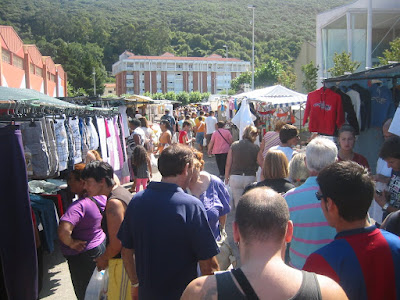
The man shrugged his shoulders, turned around and began to talk to another customer. After all the Santoña market was buzzing by now and he had a business to attend to. My linguistic grievance could take a bench and sit on it all day if it wanted to. He was not in the mood for pesky busybodies lecturing the locals on what was correct language and what was not.

It never ceases to amaze me the stark differences between the Spanish spoken in Spain and that used elsewhere in the Hispanic diaspora. It is not just words and phrases that make their norm distinct, but a whole cultural mindset that makes us outsiders feel more prudish occasionally than a heroine from a Mills & Boon novel.

During my recent holiday in Cantabria I was fascinated and shocked in equal measure by Castilian Spanish. The former occurred when talking to the locals and noticing the familiar 's' sound at the end of words that finished with 'd' as in 'verdad' (truth). They would say 'verdads', the 's' an almost imperceptible sound, but easy to hear. It reminded me of Irish English speakers who add a soft 'sh' sound to words ending in 't'. My consternation, on the other hand, was the result of coming across words that I was used to seeing in veeeery different contexts. Like the aforementioned 'cojonudos', which in this region of northern Spain referred to asparagus. More baffling for me was when I saw a stall in the same market advertising 'Chochitos Ricos' (Cuban female readers, you have no idea how much I have agonised over writing that sentence, please accept my most sincere apologies). Never mind the fact that the word 'rico' translates as 'yummy' or 'nice' into English, it was the other term I blushed over. Ironically, by then I was of a darker hue due to a couple of visits to one of the local beaches. Nevertheless, I still turned a bright red when I read that caption. The word 'chochito' (diminutive) or 'chocho' is a sexual colloquial term - although some people would call it slang - for female genitalia in Cuba and one of those vocables not to be used unless you and the femme en question are very intimate. Would Cuban women be less offended by the fact that this word was casting their privates in a positive light? Bigging them up, so to speak? Would the fact that 'chochito' (and it does sound like a term of endearment, doesn't it?) referred to a local confectionary delicacy lessen its impact?

Later on that day I had the chance to put these questions to the test. I happened to walk past a group of my fellow countryladies who were completely immersed in a discussion about how high the prices at the market still were. I was tempted to interrupt the flow of their conversation and ask them what they had to say about these linguistic peculiarities but on second thoughts I desisted because by then I'd already had enough of 'chochitos' and 'cojonudos'.

First photo taken from flickr.com, the other two images were taken by the blog author.

Copyright 2009

Next Post: 'Sunday Mornings: Coffee, Reflections and Music' to be published on Sunday 27th September at 10am

Thursday, 3 September 2009

Living in a Bilingual World (The One About My Accent)

'Where are you from?'

It is the question that has accompanied me for almost twelve years after I relocated to London. It probably stems, I think, from the fact that I have transposed into English a bit of my Havana rapid-fire pronunciation and the chopping or obscuring of sounds at the end of words. Yet, that's not the reason why I get asked about my country of origin sometimes. It is mainly because I sound like someone else.

I have been confused with people as varied and culturally different as one can possibly imagine. On one occasion a lady called the travel agency at which I used to work and asked to speak to the 'young Irish lad who was on the phone just now'. Obviously she was connected through to D, the only Irish guy in the office. But it was not him, not, it was the other 'guy, the one with the American twang'. After a lot of enquiries on the sales-floor where even Sherlock Holmes and his sidekick Watson were involved, the call was put through to our department, operations, and the minute I answered the phone the lady said: 'Oh, it's you, it's you I wanted to speak to!' And she booked a holiday on top. Sweet.

I have also been asked if I am from Mauritius. I could understand the query if I was speaking French before the question was formulated but since I rarely speak the Gallic language nowadays, I take it that there's a sound in my pronunciation that keeps making people think I am Francophone by birth. Ah, well, better to be confused with a sun-kissed Mauritian than a pint-sized French president who needs Cuban heels to boost his puny 5'5''.

And have I mentioned my East London accent? My drummer acquaintance R calls me 'the Cuban Cockney' because when I am in a friendly and relaxing environment I forgo all linguistic correctness and get down and dir'y with me ol' chinas. As the clock ticks by and I become more insouciant, I travel the whole gamut of accents you can find in London, from the, mainly Asian, 'blatant' to the Jamaican 'bredren'.


The different pronunciations that co-exist in the British capital fascinate me. In the same way that Germans will very often say 've' for 'we' and 'ven' for 'when' (watch Michael Ballack, Chelsea's midfielder, in one of his first interviews after joining the London team), Indians and Bangladeshis will often do the same. And I have not even factored in the regional accents one commonly finds when venturing beyond the M25. In Cumbria sheep farmers still count in the old dialect: yan, tan, tether, mether, pip (one, two, three, four, five).

Cross the ocean and USA is about to witness the unveiling of a Regional English Dictionary that has been forty-four years in the making. Time for 'whiffle-minded' (it means 'hesitating' in Maine) and 'devil-strip' (from Ohio, it means the grass border between pavement and road) to be given their own leading roles.

That's why I no longer feel self-conscious as I used to when I first arrived in the UK. At the time I brought with me a strong Boston accent, the result of many post-graduate courses taught by teachers hailing from that city in the States. With the passing of time my inflection changed from a rising intonation at the end of the sentences to a flatter and more nasal one, typical of the Cockney dialect. I began to drop my intervocalic 'Ts' and people could not Adam and Eve how swift my transition was. The apogee of this linguistic transformation came when I could comfortably switch from posh English (whilst still at the travel agency) to a more colloquial one. I knew then I had found my own stasis.

Still, it ain't 'alf bad being taking for a Queens Park Ranger sometimes, innit?

Copyright 2009

Next Post 'Sunday Mornings: Coffee, Reflections and Music' to be published on Sunday 6th September at 10am (GMT)

Tuesday, 31 March 2009

Living in a Bilingual World (The One About My School's Library)

This week 'Living in a Bilingual World' is inspired by Rachel Cooke's impassioned feature in The Observer a few days ago. Please, read her article first in order to understand my column better.

The year was 1983. The season was autumn, the beginning of it at any rate. Although, if true be told, we don't have a proper autumn in Cuba, except for the dry yellow leaves one crushes on the ground walking here and there. As the song by Carlos Varela goes: 'Here leaves fall down, too'. That September, though, the air had acquired a crisp, metallic smell which I lapped up on my way to school everyday. I had just started year 7 at a local secondary school (ESBU as we called it in those days) and my younger self was confused as to the changes taking place in my life. The summer before had been difficult to say the least. My mother and father were having terrible marital problems and as a consequence I had failed my first exam ever. This was a situation that would recur in my new educational establishment a couple of years hence. I sought refuge in Crusoe's island to which I arrived on Jules Vernes' submarine. I became familiar with the sounds and letters of the English language for the first time. I wanted to escape, somewhere, anywhere. And I was not even a teenager yet.

In order to get to my secondary school, I had to walk a set of blocks down a busy avenue full of cars and smog. I was in the afternoon session so therefore had the morning to do Physical Education (PE) and Work Education (Educación Laboral). My initial impression when I arrived at the school the first day was that it was not as bad as people made it out to be. I had been told that I was going to the worst secondary school in Havana. I was hoping they would be wrong, but in the end they turned out to be right. After the first few weeks of the new academic year the flimsy coat of paint that had been sprayed across its front was peeling off, revealing centuries-old layers of decay and neglect. The windows had been smashed again. Maybe on year 8's floor? Or was it year 9's? Who cared? Nobody did. Nobody does, still.

From the outset I stood out, but not in a positive light, at least to my classmates. My teachers adored me, I was their little pet, studious and labourious, I always handed in my assignments on time and never wasted class time talking or being silly. All I was missing was the glasses to represent the perfect geek. It goes without saying that I was picked on quickly by the school bullies (although I gave as good as I got) and that my days in school transformed themselves into battlegrounds for survival. If Darwin wanted further proof of his theory of the species, I was the living example of it. And I hated it.

One day after my Work Education morning session the teacher in charge of our class summoned me to her department. She said that there were going to be a group of students who would be selected to join the library scheme. This was a programme whereby all pupils had to take part in library-related activities, whether it be maintenance of the books, administration or registration. I jumped at the idea without any second thoughts.

Some weeks later I made my way up the stairs of the old school building. As I went up the dimly lit stairs (the lift was for only for school staff) the smell of urine hit me in the nostrils and almost knocked me out. It was a habit of year 7 and year 8 students from the afternoon session to pee in the corners of the stairs when exiting the building at the end of the day. At this time of the year the shadows grew longer and the days shorter and with the poor lighting the school had it was nigh impossible to capture the culprits. But we all knew who they were.

On the first floor of the building I reported for my first day at the school library. It was a quaint little room that looked more like a detention cubicle than a place where reading was encouraged. Several slogans hung from the walls and there were publicity flyers for competitions that were never run. The librarian was polite and humorous. I still think after all these years that she was surprised to see that the, by now, famous 'Philosopher' and 'Inglesito (Little Englishman)', my two nicknames at the time, was a black boy with short hair and vivacious eyes. She did crack a couple of politically incorrect jokes which I refuse to reproduce here out of respect for my readers and fellow bloggers. But that has always been the nature of racial relations in Cuba, it's like the uncle who cracks unfunny jokes about the groom at the wedding party but we are too embarrassed or polite to deal with him.

I was told there and then what my responsibilities would be, above all, the librarian said, I was there to learn how a library functioned as this was my part of the school curriculum, albeit not subject to a final examination. I don't need to add that I was over the moon about the opportunity to work in such a creative enviroment; I plunged into the role headfirst. Some of the activies in which I engaged at the time were: book-mending, cataloguing, labelling and filing. My favourite one was book-mending. Averse to blood from a young age I knew that medical school would never be my calling, however there was definitely a magical effect on me whenever I mended a book and brought it back to life. To this day that remains one of my strongest passions and my children can aver to that. Woe betide if either of them ever leaves a book face down with its pages spread-eagled on the floor.

I spent a whole year - academic year, that is - at the library and in between repairing novels by Dumas and filing non-fiction books I would steal a moment or two to read Agatha Christie or Edgar Allan Poe. The skills I acquired in that autumn served me well for the coming winter in '84 when I suddenly found myself at my mum's work instead of being in the countryside with the rest of the school during our work experience. My mum worked then (and still does) at a copyright agency and I was tasked with cabinet-filing. I managed to do it so well that I had extra time to devote myself to one of my passions: reading.

Years later...

1992. Autumn. Fourth year in university. I had been part of the Carolyn Duval's Improvisation Theatre Workshops (long story behind the name, by the way, maybe in another post) since winter that year and my face was recognisable in certain quarters. Like at the post-graduate teachers' library. This was a room situated at the far end of the Foreign Languages Faculty at the Varona Pedagogic Institute (re-baptised Pedagogic University some time after). Though still an undergraduate student I managed to book myself on a couple of post-graduate courses by the writer Dick Cluster and the drama tutor Wallace Bullock. In the meantime I still attended rehearsals with Danielle Fauteaux, our very own theatre director. In between my involvement in amateur theatre and my role as teaching assistant (alumno ayudante) I managed to sneak into the 'Americans library' (as it used to be called, regardless of the fact that there were Canadians and Brits in there, too) and borrow the books that were officially censored. It was also the beginning of my life-long literary affair with Margaret Atwood's oeuvre, a fling that has lasted well over seventeen years now. Her 'Handmaid's Tale' was haunting and having read it straight after Orwell's '1984' I admit to having had nightmares at the time. My own society was sinking in the miasma of political rhetoric and the veil over my eyes (already pierced) was peeling off once and for all. It was the time also when I discovered Dean Moriarty's thirst for living life to the full in Jack Kerouac's immortal novel 'On the Road'.

And then...

Fourteen years after I had climbed up the dirty and dimly-lit stairs of my old school building to start my library stint and continue my life-long love affair with reading and five years after I had become a regular presence at the 'American's library', I found myself in a similar institution in London. My son, a few months old was with me and my wife. The air had acquired a crisp, metallic smell which I lapped up on my way to work everyday. We were there as part of a Parents and Toddlers group, although some of the children were as young as our own offspring. In the UK there is a scheme whereby you can register your child at your local library the minute they are born. It is free and reaps good results in the long-term as I can attest.

Since there are no public libraries in Havana, only the school ones and the main one, Biblioteca Nacional (National Library), I was surprised to see so many in my borough when I arrived in London. It was a real delight to place an order for a book that I had already read years before but whose companionship I sought again, like 'The Idiot' by Dostoyevsky. I attended poetry readings and new releases by children's authors. I also began to perform in public libraries. My story-telling act caught the attention of a few librarians and as a result a group of musicians, a visual artist and me started doing the rounds in some libraries in the British capital.

And yet, this blissful experience is coming to an end, or at least having a makeover, and a very bad one indeed the way I see it. As Rachel Cooke's article points out more and more libraries are closing in the UK per year. As it is usually the case, when culture is left to the technocrats, bureaucrats and Philistines, it suffers. A couple of years ago I signed an online petition to bring dance to the fore and give it the high profile it deserves. Last year I found myself seated next to Sir Ian Mc Kellen at the Young Vic, in south London, with plenty other artists, arts organisations, companies and independent practitioners, passing a 'vote of no confidence' in Arts Council England for its mishandling and mismanagement of its funding scheme. I do not usually put my head above the parapet but sometimes causes call for one to abandon the comfortable fence which one is blithely straddling and jump off it and kick up a fuss, shout, scream and demand. Especially when a building to encourage creativity, imagination and thinking is closed and a new one opens in a shopping centre ('mall' as they call it across the pond).

It is ironic that the word 'library' is a false cognate term in Spanish (read here for more info on the subject of 'cognate' and false cognate' words) as my native tongue comes from the dead Italic lexicon. Although it does stem from Latin 'librārius', the Spanish equivalent is 'biblioteca', not 'librería', the latter translates as 'bookshop'. And as more and more libraries disappear, the selling aspect of a shop is all that remains in lieu de the old 'chest for books', as the government makes space for more retail outlets. The air again has acquired a crisp, metallic smell, but I am not lapping it up anymore.

Note: This post was amended on Thursday 2nd April, 2009. Instead of 'book-binding' which I have never done, it should have read 'book-mending' an activity in which I still engage. I have also included John Harris' article in today's Guardian on the same subject. Thanks.

Copyright 2009

LinkWithin

Related Posts Plugin for WordPress, Blogger...