Wednesday, 21 September 2016

Pieces of Me, Pieces of Havana

All cities have a unique trait. An element that sets them apart from the rest. This is not a tourist-friendly attraction to be found in a glossy brochure at a travel agency on the high road of an upmarket gentrified neighbourhood. No, this is a quirk that only becomes obvious once one has spent time living in that city. For instance, for me, after living almost 20 years in London, the salient feature of the British capital is its brain-wrecking, confusing urban grid: myriad winding one-way roads and sudden cul-de-sacs. Whilst many visitors look forward to taking a selfie at Buckingham Palace, I like nothing more than getting lost in London’s unrivalled metropolitan labyrinth, whether walking or cycling.

Havana’s unique trait is, on the other hand, its white sheets. Or rather, used to be.

As a child growing up in the Cuban capital, I became accustomed to the sight of white sheets hanging from balconies, especially on Saturdays when most people did their washing. Their ubiquity even merited a mention in what turned out to be Havana’s unofficial anthem in the early 90s, “Sábanas Blancas” (literally, “White Sheets”, by the singer songwriter Gerardo Alfonso). Thus, it was this childhood-era sight I sought out with a mix of nostalgia and eagerness recently when I went back for a two-week visit. Yet, something had happened in the intervening years since I last had been here. The bedding item had almost disappeared from clotheslines. Replacing it on balconies were either Barcelona or Real Madrid shirts amongst other foreign “invaders”. Forget Camp Nou or the Bernabeu, Spain’s La Liga was being played on the rooftops of Havana, with the likes of Messi and Ronaldo jostling for space amongst torn jeans, off-colour shirts and pocked vests.

I had already been exposed to these newly-formed soccer alliances at the aeroport on arrival. A stifling and humid August spouted its all-enveloping raging fire on my face as we came out of customs reminding me that it had been nineteen years since I had last been exposed to this kind of heat. There, it seemed to say, this is for you, just in case you had forgotten.

I had not. In the same way I had not forgotten the hustle-bustle of Terminal 3 at the José Martí aeroport. The welcome hugs and goodbye kisses: from parents to offspring, from sibling to sibling, from lover to lover. In the middle of this display of human affection the logos of Fly Emirates and Qatar Airways stood out conspicuously.

Driving just after midnight to our hotel in old Havana gave me the chance to experience once more the city’s nocturnal fauna: the late-night revellers for whom any day of the week (it was Thursday-cum-Friday) was party-day, the gay corner on 23rd Avenue and L Street as densely populated as it ever was, the seawall, Malecón, decked with drunkards, wannabe singers howling themselves hoarse, prostitutes and couples waiting for their in-laws to go to bed so that they could get some action. The Havana carnival was supposed to kick off the next evening, which meant that some of the main thoroughfares were closed. The detours I took through poorly-lit, back roads prompted me to keep one eye on the pothole-filled streets and another one up on the never-ending clotheslines, festooned from balcony to balcony with myriad garments. But alas, very few white sheets.


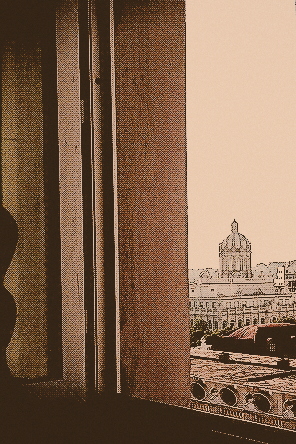
The sunrise caught me looking out of our hotel window at a Havana slowly waking up from its deep sleep. Some of the sounds were the same: horn-tooting, kiss-blowing, name-calling. Some of the sights were also familiar: the water-carrier pulling his heavy burden up a hilly road and spilling the precious liquid in the process, the American car-cum-taxi squeezing more passengers in than a normal vehicle, the peanut vendor weaving his way through the still traffic at a red light, paper cones firmly held in his hand. Up in the distance, like a small symbol of surrender (to whom? To what? To the might of Barça or Real, perhaps?) I spotted a yellowed item of bedding which had probably seen better days. As childhood mementoes go, this was one I savoured in the moment. A keepsake to remind me of Havana’s unique trait: the sight of a white sheet hanging from a balcony.

© 2016

Photo by the blog author

Next Post; “Thoughts in Progress”, to be published on Saturday 24th September at 6pm (GMT)

Saturday, 17 September 2016

Thoughts in Progress

Distance does not just create space between one and a certain object but also offers a new perspective on situations that get muddled up when looked at too close. We think of holidays as “time off”, but for some of us, mainly immigrants, going home from “home”, means sometimes an unconscious search for answers hitherto elusive, i.e., “time on”.
The view from Havana is different

I recently went back to Cuba for a fortnight. I had not been for three years and therefore I had missed out on all the “changes”. Whilst I have a lot to write about my visit, this post will not necessarily deal with the transformations my country has gone through (or subjected to, rather). I am still digesting many of the permutations to which I bore witness. This outing today is about the immigrant’s eternal conundrum: belongingness.

There comes a time when “going home” becomes “leaving home for home and returning home after”, a tautology in and of itself, but an important one. This acquires more urgency when both “homes” have undergone radical changes. Explanations are sought and theories thought up. The latter are concocted on the hoof as the former are blurted out. You ask people and they quiz you in return. Both parties look for ready-made answers but none are forthcoming, only half-baked, spontaneous responses.

I thought I had left Brexit and Cameron’s crew behind at Gatwick, only to find that I had been appointed the (unofficial) “dabster” by relatives and friends to throw some light on recent events on these isles. That, I did not mind. What surprised me was what came out of my mouth. My feelings for my adopted land had strengthened to a level I did not know until then.

The poet (poetess? Can I still say that?) Agnes Krampe writes in her poem “Perhaps the Hardest Part of Emigration” that “The rhythm of the language was not pulsing/Deep in my body. Shapeless, without pattern/the words limped on the page, where I once could/Compose in dancing meter graceful rhyme.” The language she refers to is that of the new country. I can relate to that lack of rhythm, not from a linguistic perspective, but from a cultural one. I already spoke English fluently when I arrived in London but I did not “speak” the culture. Britain defied my expectations. Whereas I, too, could once “compose in dancing meter graceful rhyme” in Cuba, over here I felt somewhat stunted at the beginning.

Not anymore. When talking about Brexit, Theresa May’s rise or the squabbles in the Labour Party a few weeks ago in my hometown, there was often a note of optimism in my voice. I know that this might come as a surprise to some of you, my fellow bloggers and readers, given that my previous post was pretty depressing. Nevertheless, distance affords one the privilege of looking at one’s adopted home through a fresh pair of prescription glasses. Mind you, to confuse my optimism with idealism would be fatal. My optimism was reality-based. Still, there I was, explaining that the recent wave of anti-immigrant, racist attacks were carried out by a minority. That London, the city I have called "home" for almost twenty years, voted to stay in the European Union. That we have a Muslim mayor. That Labour's in-fighting should be seen in the context of two factions locking horns (not at the best of times, fair to say). That... That... That... 

I have a theory about this attitude. It is almost as if some of us, immigrants, become protective of our adopted land. We know its flaws and virtues, but woe betide anyone who dares to slander it, for they shall be subjected to a tongue-lashing delivered in heavily Cuban-accented English (or similar). I have often laid into Nigel Farage and his band of bigots and fascists. Yet, when questioned about his lethal influence on British politics, my answer was usually along the lines of: “That’s different opinions for you. Without them, democracy would probably die a little bit every day. It is a risk, but it is a risk I am willing to take any time.” Surprised? I was indeed.

The life of an immigrant upon arrival in their new land can seem sometimes like a flimsy piece of paper blown away by the wind. We are led, if you like: by work, domestic life, every day demands. Whether it is lucubration or diurnal graft, moments of Wildean idleness and contemplation are few and far between. Eventually, though, the first associations appear: we make up our own story as we go along, our experience becomes a background against which we analyse our presence in our adopted land, we even come up with our own soundtrack. One that might not match the type of music we usually like.

Some other times we find a wall in our path (of Trumpian proportions) which we have to surmount: break through or jump over it. Either way, there is a transformation in you and in the wall. But only you, as the thinking being can make sense of this encounter (collision?) and its aftermath.

I am Cuban, will always be, never want to stop being Cuban. I am also British. Not just as a mere passport-holder, but as a person for whom “the rhythm of the language” is pulsing now (for language, think “culture”). Someone who can also “Compose in dancing meter graceful rhyme.” Distance does that to you. That is why whenever I touch down in London, I say nowadays: “I’m back home from home”.


© 2016

Next Post: “Pieces of Me, Pieces of Havana”, to be published on Wednesday 21st September at 6pm (GMT)

LinkWithin

Related Posts Plugin for WordPress, Blogger...