I admit that at times I had thoughts where I would face up to him, overpower him, probably even kill him. Although I was already a teenager by then, the bullying had started years before when I was still a child and by the time I turned fourteen I'd had enough. A basketball, a couple of baseballs, a few toys; they had all been snatched away by my tormentor. There was a time when I dreamt of mustering up the courage to confront him, to stand up to him. But I always failed. Sometimes, when he was around, I even wished he would take his frustration out on somebody else. And that, too, happened. More than thirty years later I feel ashamed of those thoughts.
Did Sarah Palin pull the trigger?
One of the scenarios I often imagined involved him trying to take something away from me yet again and me producing a gun in order to stop him. In my head I could clearly see the look of surprise in his eyes as the compact and steel body of my weapon made me look taller, stronger and more powerful. In my mind I even had a ready-made speech for the occasion, a panegyric full of bravado, accentuated by the barrel of my gun aiming at him. Give me my ball back! I would shout whilst waving my 6.85in. x 1.18in. at him. I would then tell him to beat it. I would probably aim at his feet and fire a couple of rounds. Although I wanted to get rid of him, I didn't want to kill-him-kill-him, but just to kill-him-scare-him, maybe kill him a little bit, but not totally.
One day we were playing baseball, or maybe basketball, details elude me now. All I know is that at some point during the game he pushed me, probably thinking that I wouldn't retaliate, but I did. It was probably about the time my situation at home, with my parents splitting up, had reached a nadir, so there was an external factor to consider. I reacted instinctively. I don't think I made a conscious decision, if I had - and that's what I've come to believe over the years - I probably wouldn't have dared to jump on him, push him to the ground and hit him. A fight ensued. There was no winner; we both ended up on the ground with dirty clothes and blood on our noses. But there was no more bullying afterwards.
Oftentimes I have wondered whether, given the opportunity and the possession of a weapon, I would have gunned my tormentor down instead of using my knuckles.
Luckily for him, and also for me, there's never been a Second Ammendment in Cuba.
Did Sarah Palin pull the trigger?
Roughly one hundred thousand people are killed or injured in the US every year as a result of gun incidents. By contrast the death toll in Viet Nam between 1965 and 1968 was in the thousands. That doesn't make the latter right, it makes the whole situation illogical. That the US has had an aggressive foreign policy for most of its existence is plain for everyone to see. That it has had the same hawk-like approach against its own population is, to put it mildly, baffling.
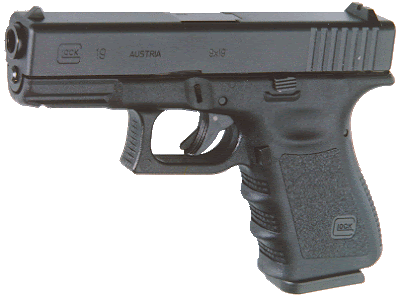
Regardless of whether Jared Lee Loughner was a loner with mental health issues or not (it's ironic that he wasn't branded a terrorist, imagine if his name had been Mohammed), he would never have shot Congresswoman Gabrielle Giffords if he had not had the chance of buying a gun. Or he would have had a tougher time trying to find a weapon with which to carry out his dastardly act. But the Glock 19 he used can be purchased anywhere in Arizona where it's completely legal to walk around with a concealed weapon in your pocket.
The attempt on Giffords' life (which also caused the death of a nine-year-old girl, my daughter's age as it happens) follows a too familiar pattern. An atrocity occurs resulting in a public outcry for tighter gun controls and then... life carries on until the next time a Jared Lee Loughner or a Seung-Hui Cho (Virginia Tech, April 2007) decides to go on a killing spree. And the aegis under which all these massacres happen is the Second Amendment to the United Constitution. It states that 'the right of the People to keep and bear arms shall not be infringed.' However this statute was only meant to repel foreign invaders, not to maim and kill US citizens. It's ironic that the worst attack on American soil happened two-hundred and fourteen years and six days after the Constitution was first read aloud to representatives of the government. And yet the possession of firearms could not save the Twin Towers, nor the people inside them. Passengers are not allowed to take guns on planes with them.
You might be wondering why I'm writing about a problem that in principle doesn't concern me. After all the UK has one of the lowest gun crime rates. There are three reasons. The first one is that many of the bloggers and readers who visit this blog are either US citizens or reside there. Through this medium we have forged a bond, albeit virtual, and with that nexus comes a flurry of feelings and emotions: friendship, respect, admiration, affection. It would be sad to lose an invisible fellow blogger to the warm muzzle of a gun. The second reason is that I would like to know what you think about this problem. What is your opinion about the right for people to bear arms and the consequences of it? Thirdly, to me it's absurd that the country that endorsed 'liberty' as one of the unalienable rights to strive for in its Declaration of Independence, continues to toss that right aside flippantly in favour of a law that has proved to undermine that freedom. Liberty dies with the gun victim.
And it's that third reason the one into which I would like to delve further. No matter how liberal or rightwing the incumbent at the White House is, possession of firearms is the one item on the political agenda they try not to touch. For all president Obama's call to unity at the funeral of the victims of Jared's terrorist act (let's call a spade a spade, shall we?), he still shows the same reticence to even address that Second Amendment. A clause, by the way, which appears in a document that many people have heard of but have rarely read.
In a brilliant essay in The New Yorker recently ('The Commandments', 17th January), the writer Jill Lapore laid bare some of the myths surrounding the US Constitution. And one of them is how it has been hijacked by the Republicans (and the Tea Party) to use as a weapon with which to hit the Democrats. One of the aspects that surprised me the most is that the former very often don't know what they're talking about as they haven't read the document in question. A good example is Christine O’Donnell, who, in the run-up to the mid-term elections, asked his opponent Chris Coons where in the Constitution the separation between church and state was mentioned. In the First Amendment, Coons replied. O’Donnell lost. But in the rush to do as much damage to their political opponents, the Republicans and their sidekicks from the Tea Party movement often overlook the importance of what Lapore calls 'those four pages of parchment'. And the effects of their shortsightedness are frequently lethal.
So, did Sarah Palin pull the trigger?
No, she did not. Or at least she is not to blame for the Arizona shooting any more than we can blame JD Salinger for John Lennon's murder or Jodie Foster for the assassination attempt on Ronald Reagan in 1981. At the same time, neither the American writer, nor the Hollywood actress designed a map which they put on their website dotted with 20 gunsight-style crosshairs over 20 congressional districts occupied by Democrats who had voted for Obama's healthcare reform. One of those government representatives, incidentally, was Gabrielle Gifford.
No, Sarah Palin did not pull the trigger. But, at the same time, she did not act responsibly. When you start attacking your political opponents using language like: "We’ll keep clinging to our Constitution, our guns, and our religion, and you can keep the change" or "Don't Retreat! Reload", you're encouraging your supporters to adopt methods that might otherwise be thought unorthodox. Like loading a gun, aiming it at a US Congresswoman and firing it.
In my view, part of the problem surrounding people's right to bear arms as a self-defence mechanism comes from a separation of perception and reality. To back up my theory I'll use an excellent article by my favourite journalist, Gary Younge, who recently wrote about the dichotomy that exists between the widespread admiration for the army in the US and the knowledge of what said army does, especially abroad.
If I may use a similar analogy, we know that guns maim and kill people. Even that younger, adolescent version of myself was aware of that. But sometimes we imagine death in abstract terms, as in pretend-death, not real-death, as in not kill-kill, but kill-a-little-kill-and-then-you're-back-on-your-feet-again-kill. That's probably, I hope, what Sarah Palin, Glenn Beck and co. have in mind when they use their warmongering, political rhetoric. They mean kill-only-to-scare-you-softie-liberal-Democrat-kill, but not kill-kill. But this separation between the perception of what a gun does and the actual outcome of it is swiftly given a reality-check when yet another innocent victim dies.
Would that younger me have picked up a gun to defend myself against my tormentor if given the chance? I don't know. On the spur of the moment anything would have been possible then. I can't help thinking, though, that right now, in the US, a window blind is being closed down on another innocent person's spring years, condemning them to an eternal winter.
© 2011
Next Post: ‘Killer Opening Songs’, to be published on Wednesday 16th February at 11:59pm (GMT)


