West Norwood: a Gothic cemetery with a touch of the millionaire about it
Halfway through what is an exceptionally warm
September day, it occurs to me that my attraction for cemetery parks is as much
about their history as it is about my disappointment with London’s modern
architecture.
As I cycle away from Nunhead Cemetery on Linden
Grove, I think of Rowan Moore, The Observer’s architecture critic, and
his opinion on many of the capital’s latest vertical additions. One of his more
recent pieces dealt with 22 Bishopsgate, a monster of a building at 278 metres
high, located a stone’s throw from Liverpool Street.
Moore asks two questions: the first one being, is
there such a thing as too big when it comes to such buildings? And the second
one is, is so much space needed at a time when remote working and the altered
habits of the pandemic might conceivably reduce the demand for conventional
office space?
I’m not interested in the second question. It is
the first one that has troubled me for almost as long as I’ve been in Britain.
22 Bishopsgate comes only second to the 310-metre Shard in the race to be the
tallest building in the UK. Throw in the Gherkin, the Grater and Nine Elms
Vauxhall (in reality, the complex sits between Battersea and Vauxhall) and for
the last fifteen, sixteen years, we have been looking up most of the time in
central London.
The effect of this new trend is that the
traditional, low-rise design I came to love so much when I first relocated here
is finding less and less urban space. Most architects want to build up,
not across. Or, if they build across, they still want to go up.
Perhaps, that’s why I feel attracted not only to London’s Magnificent Seven,
but also to its parks, green areas and (low rise) estates.
Another reason why I dislike the Shard, the Gherkin
et al, is that they all smack of money. This is the new London of
overseas investors, dark, fancy, empty flats at night (a lot of property is
bought but not occupied) and poor doors (the segregation of inner-city upmarket
apartment blocks). No, thank you very much, but that’s not for me. I’d rather
hang out in the rundown area in and around Bethnal Green than bloody One
Commercial Street.
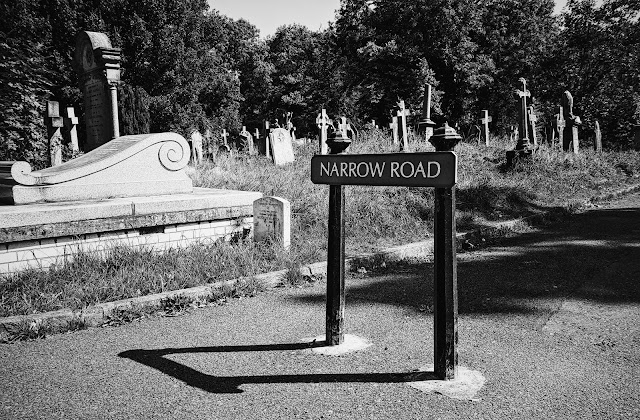
The world’s first Gothic-style graveyard,
specific-designed West Norwood sits on a hill. After a pleasant ride down
Dulwich Common (great road infrastructure), I pull up just outside this “Millionaires’
Cemetery”. The reason for the moniker is the number of high-quality mausolea
and memorials.
At first sight the formerly known South
Metropolitan Cemetery has more in common with Nunhead than with both Tower
Hamlets and Abney. Its paths are tidy, its landscaping manicured and its architectural
gems clearly signposted. I wonder what autumn here will look like. It must be a
festival of colour with so many trees (oak and lime amongst others) providing
much-welcomed shade right now. Grade II-listed West Norwood boasts great
biodiversity as well. Bats, woodpeckers and tawny owls have found a home here.
In addition, a £4.6m awarded by the National Lottery Heritage Fund in 2019 will
help restore historic monuments and secure the graveyard’s future for years to
come.
Amongst the people buried here, some names are
familiar: Baron Julias de Reuter, who went on to found the well-renowned
Reuters agency and Sir Henry Tate, founder of the Tate Gallery.


