Thursday, 20 January 2022

Around London’s Magnificent Seven

Tower Hamlets Cemetery Park: not just a burial ground for the East End’s working class.

My early morning cycle ride to Abney Park sets me up for the journey ahead. Carrying on to Mile End, my body welcomes Hackney’s flat terrain. Not too much exertion yet.

At the bottom of Globe Road I turn left onto Mile End Road in order to continue my journey towards Tower Hamlets Cemetery Park. I’m now on the previously much-maligned Cycle Superhighway 2. Hard to believe that it was only a few years ago that this long road, running from Aldgate East to Stratford, was nothing more than a blue strip with no dividing line  between motor vehicles and bicycles.

The difference between then and now couldn’t be starker. At present an off-road, segregated lane snakes almost all the way eastwards.

I fall behind a head-down, traffic-charging, heavily tattooed fellow cyclist. “Fellow” might be stretching it a bit. With his brake-free, fixed-wheel track bicycle, he belongs to the sort of tribe for whom purity in cycling is all that matters. A frame, two wheels, pedals, handlebar and seat (D-lock hanging from his rucksack, of course). That’s it. Who needs my seven gears when his own muscular legs can propel him anywhere he wants to go?

His D-lock becomes a blur before I go over the canal. I’m now in Tower Hamlets, home to the largest Bangladeshi community in the UK. Saris are a common sight and I immediately think of Sujata Bhatt’s poem “My Mother’s Way of Wearing a Sari”. I still remember a few lines but I will have to look up the rest when I get home.

These days

in the darkness,

broken up by the moon’s

almost full brightness, before dawn

my mother rises

and in this room without a mirror

in this room where we all sleep together

she turns away from the windows-

her glass bangles pushed up, away

                   from her wrists

so they are motionless on her arms

                                      soundless-

In the darkness she finds her sari

and begins to wrap it around

her waist – her right hand is firm

and fast and moves like a fish

fanning in and out of the waves-

                   blind, mute,

her hand zigzags making pleats

so fast I cannot count them

By the time I enter Tower Hamlets Cemetery Park the sun has inched further up on the cloudless sky. I’m beginning to feel the effect of this early September’s Indian summer.

Unlike other members of the Magnificent Seven (Highgate, Abney and Kensal Green, for instance) THCP is not a celebrity-magnet. In fact, this cemetery almost ceased to exist in the mid-to-late 60s. At the time the Greater London Council (GLC) decided to clear the graveyard in order to make way for a brand new park.

The GLC’s plans hit a wall when many local residents, whose relatives were buried here, voiced their disapproval. The idea was shelved, but not before a section of the grounds was cleared for the intended park.

Tower Hamlets Cemetery Park’s proximity to the Docklands might be an explanation for the number of sailors interred here. Many of them lie in unmarked public graves.

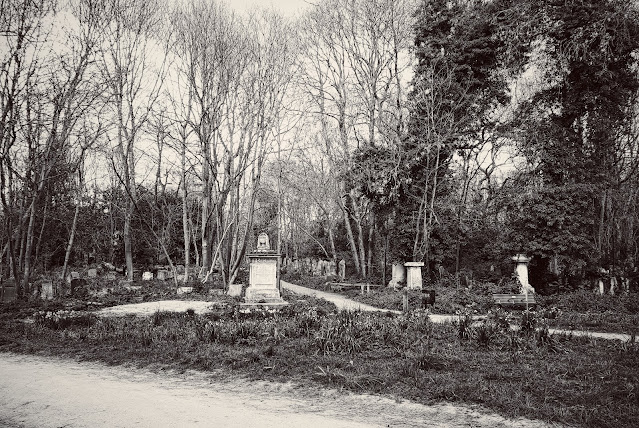
Like Abney Park, THCP has a scruffy look. Paved paths and bush-covered trails share space equally. Personally speaking, I love it. The grounds have an air of wilderness about it. Plants and flowers grow almost undisturbed and species vary between woodland and meadow.

There’s however a sad story behind THCP’s “rough” look. During the Blitz, the Luftwaffe targeted the aforementioned Docklands (the Thames being a centuries-old major trading and shipbuilding area) which resulted in the East End being left in ruins. Many homes were left uninhabitable, shops and local business destroyed and a third of London’s docks wrecked. Tower Hamlets Cemetery Park suffered a similar fate unfortunately.

Trivia moment of the day. I learnt recently that one of the graveyard’s most famous memorials belongs to Joseph Westwood. This man ran a shipbuilding company. Eventually the company became known as Thames Iron Works. Some of the employees put a football team together. With the passing of time, the football team became West Ham United FC. The team’s origins are still referenced in nicknames such as “The Hammers” and “The Irons”.

Reaching-out me would have loved to share this information with my “fellow” track bicycle rider, but I doubt he’d have stopped to listen. It looked as if he had places to rush to, his D-lock hanging from his rucksack as he disappeared in the distance.


Tuesday, 18 January 2022

Around London's Magnificent Seven

Abney Park: a hidden treasure in north London 


A serotinal morning announces itself by blending extant estival greens with emerging autumnal reds. Perfect start for a Covid-delayed tour of London’s Magnificent Seven. These are Victorian-era cemeteries that were created to ease pressure on parish burial grounds.

It’s logical that as a north London resident I kick off at Abney Park, a graveyard opened in 1840, in nowadays trendy Stoke Newington. I don’t spend much time inside, though. I’m so used to these grounds, having found them by chance many years ago, on one of my many cycling jaunts. During the first lockdown in 2020 Abney was one of the two places, along with nearby Clissold Park, my girlfriend and I frequented.

Today I come across early-rising runners, friendly dog-walking strangers and school-age children following anxious-looking parents. Abney’s location serves as a quiet short cut between Stoke Newington High Street’s hustle-bustle and Stoke Newington Church Street’s café life with the added bonus of chancing upon famous graves.

Like those belonging to the non-conformists buried here. These were rebels who defied the ways of the Church of England and refused to align with a particular Christian denomination. The chapel (derelict and rundown, though it is) was designed in a manner that showed no bias towards a single Christian sect.

In addition, if like me, you are into the music of the late singer Amy Winehouse, you’ll be interested to know that her video “Back to Black” was partly shot here.

With the sun beginning to beat down on the pavement and my stomach rumbling, I hop back on my bicycle and head off for my second destination: Tower Hamlets Cemetery Park.

No matter which route I choose, everywhere is bumper-to-bumper. The start of the academic year, road closures and the proliferation of LTNs (low traffic neighbourhoods, a polarising issue if ever I saw one) means that from Amhurst Road and all the way down Mare Street to Roman Road, I have to zigzag my way around buses, lorries and cars.

Some years ago I came up with a moniker for this area: the Hipster Republic of North, North-eastern and Eastern London. Its borders have changed slightly (gentrification works in mysterious ways), but the core of it remains the same. It starts in N16 Stamford Hill and continues through Stokey, Dalston, Hackney, Hoxton, Homerton and Shoreditch. From £5 bowls of cereal to ironic beards, from zany and thought-provoking graffiti to checked shirts, this is the new, creative (and some might say, overpriced) London.

One of the tell-tale signs that lets you know you have arrived in Hipster Land is the frames you see either on the road or parked. I’ve been dipping in and out of Laurent Belando’s excellent book, Urban Cycling, so I’m able to recognise some of the specimens. The bicycle par excellence in these parts is the fixie, or its close relative, the single speed two-wheeler. Understandable when you notice how flat most of east London is.

But it’s not just the road surface that contributes to the ubiquitousness of these machines. Both fixie and single speeds are fashion statements. Their cultish and aesthetic appeal is all part of the phenomenon I’ve come to describe as “the individualisation of cycling” (some people would call it “fetishisation”). A bicycle is not just a bicycle. A bicycle is an extension of a rider’s individuality.

Furthermore, there’re also the professions. Fixie/single speed owners tend to belong to that turn-of-the-century cabal that spread slowly through previous no-go areas in east London (I still remember when someone told me Mile End was known as “Knife End”) bringing rents and house prices up. They are the artistic directors, marketing managers, graphic artists, web designers, performers, project managers, communications and media managers. Of course, their bikes have to say something about them in the same way the brands they create say something about their company.

Following hot on the (w)heels of the fixie and single speed come the road bike, porter bike and vintage two-wheeler. Today I spot an equal number of these frames on the road. From just past Hackney Empire to Old Ford Road, off Cambridge Heath Road, they seem to be everywhere.

Out of the three, it’s both the porter and vintage bikes I’ve got a soft spot for. Road bikes, or “racing bikes” leave me cold. Perhaps, it’s their aggressive look, too much Tour de France, incongruous on these narrow streets.

The porter and vintage bikes, on the other hand, invite effortless elegance and style. Today I see a lot of what was formerly known as girls’/women’s bicycles and have been thankfully re-baptised as “step-thru bikes”. Just a clever way of convincing gents that they don’t have to swing their legs over their seats the whole time to prove they’ve got a pair.

Rolled-up yoga mats poke out of baskets sitting at the front of porter bicycles. In others, pooches sit comfortably, a gentle breeze ruffling their hair. In open defiance to speed or terrain, porter and vintage bikes are the non-conformists of our age. Perhaps a place at Abney is already waiting for them when they reach the end of their cycle.

LinkWithin

Related Posts Plugin for WordPress, Blogger...