This post and video are dedicated to my mother, who turns 80 on Tuesday, 14th February. I love you, mum, always have, always will. The poem was written by the late Palestinian poet, Mahmoud Darwish.
Next Post: "Thoughts in Progress", to be published on Saturday 18th February at 6pm (GMT)
Showing posts with label poem. Show all posts
Showing posts with label poem. Show all posts
Saturday, 11 February 2017


Sunday, 16 November 2014
Sunday Mornings: Coffee, Reflections and Music
And in the end what are we all,
A brick from the old Berlin wall?
Somebody’s question or someone’s answer
A puzzle spinning like a dancer?
What are we all? I asked before,
Creatures we are, under the floor,
The maligned rat, the tiny mouse,
In darkness roaming through the house.
We are the dust that in the wind
Became the song that Kansas dreamed
We are the chords of the guitar
Carrying our life’s score very far
What in the end are we, us, all?
The misheard word, the miskicked ball
Sometimes shaming us for years to come
Till we learn that of the bread we’re but one crumb
Is this us in the mirror, us all?
Is this our reflection, no fear to fall?
Or is it the mask we don for the show
Shielding our selves, our ids, our souls
We can be lovers, good friends or traitors
Of our exhibit the sole curators
Of our performance we’re the one actor
One piece, one act. The theme? Fear factor
What are we all, in this one life?
We’re gain and loss, accord and strife
We are the hauling, dragging and pulling
We’re also the thrusting, shoving and pushing
And in the end, what are we all?
Same question, yes, but, please, don’t call
Phone down, give me no answer
I am still learning from the dancer.

© 2014
Next Post: “Sunday Mornings: Coffee, Reflections and Music”, to be published on Sunday 23rd November at 10am (GMT)
A brick from the old Berlin wall?
Somebody’s question or someone’s answer
A puzzle spinning like a dancer?
What are we all? I asked before,
Creatures we are, under the floor,
The maligned rat, the tiny mouse,
In darkness roaming through the house.
We are the dust that in the wind
Became the song that Kansas dreamed
We are the chords of the guitar
Carrying our life’s score very far
What in the end are we, us, all?
The misheard word, the miskicked ball
Sometimes shaming us for years to come
Till we learn that of the bread we’re but one crumb
Is this us in the mirror, us all?
Is this our reflection, no fear to fall?
Or is it the mask we don for the show
Shielding our selves, our ids, our souls
We can be lovers, good friends or traitors
Of our exhibit the sole curators
Of our performance we’re the one actor
One piece, one act. The theme? Fear factor
What are we all, in this one life?
We’re gain and loss, accord and strife
We are the hauling, dragging and pulling
We’re also the thrusting, shoving and pushing
And in the end, what are we all?
Same question, yes, but, please, don’t call
Phone down, give me no answer
I am still learning from the dancer.
Two things first. It is my birthday today and for only the third or fourth time in my life I have dared to write a poem in English.
To the first one of these two things. Although it is an occasion for me to celebrate – and indeed I am celebrating – this birthday poem was inspired by a recent sad experience. Earlier this year we lost an unbelievable colleague at the school where I work. She was a nursery teacher who had been a member of the staff for many, many years, to the point where some of the current teachers and teaching assistants were taught by this amazing teacher when they themselves were little. I got to know this incredible human being very well, despite the fact that when she died I had been at my primary school for less than a year. Some people make you feel welcome just by looking at you. My colleague was one of those people. She also had a great sense of humour. About a year ago to the day she and I attended a training session near King's Cross station. There was a tube strike that day which affected our journey. I got to the venue about ten minutes before she did. But when she came into the room it felt as if she had just lit it up. Some people have that effect. As our headteacher read the tributes written by the staff, the first line of today’s poem started sounding in my head: what are we all? In the end, what are we? That line took my head as its abode and didn’t leave me alone from that day until recently. I knew I had to do something but I didn’t know what or how.
The second thing today. I knew I had a poem in me. Not a short story. I knew it had to be a poem because that line ended in “all”. And I could come up with all kinds of rhymes and combinations to develop the theme. The theme of what? I mentioned fear factor in the poem, but it’s more than that. It’s the theme of mortality and the way we see ourselves and our selves. Whether we believe that we have accomplished everything by the time the Grim Reaper pokes its ugly head in, taps us on our shoulder and tells us it's time to go or we think that there’s a lot of work to be done still. And are we humans really that far apart from the “others” (plants, animals, dust, etc.) that we can afford to behave in such a solipsistic way?
No.
We’re connected in a way of which we might not be aware sometimes. This idea of a gigantic network of people, things and animals might have been hijacked by the New Age brigade and its spin-offs but strip the layers that make us who we are and at the core you will find the dust, the - beautiful – contradictions and the tiny mouse.
I couldn’t give two monkeys about the quality of the poem or lack of it thereof. I really don’t. It's not praise I'm after but steam I'm letting off. I don’t care which style (if any) the poem falls under. That’s why I don’t think I could ever belong to a writers’ collective or rise up to the challenge of writing a sonnet, or haiku, or suchlike on commission. I just couldn’t do it. I feel jealous of people who can, though. I like making up and breaking my own rules. And because I “discovered” the English language on my own at a young age, I have always believed that English and I have a special relationship. Like two brothers or a brother and a sister, or two good mates who fall out every now and then (all those “likes” and “sos”, "sortas" and "kindas" and rising intonation at the end of statements?) but who always find their way back into the friendship.
That still does not deviate from the fact that writing in a foreign language is very hard. Terribly hard. Believe me; I do it day in, day out, week in, week out. I do it as a hobby and professionally. At the same time there’s a pleasure to be had, mixing, stirring, decanting and tasting sentences, words and connectors. I wouldn’t be able to write this blog if I didn’t derive pleasure from doing it.
So, there you have it. A poem inspired by the life and work of an extraordinary person who is sadly no longer amongst us, posted on the day I celebrate adding another candle to this cake I call life and which you might call something else. I would like to raise a glass of apple juice (I’m teetotal, remember) to you all and ask you to keep posing the same question to others and to yourselves: and in the end, what are we all?
To the first one of these two things. Although it is an occasion for me to celebrate – and indeed I am celebrating – this birthday poem was inspired by a recent sad experience. Earlier this year we lost an unbelievable colleague at the school where I work. She was a nursery teacher who had been a member of the staff for many, many years, to the point where some of the current teachers and teaching assistants were taught by this amazing teacher when they themselves were little. I got to know this incredible human being very well, despite the fact that when she died I had been at my primary school for less than a year. Some people make you feel welcome just by looking at you. My colleague was one of those people. She also had a great sense of humour. About a year ago to the day she and I attended a training session near King's Cross station. There was a tube strike that day which affected our journey. I got to the venue about ten minutes before she did. But when she came into the room it felt as if she had just lit it up. Some people have that effect. As our headteacher read the tributes written by the staff, the first line of today’s poem started sounding in my head: what are we all? In the end, what are we? That line took my head as its abode and didn’t leave me alone from that day until recently. I knew I had to do something but I didn’t know what or how.
The second thing today. I knew I had a poem in me. Not a short story. I knew it had to be a poem because that line ended in “all”. And I could come up with all kinds of rhymes and combinations to develop the theme. The theme of what? I mentioned fear factor in the poem, but it’s more than that. It’s the theme of mortality and the way we see ourselves and our selves. Whether we believe that we have accomplished everything by the time the Grim Reaper pokes its ugly head in, taps us on our shoulder and tells us it's time to go or we think that there’s a lot of work to be done still. And are we humans really that far apart from the “others” (plants, animals, dust, etc.) that we can afford to behave in such a solipsistic way?
No.
We’re connected in a way of which we might not be aware sometimes. This idea of a gigantic network of people, things and animals might have been hijacked by the New Age brigade and its spin-offs but strip the layers that make us who we are and at the core you will find the dust, the - beautiful – contradictions and the tiny mouse.
I couldn’t give two monkeys about the quality of the poem or lack of it thereof. I really don’t. It's not praise I'm after but steam I'm letting off. I don’t care which style (if any) the poem falls under. That’s why I don’t think I could ever belong to a writers’ collective or rise up to the challenge of writing a sonnet, or haiku, or suchlike on commission. I just couldn’t do it. I feel jealous of people who can, though. I like making up and breaking my own rules. And because I “discovered” the English language on my own at a young age, I have always believed that English and I have a special relationship. Like two brothers or a brother and a sister, or two good mates who fall out every now and then (all those “likes” and “sos”, "sortas" and "kindas" and rising intonation at the end of statements?) but who always find their way back into the friendship.
That still does not deviate from the fact that writing in a foreign language is very hard. Terribly hard. Believe me; I do it day in, day out, week in, week out. I do it as a hobby and professionally. At the same time there’s a pleasure to be had, mixing, stirring, decanting and tasting sentences, words and connectors. I wouldn’t be able to write this blog if I didn’t derive pleasure from doing it.
So, there you have it. A poem inspired by the life and work of an extraordinary person who is sadly no longer amongst us, posted on the day I celebrate adding another candle to this cake I call life and which you might call something else. I would like to raise a glass of apple juice (I’m teetotal, remember) to you all and ask you to keep posing the same question to others and to yourselves: and in the end, what are we all?
© 2014
Next Post: “Sunday Mornings: Coffee, Reflections and Music”, to be published on Sunday 23rd November at 10am (GMT)
Tuesday, 22 October 2013
Of Literature and Other Abstract Thoughts
I recently
coordinated a five-week literacy course for parents in my school through our
local community learning unit. The weekly sessions (still going as I write) are
meant to acquaint parents with what their children are learning in school. I
have known the tutor for quite some time now and he has always struck me as someone
who goes the extra mile in making his lessons fun. Like the other day, for
instance, when I happened to walk in on him waxing lyrical about poetry and
what characterises it. He was in the middle of defining what poetry was and I lingered
in the room for longer than I needed to hear what he had to say. He spoke of
stanzas, of verses, of rhyme (and non-rhyme) and rhythm. This last element was
what caught my attention. Most people would agree with the tutor that a poem is
made of verses, stanzas and the like. But rhythm is so subjective, so hard to
define that most people would probably not give it a second thought.
However, to me, this is the difference between a good and a bad poem: rhythm. An under-par poem sounds flat to me whichever way I read it. On the other hand, a poem with its own groove, jumps, skips and hops around. When I was younger I paid a closer attention to rhyme (it took me a while to get into non-rhyming poems) and this, ironically, gave me a sense of rhythm. As a grown-up cadence became more internal and therefore more subjective. No longer did I depend on rhyming verses, whether assonant or not. I searched for authors who could provide the kind of rhythm to which I was getting used.
An example
is Dylan Thomas’s poem “Should Lanterns
Shine”, from which the current quote adorning my blog header comes. I love
the beginning of the second stanza with its alliterative second verse:
I have been told to reason by the heart,
But heart, like head, leads helplessly
Needless to say, for a Spanish speaker that “heart... head... helplessly” is a linguistic nightmare. But Dylan’s honesty overcomes any pronunciation issues. I first came across this poem through a Spanish translation of the last line in an Argentinean film. I then sought the original in English and I loved it even more. Dylan is on a quest, looking for guidance on how to lead his life. He has tried reason (the “head”) and love (the “heart”) but the ball he threw in the park “has not yet reached the ground”. Isn’t that what life’s about? A constant search despite our adulthood and maturity. This constant search is rammed home by a beautiful combination of syncopated verses.
Closer to home, as in Latin America, an author who has always made me value the importance of rhythm in poetry is Oliverio Girondo. Although long gone, his poems have never gone out of fashion. Oliverio was a master at creating rhythm through repetition. His poems (usually short) are like little melodic explosions where a crescendo is reached very quickly. A good example is “¡Todo Era Amor!” (“All was Love”) and its mid-section:
“Amor con una gran M, con una M mayúscula,
chorreado de merengue,
cubierto de flores blancas...
Amor espermatozoico, esperantista.
Amor desinfectado, amor untuoso...”( apologies for the lack of translation)
The repetition of the word “love” (“amor” in Spanish) is not an empty gesture, the result of an out-of-sorts poet. He is merely attempting to describe the different kinds of love there are. I must say that he could have gone on for another twenty or thirty lines and I wouldn’t have bat an eyelid. I love Girondo’s poetry.
My last example is a rarity in that it is a poem by an author who is not a poet. Toni Morrison wrote “The Big Box” in collaboration with her son Slade in 1999. Thought-provoking is too mild a term to describe “The Big Box”. Three children Patty, Mickey and Liza Sue are put in this big brown box that has swings and slides but it also has a door with three big locks that only opens one way. The three children each take turns to tell their stories but the following stanza (with slight variations) is included in all their testimonies:
“Even sparrows scream,
And rabbits hop,
And beavers chew trees when they need ‘em.
I don’t mean to be rude: I want to be nice,
But I’d like to hang on to my freedom.”
The cadence of the poem reflects the complicated relationship between the adults of the story and the children. It is far from simple and yet beautiful. That beauty is partly brought about by that indispensable element in good poetry: rhythm.
© 2013
Next Post: “Living in a Multilingual World”, to be published on Thursday 24th October at 11:59pm (GMT)
However, to me, this is the difference between a good and a bad poem: rhythm. An under-par poem sounds flat to me whichever way I read it. On the other hand, a poem with its own groove, jumps, skips and hops around. When I was younger I paid a closer attention to rhyme (it took me a while to get into non-rhyming poems) and this, ironically, gave me a sense of rhythm. As a grown-up cadence became more internal and therefore more subjective. No longer did I depend on rhyming verses, whether assonant or not. I searched for authors who could provide the kind of rhythm to which I was getting used.
 |
| Dylan Thomas: a good sense of rhythm |
I have been told to reason by the heart,
But heart, like head, leads helplessly
Needless to say, for a Spanish speaker that “heart... head... helplessly” is a linguistic nightmare. But Dylan’s honesty overcomes any pronunciation issues. I first came across this poem through a Spanish translation of the last line in an Argentinean film. I then sought the original in English and I loved it even more. Dylan is on a quest, looking for guidance on how to lead his life. He has tried reason (the “head”) and love (the “heart”) but the ball he threw in the park “has not yet reached the ground”. Isn’t that what life’s about? A constant search despite our adulthood and maturity. This constant search is rammed home by a beautiful combination of syncopated verses.
Closer to home, as in Latin America, an author who has always made me value the importance of rhythm in poetry is Oliverio Girondo. Although long gone, his poems have never gone out of fashion. Oliverio was a master at creating rhythm through repetition. His poems (usually short) are like little melodic explosions where a crescendo is reached very quickly. A good example is “¡Todo Era Amor!” (“All was Love”) and its mid-section:
“Amor con una gran M, con una M mayúscula,
chorreado de merengue,
cubierto de flores blancas...
Amor espermatozoico, esperantista.
Amor desinfectado, amor untuoso...”( apologies for the lack of translation)
The repetition of the word “love” (“amor” in Spanish) is not an empty gesture, the result of an out-of-sorts poet. He is merely attempting to describe the different kinds of love there are. I must say that he could have gone on for another twenty or thirty lines and I wouldn’t have bat an eyelid. I love Girondo’s poetry.
My last example is a rarity in that it is a poem by an author who is not a poet. Toni Morrison wrote “The Big Box” in collaboration with her son Slade in 1999. Thought-provoking is too mild a term to describe “The Big Box”. Three children Patty, Mickey and Liza Sue are put in this big brown box that has swings and slides but it also has a door with three big locks that only opens one way. The three children each take turns to tell their stories but the following stanza (with slight variations) is included in all their testimonies:
“Even sparrows scream,
And rabbits hop,
And beavers chew trees when they need ‘em.
I don’t mean to be rude: I want to be nice,
But I’d like to hang on to my freedom.”
The cadence of the poem reflects the complicated relationship between the adults of the story and the children. It is far from simple and yet beautiful. That beauty is partly brought about by that indispensable element in good poetry: rhythm.
© 2013
Next Post: “Living in a Multilingual World”, to be published on Thursday 24th October at 11:59pm (GMT)
Wednesday, 10 October 2012
Of Literature and Other Abstract Thoughts
Literature is made up of some essential ingredients in my view. For a start the book in my hand has to entertain me. But not in a way that might be interpreted as condescending. I can't stand authors who show no respect for their audiences and appeal to their lowest common denominator. Hence my preference for literary pieces that have an in-built mystery, a je-ne-sais-qoui about them that lures me into their plot. After the entertainment part come story, characters, setting and the like. The meat, so to speak. Sometimes I like a lineal structure, some others I like a bit of experimentation with the narrative. Regardless of the genre I usually like a bit of adventurousness, a bit of spice. The author's literary pedigree also plays an important role in my decision to pick up a certain book. I am very loyal when it comes to reading.
The fourth elements are joined at the hip: the when and where. I have on occasions begun books for which I wasn't ready yet at the time of picking them up. The result has often been disappointment, especially when I was a teenager. However, years down the line I have opted for the same book and the outcome has been more satisfactory. The where refers mainly to the place(s) in which I choose to read. My holiday list is usually full of re-reads as I have been in that awful situation before where a newly-purchased book you have high hopes for turns out to be a dud. What I read on a beach differs greatly from what I read at work during my lunch break. This where is also rooted in my penchant for certain places. For instance, I have a couple of corners in my house where I can be found in the early hours of the morning devouring a good novel or poetry collection.
But life has a way of throwing unexpected surprises in one's path and this summer I found myself breaking my own rule. During my recent holiday in Ravello, Italy, I took three books with me which I'd never read before. One was a non-fiction tome (I must admit that my decision was based more on the fact that I hadn't yet finished reading the book in question by the time I'd boarded my flight to Italy than unbridled passion for its subject matter). This was followed by a collection of short stories that came free with The Guardian some months ago and lay unthumbed on my bookshelf. Then just as my holiday was almost over my eyes alighted on a collection of poems by the author and fellow blogger Judy Croome.
It's the latter that makes up the bulk of this post tonight. Because it deals with that when and where I mentioned before. Judy's book, a Lamp at Midday, is divided in two sections: Into the Full Moon and Vignettes of Life and Love. The first one deals with Judy's father's death, an event about which she even wrote on her own blog and which I imagine left an indelible mark on her. The second part focuses mainly on Judy's celebration of her own endless questioning of all things spiritual.
 a Lamp at Midday (I've decided to keep the title in the same way it appears on the cover) is that rare creature that manages to confound expectations. After reading the introduction I wondered if it'd been a wise decision on my part to bring a series of poems about death on vacation with me when all around me was bursting with life. But I'm happy to say I was wrong. Very wrong. First of all, Judy's book is not about death per se but about emotions. Especially the opening section is about this person whom she calls her "'pardner', hero and father". As the author herself explains, the inspiration for many of the poems came from her father's obsession with the full moon. Apparently after his first major stroke he was convinced God lived in the moon and, according to Judy, he would spend hours watching and praying to the moon. As a full moon, similar, I'm sure, to the one of which Judy's dad had gradually grown fond, lit up the beautiful expansive Ravello coast, I became convinced that I'd made the right decision about bringing this book with me on holiday. The when and where began to make sense.
The opening salvo in the collection is a beautiful reflection of a particular moment shared by father and daughter together. Called simply The Painters, the pair's internal dialogue alternates with the hustle and bustle of the streets outside. There's mention of children's laughter and dogs barking. And also of Changing worlds from grey to green/Never touching our love. The Long Corridor starts with two questions that later echo throughout the poem: Can love run dry/Can love run out... even die? I read Full Moon during one of the most beautiful thunderstorms I've ever seen in my life. Its lines were pregnant with a lyricism that matched perfectly the syncopated rhythm of the fat raindrops hammering on the roof of our house. The first stanza had a magical, mesmerising melody of its own: Walk with me/O my soul/Walk into the white light of the Moon/Where my loved ones cannot follow?Nor I return. It will probably spook readers a bit when I tell you that our very own Italian version of a full moon came out brighter than ever after the downpour.
I read the second part of the book, Vignettes of Life and Love, on the way back to London. I started it at the airport in Naples and finished it as our aeroplane circled around western London, Heathrow bound, ready to land. The title poem, A Lamp at Midday, was a mystical rumination on a man's search of his beloved. The metaphor of the burning wick flickering in the warm breeze, waiting to be quenched by the breath of my beloved was a fine homage to those of us who spend our lives looking for "the one who flies", to half-quote the Argentinian poet Oliverio Girondo.
With so much richness of verse and tropes, I could even forgive Judy her moment of self-doubt. This arrived in the last poem of her fantastic collection, Will Anyone Ever Read This? I could sympathise with her feelings and emotions and I wonder who, amongst us, writers and bloggers, hasn't felt exactly the same: I pour my soul onto the page/Word after word/I tear from the ether of my mind (...) But no one will ever read this/My voice drowns/In the resplendent chorus of a million voices/Each with a story of their own/Who, then, is left to read my ordinary dreams?
Us. That's my answer. Literature is made up, in my humble opinion, of some essential ingredients: plot, magic, characters. But there's also the when and where. The moment when you realise that you were meant to read that particular book at that particular moment in that particular place. It happened to me with a Lamp at Midday, and I hope it happens to you, too.
© 2012
Next post: “Sunday Mornings: Coffee, Reflections and Music”, to be posted on Sunday 14th October at 10am (GMT)
The fourth elements are joined at the hip: the when and where. I have on occasions begun books for which I wasn't ready yet at the time of picking them up. The result has often been disappointment, especially when I was a teenager. However, years down the line I have opted for the same book and the outcome has been more satisfactory. The where refers mainly to the place(s) in which I choose to read. My holiday list is usually full of re-reads as I have been in that awful situation before where a newly-purchased book you have high hopes for turns out to be a dud. What I read on a beach differs greatly from what I read at work during my lunch break. This where is also rooted in my penchant for certain places. For instance, I have a couple of corners in my house where I can be found in the early hours of the morning devouring a good novel or poetry collection.
But life has a way of throwing unexpected surprises in one's path and this summer I found myself breaking my own rule. During my recent holiday in Ravello, Italy, I took three books with me which I'd never read before. One was a non-fiction tome (I must admit that my decision was based more on the fact that I hadn't yet finished reading the book in question by the time I'd boarded my flight to Italy than unbridled passion for its subject matter). This was followed by a collection of short stories that came free with The Guardian some months ago and lay unthumbed on my bookshelf. Then just as my holiday was almost over my eyes alighted on a collection of poems by the author and fellow blogger Judy Croome.
It's the latter that makes up the bulk of this post tonight. Because it deals with that when and where I mentioned before. Judy's book, a Lamp at Midday, is divided in two sections: Into the Full Moon and Vignettes of Life and Love. The first one deals with Judy's father's death, an event about which she even wrote on her own blog and which I imagine left an indelible mark on her. The second part focuses mainly on Judy's celebration of her own endless questioning of all things spiritual.
The opening salvo in the collection is a beautiful reflection of a particular moment shared by father and daughter together. Called simply The Painters, the pair's internal dialogue alternates with the hustle and bustle of the streets outside. There's mention of children's laughter and dogs barking. And also of Changing worlds from grey to green/Never touching our love. The Long Corridor starts with two questions that later echo throughout the poem: Can love run dry/Can love run out... even die? I read Full Moon during one of the most beautiful thunderstorms I've ever seen in my life. Its lines were pregnant with a lyricism that matched perfectly the syncopated rhythm of the fat raindrops hammering on the roof of our house. The first stanza had a magical, mesmerising melody of its own: Walk with me/O my soul/Walk into the white light of the Moon/Where my loved ones cannot follow?Nor I return. It will probably spook readers a bit when I tell you that our very own Italian version of a full moon came out brighter than ever after the downpour.
I read the second part of the book, Vignettes of Life and Love, on the way back to London. I started it at the airport in Naples and finished it as our aeroplane circled around western London, Heathrow bound, ready to land. The title poem, A Lamp at Midday, was a mystical rumination on a man's search of his beloved. The metaphor of the burning wick flickering in the warm breeze, waiting to be quenched by the breath of my beloved was a fine homage to those of us who spend our lives looking for "the one who flies", to half-quote the Argentinian poet Oliverio Girondo.
With so much richness of verse and tropes, I could even forgive Judy her moment of self-doubt. This arrived in the last poem of her fantastic collection, Will Anyone Ever Read This? I could sympathise with her feelings and emotions and I wonder who, amongst us, writers and bloggers, hasn't felt exactly the same: I pour my soul onto the page/Word after word/I tear from the ether of my mind (...) But no one will ever read this/My voice drowns/In the resplendent chorus of a million voices/Each with a story of their own/Who, then, is left to read my ordinary dreams?
Us. That's my answer. Literature is made up, in my humble opinion, of some essential ingredients: plot, magic, characters. But there's also the when and where. The moment when you realise that you were meant to read that particular book at that particular moment in that particular place. It happened to me with a Lamp at Midday, and I hope it happens to you, too.
© 2012
Next post: “Sunday Mornings: Coffee, Reflections and Music”, to be posted on Sunday 14th October at 10am (GMT)
Thursday, 7 October 2010
National Poetry Day (UK)

I know it's one minute to midnight and very, very soon it will be Friday 8th October. But I didn't want to miss the opportunity to celebrate National Poetry Day in the UK, which is (was) on Thursday 7th October.
Here's my offering, by one of the UK's foremost, meekest and funniest poets, Benjamin Zephaniah:
"Everybody Is Doing It"
In Hawaii they Hula
They Tango in Argentina
They Reggae in Jamaica
And they Rumba down in Cuba,
In Trinidad and Tobago
They do the Calypso
And in Spain the Spanish
They really do Flamenco.
In the Punjab they Bhangra
How they dance Kathak in India
Over in Guatemala
They dance the sweet Marimba,
Even foxes dance a lot
They invented the Fox Trot,
In Australia it's true
They dance to the Didgeridoo.
In Kenya they Benga
They Highlife in Ghana
They dance Ballet all over
And Rai dance in Algeria,
They Jali in Mali
In Brazil they Samba
And the girls do Belly Dancing
In the northern parts of Africa.
Everybody does the Disco
From Baghdad to San Francisco
Many folk with razzamataz
Cannot help dancing to Jazz,
They do the Jig in Ireland
And it is really true
They still Morris dance in England
When they can find time to."
(taken from A Poet Called Benjamin Zephaniah)
Next Post: "Sunday Mornings: Coffee, Reflections and Music", to be published on Sunday 10th October at 10am (GMT)
Thursday, 21 May 2009
Goobye, Mr Poet
 I never stayed motionless by the roadside, Mario, I moved on and walked. And I am still walking...
The clip below was taken from the movie 'El Lado Oscuro del Corazón' (The Dark Side of the Heart), one of the landmarks of Latin American cinema in the early 90s and a movie that influenced my generation a great deal. It introduced several young people to the poetry of Oliverio Girondo, Juan Gelman and the poet to whom this tribute is dedicated tonight and who has just died, Mario Benedetti. To watch the same scene with subtitles in English, click here. I reserve my opinion on the quality of the translation, or lack of it thereof. Many thanks
Mario Benedetti, Uruguayan poet (born 14th September, 1920, Montevideo, died 17th May, 2009)
Next Post: 'Song for a Spring Sunday Morning' to be published on Sunday 24th May at 10am (GMT)
Thursday, 30 April 2009
April, Poetry Month - Kidnap Poem by Nikki Giovanni
kidnap poem
ever been kidnapped by a poet
if i were a poet
i'd kidnap you
put you in my phrases and meter
you to jones beach
or maybe coney island
or maybe just to my house
lyric you in lilacs
dash you in the rain
blend into the beach
to complement my sea
play the lyre for you
ode you with my love song
anything to win you
wrap you in the red black green
show you off to mama
yeah if i were a poet i'd kidnap you

ever been kidnapped by a poet
if i were a poet
i'd kidnap you
put you in my phrases and meter
you to jones beach
or maybe coney island
or maybe just to my house
lyric you in lilacs
dash you in the rain
blend into the beach
to complement my sea
play the lyre for you
ode you with my love song
anything to win you
wrap you in the red black green
show you off to mama
yeah if i were a poet i'd kidnap you
Sylvie Guillem and Russell Maliphant in 'Push'
Next Post: Song for a Spring Sunday Morning, to be published on Sunday 3rd May, 10:00am (GMT)
Wednesday, 8 October 2008
Living in a Bilingual World (Recitative)
Traduttore, traditore
so very adept at wrongly faulting womankind,
not seeing you're alone to blame
for faults you plant in woman's mind.
After you've won by urgent plea
the right to tarnish her good name,
you still expect her to behave
you, that coaxed her into shame.
You batter her resistance down
and then, all righteousness, proclaim
that feminine frivolity,
not your persistence, is to blame.
When it comes to bravely posturing,
your witlessness must take the prize:
you're the child that makes a bogeyman,
and then recoils in fear and cries.
Presumptuous beyond belief,
you'd have the woman you pursue
be Thais when you're courting her,
Lucretia once she falls to you.
For plain default of common sense,
could any action be so queer
as oneself to cloud the mirror,
then complain that it's not clear?
Whether you're favored or disdained,
nothing can leave you satisfied.
You whimper if you're turned away,
you sneer if you've been gratified.
With you, no woman can hope to score;
whichever way, she's bound to lose;
spurning you, she's ungrateful
succumbing, you call her lewd.
Your folly is always the same:
you apply a single rule
to the one you accuse of looseness
and the one you brand as cruel.
What happy mean could there be
for the woman who catches your eye,
if, unresponsive, she offends,
yet whose complaisance you decry?
Still, whether it's torment or anger
and both ways you've yourselves to blame
God bless the woman who won't have you,
no matter how loud you complain.
It's your persistent entreaties
that change her from timid to bold.
Having made her thereby naughty,
you would have her good as gold.
So where does the greater guilt lie
for a passion that should not be:
with the man who pleads out of baseness
or the woman debased by his plea?
Or which is more to be blamed
though both will have cause for chagrin:
the woman who sins for money
or the man who pays money to sin?
So why are you men all so stunned
at the thought you're all guilty alike?
Either like them for what you've made them
or make of them what you can like.
If you'd give up pursuing them,
you'd discover, without a doubt,
you've a stronger case to make
against those who seek you out.
I well know what powerful arms
you wield in pressing for evil:
your arrogance is allied
with the world, the flesh, and the devil!
REDONDILLAS - Sor Juana Inés de la Cruz
Hombres necios que acusáis
a la mujer, sin razón,
sin ver que sois la ocasión
de lo mismo que culpáis;
si con ansia sin igual
solicitáis su desdén,
por qué queréis que obren bien
si las incitáis al mal?
Combatís su resistencia
y luego, con gravedad,
decís que fue liviandad
lo que hizo la diligencia.
Parecer quiere el denuedo
de vuestro parecer loco,
al niño que pone el coco
y luego le tiene miedo.
Queréis, con presunción necia,
hallar a la que buscáis
para prentendida, Thais,
y en la posesión, Lucrecia.
¿Qué humor puede ser más raro
que el que, falto de consejo,
él mismo empaña el espejo
y siente que no esté claro?
Con el favor y el desdén
tenéis condición igual,
quejándoos, si os tratan mal,
burlándoos, si os quieren bien.
Opinión, ninguna gana,
pues la que más se recata,
si no os admite, es ingrata,
y si os admite, es liviana.
Siempre tan necios andáis
que, con desigual nivel,
a una culpáis por cruel
y a otra por fácil culpáis.
¿Pues como ha de estar templada
la que vuestro amor pretende?,
¿si la que es ingrata ofende,
y la que es fácil enfada?
Mas, entre el enfado y la pena
que vuestro gusto refiere,
bien haya la que no os quiere
y quejaos en hora buena.
Dan vuestras amantes penas
a sus libertades alas,
y después de hacerlas malas
las queréis hallar muy buenas.
¿Cuál mayor culpa ha tenido
en una pasión errada:
la que cae de rogada,
o el que ruega de caído?
¿O cuál es de más culpar,
aunque cualquiera mal haga;
la que peca por la paga
o el que paga por pecar?
¿Pues, para qué os espantáis
de la culpa que tenéis?
Queredlas cual las hacéis
o hacedlas cual las buscáis.
Dejad de solicitar,
y después, con más razón,
acusaréis la afición
de la que os fuere a rogar.
Bien con muchas armas fundo
que lidia vuestra arrogancia,
pues en promesa e instancia
juntáis diablo, carne y mundo.
Copyright 2008
Thus goes this old Italian axiom. Translator, traitor. And sometimes I join the chorus of disapproving voices whenever a book or poem I have read in the original language has failed to deliver the same hypnotic feeling in the lingo translated into.
I have already addressed this issue in previous posts (here, here, and here). But whereas before I focused mainly on my own experience as a former translator and interpreter (although every now and then I still dabble in the odd translation, especially if it's well paid), today I would like to concentrate more on the travails a language specialist faces in his or her daily labour.
So, traduttore, traditore?
I don't think so. Or at least not most of the time. A translator is a living bridge that serves as a link, and on occasions as the only link between cultures and therefore the onus on him or her is far too big to think of their work glibly or to dismiss it off-handedly. There are many examples of bad translation and one of them can be found in one of the links I provided above. Yet, the positive case studies far outweigh the negative ones. The translator's job is not just to transpose words, phrases and idioms from one language to another, but to place them ever so carefully in the right order and context so as to make the reader believe that what they are digesting is the real McCoy. And that's artistry at its best.
A few weeks ago the owner of one of the blogs I frequent, Willow from Life in Willow Manor, uploaded a couple of poems by two Italian poets. One of them you can find it here and the other one here. What captivated me from the first moment was not just the beautiful images each work evoked, but the careful and detailed translation. Remember, they were being transposed from a romance language to a Germanic one. And the translator pulled it off, in my humble opinion.
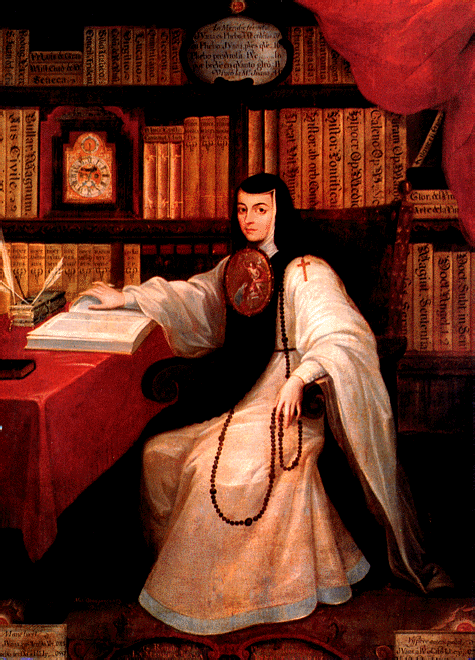
Those two poems also reminded me of the time when I came across a translation of one of my favourite pieces ever by the Mexican nun Sor Juana Inés de la Cruz a few years ago. This was a woman born at a time when Spain still had a strong colonial presence in America, 17th century; when 'to speak too openly was the equivalent of sinning'. Juana Inés de Asbaje y Ramírez de Santillana's talent shone from a very early age and she used it to further women's cultural rights from her ecclesiastic position. It was her achievements in this field that have led academics and scholars alike to name her Latin America's first femininist. And when you read the poem I have selected below you will find out why. And all thanks to the wonderful power of translation.
N.B. (I found this translation online but could not find the author. Please, be aware that no permission has been sought to reproduce the text and should the author want me to remove it, I will comply immediately with her/his request. Also, should the author want me to credit him/her with the translation of the poem, I will update the post accordingly. Thanks)
You Men
Silly, you menso very adept at wrongly faulting womankind,
not seeing you're alone to blame
for faults you plant in woman's mind.
After you've won by urgent plea
the right to tarnish her good name,
you still expect her to behave
you, that coaxed her into shame.
You batter her resistance down
and then, all righteousness, proclaim
that feminine frivolity,
not your persistence, is to blame.
When it comes to bravely posturing,
your witlessness must take the prize:
you're the child that makes a bogeyman,
and then recoils in fear and cries.
Presumptuous beyond belief,
you'd have the woman you pursue
be Thais when you're courting her,
Lucretia once she falls to you.
For plain default of common sense,
could any action be so queer
as oneself to cloud the mirror,
then complain that it's not clear?
Whether you're favored or disdained,
nothing can leave you satisfied.
You whimper if you're turned away,
you sneer if you've been gratified.
With you, no woman can hope to score;
whichever way, she's bound to lose;
spurning you, she's ungrateful
succumbing, you call her lewd.
Your folly is always the same:
you apply a single rule
to the one you accuse of looseness
and the one you brand as cruel.
What happy mean could there be
for the woman who catches your eye,
if, unresponsive, she offends,
yet whose complaisance you decry?
Still, whether it's torment or anger
and both ways you've yourselves to blame
God bless the woman who won't have you,
no matter how loud you complain.
It's your persistent entreaties
that change her from timid to bold.
Having made her thereby naughty,
you would have her good as gold.
So where does the greater guilt lie
for a passion that should not be:
with the man who pleads out of baseness
or the woman debased by his plea?
Or which is more to be blamed
though both will have cause for chagrin:
the woman who sins for money
or the man who pays money to sin?
So why are you men all so stunned
at the thought you're all guilty alike?
Either like them for what you've made them
or make of them what you can like.
If you'd give up pursuing them,
you'd discover, without a doubt,
you've a stronger case to make
against those who seek you out.
I well know what powerful arms
you wield in pressing for evil:
your arrogance is allied
with the world, the flesh, and the devil!
REDONDILLAS - Sor Juana Inés de la Cruz
Hombres necios que acusáis
a la mujer, sin razón,
sin ver que sois la ocasión
de lo mismo que culpáis;
si con ansia sin igual
solicitáis su desdén,
por qué queréis que obren bien
si las incitáis al mal?
Combatís su resistencia
y luego, con gravedad,
decís que fue liviandad
lo que hizo la diligencia.
Parecer quiere el denuedo
de vuestro parecer loco,
al niño que pone el coco
y luego le tiene miedo.
Queréis, con presunción necia,
hallar a la que buscáis
para prentendida, Thais,
y en la posesión, Lucrecia.
¿Qué humor puede ser más raro
que el que, falto de consejo,
él mismo empaña el espejo
y siente que no esté claro?
Con el favor y el desdén
tenéis condición igual,
quejándoos, si os tratan mal,
burlándoos, si os quieren bien.
Opinión, ninguna gana,
pues la que más se recata,
si no os admite, es ingrata,
y si os admite, es liviana.
Siempre tan necios andáis
que, con desigual nivel,
a una culpáis por cruel
y a otra por fácil culpáis.
¿Pues como ha de estar templada
la que vuestro amor pretende?,
¿si la que es ingrata ofende,
y la que es fácil enfada?
Mas, entre el enfado y la pena
que vuestro gusto refiere,
bien haya la que no os quiere
y quejaos en hora buena.
Dan vuestras amantes penas
a sus libertades alas,
y después de hacerlas malas
las queréis hallar muy buenas.
¿Cuál mayor culpa ha tenido
en una pasión errada:
la que cae de rogada,
o el que ruega de caído?
¿O cuál es de más culpar,
aunque cualquiera mal haga;
la que peca por la paga
o el que paga por pecar?
¿Pues, para qué os espantáis
de la culpa que tenéis?
Queredlas cual las hacéis
o hacedlas cual las buscáis.
Dejad de solicitar,
y después, con más razón,
acusaréis la afición
de la que os fuere a rogar.
Bien con muchas armas fundo
que lidia vuestra arrogancia,
pues en promesa e instancia
juntáis diablo, carne y mundo.
Copyright 2008
Tuesday, 7 October 2008
Down There
Disclaimer: Sensitive readers and bloggers might find some of the language used in the poem that follows offensive. Thanks.
Down There – by Sandra Cisneros
At that moment, Little Flower scratched herself
Where one never scratches herself
From “The Smallest woman in the World”
- Clarice Lispector
Your poem thinks it’s bad.
Because it farts in the bath.
Cracks it knuckles in class.
Grabs its balls in public
and adjusts – one,
then the other –
back and forth like Slinky. No,
more like the motion
of a lava lamp.
You follow me?
Your poem thinks it
cool to pee in the pool.
Waits for the moment
someone’s watching before
it sticks a finger up
its nose and licks
it. Your poem’s weird.
The kind that swaggers in like Wayne
or struts its stuff like Rambo.
The kind that learned
to spit at 13 and still
is doing it.
It blames its bad habits
on the Catholic school.
Picked up words that
Snapped like bra straps.
Learned words that ignite
of their own gas
like a butt hole flower.
Fell in love with words
that thudded like stones and sticks.
Or stung like fists.
Or stank like shit
gorillas throw at zoos.
Your poem never washes
its hands after using the can.
Stands around rolling
toilet paper into wet balls
it can toss up to the ceiling
just to watch them stick.
Yuk yuk.
Your poem is a used rubber
sticky on the floor next morning.
the black elephant
skin of testicles,
hairy as kiwi fruit
and silly, the shaving
stubble against the purity
of porcelain,
one black pubic
hair on the sexy
lip of toilet seat,
the swirl of spit
with a cream of celery
center,
a cigarette
stub sent hissing
to the piss pot,
half finished
bottles of beer reeking
their yeast incense,
the miscellany of maleness:
nail clippers and keys,
tobacco and ashes,
pennies quarters nickels dimes and
dollars folded into complicated origami
stub of ticket and pencil and cigarette, and
the crumb of the pockets
all scattered on the Irish
linen of the bedside table.
Oh my little booger,
it’s true.
Because someone once
said Don’t
do that!
you like to do it.
Baby, I’d like to mention
the Tampax you pulled with your teeth
once in a Playboy poem*
and fond it, darling, not so bloody.
Not so bloody at all, in fact.
Hardly blood cousin
except for an unfortunate
association of color
that makes you want to swoon.
Yes,
I want to talk at length about Menstruation.
Or my period.
Or the rag as you so lovingly put it.
All right then.
I’d like to mention my rag time.
Gelatinous. Steamy
and lovely to the light to look at
like a good glass of burgundy. Suddenly
I’m artist each month.
The star inside this like a ruby.
Fascinating bits of sticky
I-don’t-know-what-stuff.
The afterbirth without the birth.
The gobs of a strawberry jam.
Membrane stretchy like
saliva in your hand.
It’s important that you feel its slickness,
understand the texture isn’t bloody at all.
That you don’t gush
between the legs. Rather,
it unravels itself like a string from some deep deep center –
like a Russian subatomic submarine,
or better, like a mad Karlov cackling
behind beakers and blooping spirals.
Still with me?
Oh I know, darling,
I’m indulging, but indulge
me if you please.
I find the subject charming.
In fact,
I’d like to dab my fingers
in my inkwell
and write a poem across the wall.
“A Poem of Womanhod”
now wouldn’t that be something?
Words writ in blood. But no,
not blood at all, I told you.
If blood is thicker than water, then
menstruation is thicker than brotherhood.
And the way
it metamorphosizes! Dazzles.
changing daily
like starlight.
From the first
Transparent drop of light
To the fifth day chocolate paste.
I haven’t mentioned smell. Think
Persian rug.
But thicker. Think
Cello.
But richer.
A sweet exotic snuff
From an ancient prehistoric center.
Dark, distinct,
and excellently
female.
*John Updike's "Cunts" in Playboy (January 1984), 163.
This poem is included in the book ‘Loose Woman’ published by Vintage Books, a division of Random House, 1995.
Down There – by Sandra Cisneros
At that moment, Little Flower scratched herself
Where one never scratches herself
From “The Smallest woman in the World”
- Clarice Lispector
Your poem thinks it’s bad.
Because it farts in the bath.
Cracks it knuckles in class.
Grabs its balls in public
and adjusts – one,
then the other –
back and forth like Slinky. No,
more like the motion
of a lava lamp.
You follow me?
Your poem thinks it
cool to pee in the pool.
Waits for the moment
someone’s watching before
it sticks a finger up
its nose and licks
it. Your poem’s weird.
The kind that swaggers in like Wayne
or struts its stuff like Rambo.
The kind that learned
to spit at 13 and still
is doing it.
It blames its bad habits
on the Catholic school.
Picked up words that
Snapped like bra straps.
Learned words that ignite
of their own gas
like a butt hole flower.
Fell in love with words
that thudded like stones and sticks.
Or stung like fists.
Or stank like shit
gorillas throw at zoos.
Your poem never washes
its hands after using the can.
Stands around rolling
toilet paper into wet balls
it can toss up to the ceiling
just to watch them stick.
Yuk yuk.
Your poem is a used rubber
sticky on the floor next morning.
the black elephant
skin of testicles,
hairy as kiwi fruit
and silly, the shaving
stubble against the purity
of porcelain,
one black pubic
hair on the sexy
lip of toilet seat,
the swirl of spit
with a cream of celery
center,
a cigarette
stub sent hissing
to the piss pot,
half finished
bottles of beer reeking
their yeast incense,
the miscellany of maleness:
nail clippers and keys,
tobacco and ashes,
pennies quarters nickels dimes and
dollars folded into complicated origami
stub of ticket and pencil and cigarette, and
the crumb of the pockets
all scattered on the Irish
linen of the bedside table.
Oh my little booger,
it’s true.
Because someone once
said Don’t
do that!
you like to do it.
Baby, I’d like to mention
the Tampax you pulled with your teeth
once in a Playboy poem*
and fond it, darling, not so bloody.
Not so bloody at all, in fact.
Hardly blood cousin
except for an unfortunate
association of color
that makes you want to swoon.
Yes,
I want to talk at length about Menstruation.
Or my period.
Or the rag as you so lovingly put it.
All right then.
I’d like to mention my rag time.
Gelatinous. Steamy
and lovely to the light to look at
like a good glass of burgundy. Suddenly
I’m artist each month.
The star inside this like a ruby.
Fascinating bits of sticky
I-don’t-know-what-stuff.
The afterbirth without the birth.
The gobs of a strawberry jam.
Membrane stretchy like
saliva in your hand.
It’s important that you feel its slickness,
understand the texture isn’t bloody at all.
That you don’t gush
between the legs. Rather,
it unravels itself like a string from some deep deep center –
like a Russian subatomic submarine,
or better, like a mad Karlov cackling
behind beakers and blooping spirals.
Still with me?
Oh I know, darling,
I’m indulging, but indulge
me if you please.
I find the subject charming.
In fact,
I’d like to dab my fingers
in my inkwell
and write a poem across the wall.
“A Poem of Womanhod”
now wouldn’t that be something?
Words writ in blood. But no,
not blood at all, I told you.
If blood is thicker than water, then
menstruation is thicker than brotherhood.
And the way
it metamorphosizes! Dazzles.
changing daily
like starlight.
From the first
Transparent drop of light
To the fifth day chocolate paste.
I haven’t mentioned smell. Think
Persian rug.
But thicker. Think
Cello.
But richer.
A sweet exotic snuff
From an ancient prehistoric center.
Dark, distinct,
and excellently
female.
*John Updike's "Cunts" in Playboy (January 1984), 163.
This poem is included in the book ‘Loose Woman’ published by Vintage Books, a division of Random House, 1995.
Subscribe to:
Posts (Atom)
LinkWithin
