Showing posts with label Poetry. Show all posts

Wednesday, 22 February 2017

Of Literature and Other Abstract Thoughts

I recently cycled along the River Lee Navigation. For those of you who are not acquainted with one of London and Hertfordshire’s (a county just outside the British capital to the north) most picturesque routes I would strongly recommend that you keep it in mind if you ever visit the UK. The unbroken path is perfect for walking and biking. I have made this trip before but on this occasion I went much further up.

Travelling from someone near east London up to Cheshunt the journey took me through some of the most scenic open spaces ever. As it is the custom with me when I am cycling on a traffic-free route, I went into reverie mode, whilst at the same time paying close attention to the path and the people walking or cycling on it.

I do not know if poetry has the same effect on you, fellow bloggers and readers, but in my case I have always seen it as evocative. A poem like Ode to a Nightingale makes me think more of the feelings that led Keats to compose the piece and the sentiments it continues to trigger to this day. The bird in question becomes secondary or even non-existent.

This is exactly what happened that day on the towpath of the River Lee Navigation. Perhaps it was the peace around me, the calm water, the stationery boats, the slow pace, both amongst walkers and cyclists and the overpowering sense of history that triggered off a deep spiritual connection to my immediate environment. As I neared the Lee Valley White Water Centre I saw a wall (or the remains of it) on my right handside with a crack running down the middle. I stopped on one side of the path for a couple of minutes and watched the concrete entity closer.

In the context of everything I had seen so far the wall was ugly. It broke the harmony of the urban and rural mix I had cycled past up to now on my way to Hertfordshire. Yet, all the same I felt that there was a reason for that wall to be part of this bucolic landscape. All of a sudden, lines from Fleur Adcock’s poem Against Coupling came to my mind. I could not remember the whole piece (I very rarely remember entire poems by heart) but I did recall the following verses: “There is much to be said for abandoning this no longer novel exercise/for not’ participating in total experience’.

The strange thing was that whereas Fleur was writing about the need for occasional alienation in a couple (temporary “uncoupling”, if you like), I was looking at the wall in a whole different light. To me it was an object that refused to conform to the beauty standards that the canal had unwittingly imposed. It was an unremarkable wall by any definition. One that could be found anywhere else in the world: South Africa, Thailand, Cuba. However, to me it only made sense in that moment, surrounded by cormorants, herons and oak trees.

I carried on, still thinking of the odd relationship between that wall’s ordinariness and inelegance and the canal’s exuberance. And how poetry married (at least in my head) the two of them somehow.


© 2017

Photo taken by the blog author

Next Post: “Thoughts in Progress”, to be published on Saturday 25th February at 6pm (GMT)

Saturday, 11 February 2017

Birthday Post

This post and video are dedicated to my mother, who turns 80 on Tuesday, 14th February. I love you, mum, always have, always will. The poem was written by the late Palestinian poet, Mahmoud Darwish.


Next Post: "Thoughts in Progress", to be published on Saturday 18th February at 6pm (GMT)

Saturday, 17 December 2016

Thoughts in Progress

I recently thought of an Alan Bennet’s quote, which I first came across in a column by Laura Barton, music writer at The Guardian: “The best moments in reading are when you come across something – a thought, a feeling, a way of looking at things – which you had thought special and particular to you. And now, here it is, set down by someone else, a person you have never met, someone even who is long dead. And it is as if a hand has come out, and taken yours.” The reason for that pensive moment? Seamus Heaney.

The Irish poet, who died in 2013, left behind an extensive and rich body of work. Yet, I had never “got” Seamus. No matter how many articles and essays I read, including a nostalgia-tinted eulogy by his fellow poet and long-time admirer, Andrew Motion, I failed to connect with his poems.

Until “his hand came out and took mine” a few weeks ago. We had our annual Christmas Bazaar at my school which, as a fund-raising opportunity, always delivers the goods. This time I was put in charge of the teddies’ tombola. Next to me was the “second-hand bookshop” stall. During one of our breaks I nipped over for a quick browse and left with a copy of Contemporary British Poetry. And which author was the first one to be featured? Our Seamus.


"Where finally gold flecks began to dance"

I left work a bit later that evening on account of all the tidying-up. By the time I got home it was dark. With my bike still outside the open front door and my helmet on, I read the first poem in the collection.

Reader, I married Seamus Heaney that night. And no, I don’t care that I am misquoting our lovely and talented Charlotte. The first three lines of Churning Day have stuck with me since: A thick crust, coarse-grained as limestone rough-cast/hardened gradually on top of the four crocks/that stood, large pottery bombs, in the small pantry.

I thought of the hand that was being offered to me. I took it. I dared not hesitate, nor reject it. The fullness of those three lines hit me like a heavyweight boxer’s uppercut in my sternum. They spoke not only of the alchemy-like process of making butter in a farm. They became melodic madeleines that took me back to the Havana of my childhood. No, we didn’t make butter at home. But we did our washing on a Saturday and called out to our neighbours who lived in the flat below ours to warn them that our clothes might drip a bit and “would it be all right if they could put out their washing after?”. Of course, we would let them know when we were done. The delight of feeling this connection with a culture - the Irish - that is as strange to mine as mine is to it is the familiarity Seamus' verses breed. Churning Day was not the only poem of his that made me feel this way but it is the one that has stayed with me the longest.

It is a theory of mine that this is one of the advantages of middle age. The lack of rush and abundance of patience. If you have been reading this blog for a long time, then, you know by now that I am not in the habit of chasing after the latest bestseller (although I am one third of the way into Zadie Smith’s latest novel, Swing Time. Then, again, Zadie is an exception) or the newest music releases. It is almost a rule I live my life by that the more people hype up an author or musician, the less I want to know about their work.

The literature I read, the music I listen to, the art I enjoy, they all come from a similar place: closeness, intimacy. I want to believe that Churning Day was written for me. In fact, I believe it was. Poems like the ones Seamus wrote (yup, you guessed it, I have read a few more, I am catching up very quickly), nuzzle up to your ribs. They fill the space in which you are.

In times of ugliness, as the ones I think we are living through now, I take refuge in art, be it literature or cinema. Art connects me to other human beings, hopefully less interested in pussy-grabbing than in bridge-building. Art knows no boundaries, arrives unbidden and undemanding. But once you acquaint yourself with it, it asks to be fed. Your brain, it wants your brain, your full attention, your senses, your feelings and emotions. Seamus has showed me that recently. I did not “get” him at first because I was looking for him. Sometimes it is better to let that which we are trying to understand, find you instead. Even if it means that your house will “stink long after churning day/acrid as a sulphur mine. The empty crocks/were ranged along the wall again, the butter/in soft printed slabs was piled on pantry shelves/And in the house we moved with gravid ease/our brains turned crystals full of clean deal churns/the plash and gurgle of the sour-breathed milk/the pat and slap of small spades on wet lumps.” As for my hand, it feels a bit greasy. It must be the butter.

This is my last column this year. See you all in the New Year. I hope you have a fantastic holiday period wherever you are and with whomever you spend it.

Sunday, 16 November 2014

Sunday Mornings: Coffee, Reflections and Music

And in the end what are we all,
A brick from the old Berlin wall?
Somebody’s question or someone’s answer
A puzzle spinning like a dancer?

What are we all? I asked before,
Creatures we are, under the floor,
The maligned rat, the tiny mouse,
In darkness roaming through the house.

We are the dust that in the wind
Became the song that Kansas dreamed
We are the chords of the guitar
Carrying our life’s score very far

What in the end are we, us, all?
The misheard word, the miskicked ball
Sometimes shaming us for years to come
Till we learn that of the bread we’re but one crumb

Is this us in the mirror, us all?
Is this our reflection, no fear to fall?
Or is it the mask we don for the show
Shielding our selves, our ids, our souls

We can be lovers, good friends or traitors
Of our exhibit the sole curators
Of our performance we’re the one actor
One piece, one act. The theme? Fear factor

What are we all, in this one life?
We’re gain and loss, accord and strife
We are the hauling, dragging and pulling
We’re also the thrusting, shoving and pushing

And in the end, what are we all?
Same question, yes, but, please, don’t call
Phone down, give me no answer
I am still learning from the dancer.

 
Two things first. It is my birthday today and for only the third or fourth time in my life I have dared to write a poem in English.

To the first one of these two things. Although it is an occasion for me to celebrate – and indeed I am celebrating – this birthday poem was inspired by a recent sad experience. Earlier this year we lost an unbelievable colleague at the school where I work. She was a nursery teacher who had been a member of the staff for many, many years, to the point where some of the current teachers and teaching assistants were taught by this amazing teacher when they themselves were little. I got to know this incredible human being very well, despite the fact that when she died I had been at my primary school for less than a year. Some people make you feel welcome just by looking at you. My colleague was one of those people. She also had a great sense of humour. About a year ago to the day she and I attended a training session near King's Cross station. There was a tube strike that day which affected our journey. I got to the venue about ten minutes before she did. But when she came into the room it felt as if she had just lit it up. Some people have that effect. As our headteacher read the tributes written by the staff, the first line of today’s poem started sounding in my head: what are we all? In the end, what are we? That line took my head as its abode and didn’t leave me alone from that day until recently. I knew I had to do something but I didn’t know what or how.

The second thing today. I knew I had a poem in me. Not a short story. I knew it had to be a poem because that line ended in “all”. And I could come up with all kinds of rhymes and combinations to develop the theme. The theme of what? I mentioned fear factor in the poem, but it’s more than that. It’s the theme of mortality and the way we see ourselves and our selves. Whether we believe that we have accomplished everything by the time the Grim Reaper pokes its ugly head in, taps us on our shoulder and tells us it's time to go or we think that there’s a lot of work to be done still. And are we humans really that far apart from the “others” (plants, animals, dust, etc.) that we can afford to behave in such a solipsistic way?

No.

We’re connected in a way of which we might not be aware sometimes. This idea of a gigantic network of people, things and animals might have been hijacked by the New Age brigade and its spin-offs but strip the layers that make us who we are and at the core you will find the dust, the - beautiful – contradictions and the tiny mouse.

I couldn’t give two monkeys about the quality of the poem or lack of it thereof. I really don’t. It's not praise I'm after but steam I'm letting off. I don’t care which style (if any) the poem falls under. That’s why I don’t think I could ever belong to a writers’ collective or rise up to the challenge of writing a sonnet, or haiku, or suchlike on commission. I just couldn’t do it. I feel jealous of people who can, though. I like making up and breaking my own rules. And because I “discovered” the English language on my own at a young age, I have always believed that English and I have a special relationship. Like two brothers or a brother and a sister, or two good mates who fall out every now and then (all those “likes” and “sos”, "sortas" and "kindas" and rising intonation at the end of statements?) but who always find their way back into the friendship.

That still does not deviate from the fact that writing in a foreign language is very hard. Terribly hard. Believe me; I do it day in, day out, week in, week out. I do it as a hobby and professionally. At the same time there’s a pleasure to be had, mixing, stirring, decanting and tasting sentences, words and connectors. I wouldn’t be able to write this blog if I didn’t derive pleasure from doing it.

So, there you have it. A poem inspired by the life and work of an extraordinary person who is sadly no longer amongst us, posted on the day I celebrate adding another candle to this cake I call life and which you might call something else. I would like to raise a glass of apple juice (I’m teetotal, remember) to you all and ask you to keep posing the same question to others and to yourselves: and in the end, what are we all?


© 2014

Next Post: “Sunday Mornings: Coffee, Reflections and Music”, to be published on Sunday 23rd November at 10am (GMT)

Tuesday, 22 October 2013

Of Literature and Other Abstract Thoughts

I recently coordinated a five-week literacy course for parents in my school through our local community learning unit. The weekly sessions (still going as I write) are meant to acquaint parents with what their children are learning in school. I have known the tutor for quite some time now and he has always struck me as someone who goes the extra mile in making his lessons fun. Like the other day, for instance, when I happened to walk in on him waxing lyrical about poetry and what characterises it. He was in the middle of defining what poetry was and I lingered in the room for longer than I needed to hear what he had to say. He spoke of stanzas, of verses, of rhyme (and non-rhyme) and rhythm. This last element was what caught my attention. Most people would agree with the tutor that a poem is made of verses, stanzas and the like. But rhythm is so subjective, so hard to define that most people would probably not give it a second thought.

However, to me, this is the difference between a good and a bad poem: rhythm. An under-par poem sounds flat to me whichever way I read it. On the other hand, a poem with its own groove, jumps, skips and hops around. When I was younger I paid a closer attention to rhyme (it took me a while to get into non-rhyming poems) and this, ironically, gave me a sense of rhythm. As a grown-up cadence became more internal and therefore more subjective. No longer did I depend on rhyming verses, whether assonant or not. I searched for authors who could provide the kind of rhythm to which I was getting used.

Dylan Thomas: a good sense of rhythm
An example is Dylan Thomas’s poem “Should Lanterns Shine”, from which the current quote adorning my blog header comes. I love the beginning of the second stanza with its alliterative second verse:

I have been told to reason by the heart,
But heart, like head, leads helplessly

Needless to say, for a Spanish speaker that “heart... head... helplessly” is a linguistic nightmare. But Dylan’s honesty overcomes any pronunciation issues. I first came across this poem through a Spanish translation of the last line in an Argentinean film. I then sought the original in English and I loved it even more. Dylan is on a quest, looking for guidance on how to lead his life. He has tried reason (the “head”) and love (the “heart”) but the ball he threw in the park “has not yet reached the ground”. Isn’t that what life’s about? A constant search despite our adulthood and maturity. This constant search is rammed home by a beautiful combination of syncopated verses.

Closer to home, as in Latin America, an author who has always made me value the importance of rhythm in poetry is Oliverio Girondo. Although long gone, his poems have never gone out of fashion. Oliverio was a master at creating rhythm through repetition. His poems (usually short) are like little melodic explosions where a crescendo is reached very quickly. A good example is “¡Todo Era Amor!” (“All was Love”) and its mid-section:

Amor con una gran M, con una M mayúscula,
chorreado de merengue,
cubierto de flores blancas...
Amor espermatozoico, esperantista.
Amor desinfectado, amor untuoso...”( apologies for the lack of translation)

The repetition of the word “love” (“amor” in Spanish) is not an empty gesture, the result of an out-of-sorts poet. He is merely attempting to describe the different kinds of love there are. I must say that he could have gone on for another twenty or thirty lines and I wouldn’t have bat an eyelid. I love Girondo’s poetry.

My last example is a rarity in that it is a poem by an author who is not a poet. Toni Morrison wrote “The Big Box” in collaboration with her son Slade in 1999. Thought-provoking is too mild a term to describe “The Big Box”. Three children Patty, Mickey and Liza Sue are put in this big brown box that has swings and slides but it also has a door with three big locks that only opens one way. The three children each take turns to tell their stories but the following stanza (with slight variations) is included in all their testimonies:

Even sparrows scream,
And rabbits hop,
And beavers chew trees when they need ‘em.
I don’t mean to be rude: I want to be nice,
But I’d like to hang on to my freedom.

The cadence of the poem reflects the complicated relationship between the adults of the story and the children. It is far from simple and yet beautiful. That beauty is partly brought about by that indispensable element in good poetry: rhythm.

© 2013

Next Post: “Living in a Multilingual World”, to be published on Thursday 24th October at 11:59pm (GMT)

Sunday, 13 October 2013

Sunday Mornings: Coffee, Reflections and Music

Last Friday 4th October, one of the finest poets I've ever read but whom I never had the privilege to meet, died peacefully. I found out about his death through another equally excellent poet. The news left me speechless and tearful.

Dave King, the author of the Pics and Poems blog, was that autumn light that breaks through the tall trees bringing solace and comfort to those who venture through the multi-coloured foliage Mother Nature gifts us every year. Sometimes facetious, sometimes sombre, his poetry was (is) hard to categorise. Yet, what no one can deny is the sheer quality his oeuvre had. His output was incredible. There were times when I would spend a few minutes on a Saturday afternoon at home reading the three or four poems Dave had posted during that week.

I'll leave you today with a poem I uploaded on my blog back in 2009 to celebrate National Poetry Day in the UK. Dave, very kindly, allowed me to use this beautiful poem. Also, in memory of Dave King this blog is officially in mourning for a week. It will resume on Sunday 20th October. My most sincere condolences to Dave King's family.

On Turning Over a New Leaf

When the apple tree turned over a new leaf
it began producing plums.

When the pear turned over a new leaf
it brought forth grapes instead.

When the cherry turned over a new leaf
it found acorns on its branches.

When The Book of Life turned over a new leaf
a skeleton crawled out.

When the woods turned over their new leaves
a million tiny creatures saw the sun.

When these turned over the dead leaves
the dust and ash beneath began to smoke.

When humankind turned over its new leaves
it took leave of its senses

and not until it turned again the old leaves
did the trees bring forth their true and ample fruit.


Sunday, 2 December 2012

Sunday Mornings: Coffee and Poetry


Dear all, last Sunday I asked you to take part in a game I used to play with some of my friends at uni and lo, and behold, the response was massive. I thought of splitting this post into two, but my greedy inner self decided to gorge on all your contributions in one go. Your poems appear in the order they were submitted. The images below were copied and pasted from your online profiles. And I also included the reasons why you sent me your poems. Some of them cracked me up.

First off is Brian Miller.

[meb.png]

Brian Miller blogs at Waystation and he writes some of the most wonderful poetry I’ve read recently. One of many pleasant “discoveries” I’ve made lately. I love the fact he submitted a poem by Nikki Giovanni, an author about whose work I’ve blogged on this forum.

ha fun game...here goes...

balances by nikki giovanni

in life
one is always
balancing

like we juggle our mothers
against our fathers

or one teacher
against another
(only to balance our grade average)

3 grains of salt
to one ounce truth

our sweet black essence
or the funky honkies down the street

and lately i've begun wondering
if you're trying to tell me something

we used to talk all night
and do things alone together

and i've begun

(as a reaction to a feeling)
to balance
the pleasure of loneliness
against the pain
of loving you
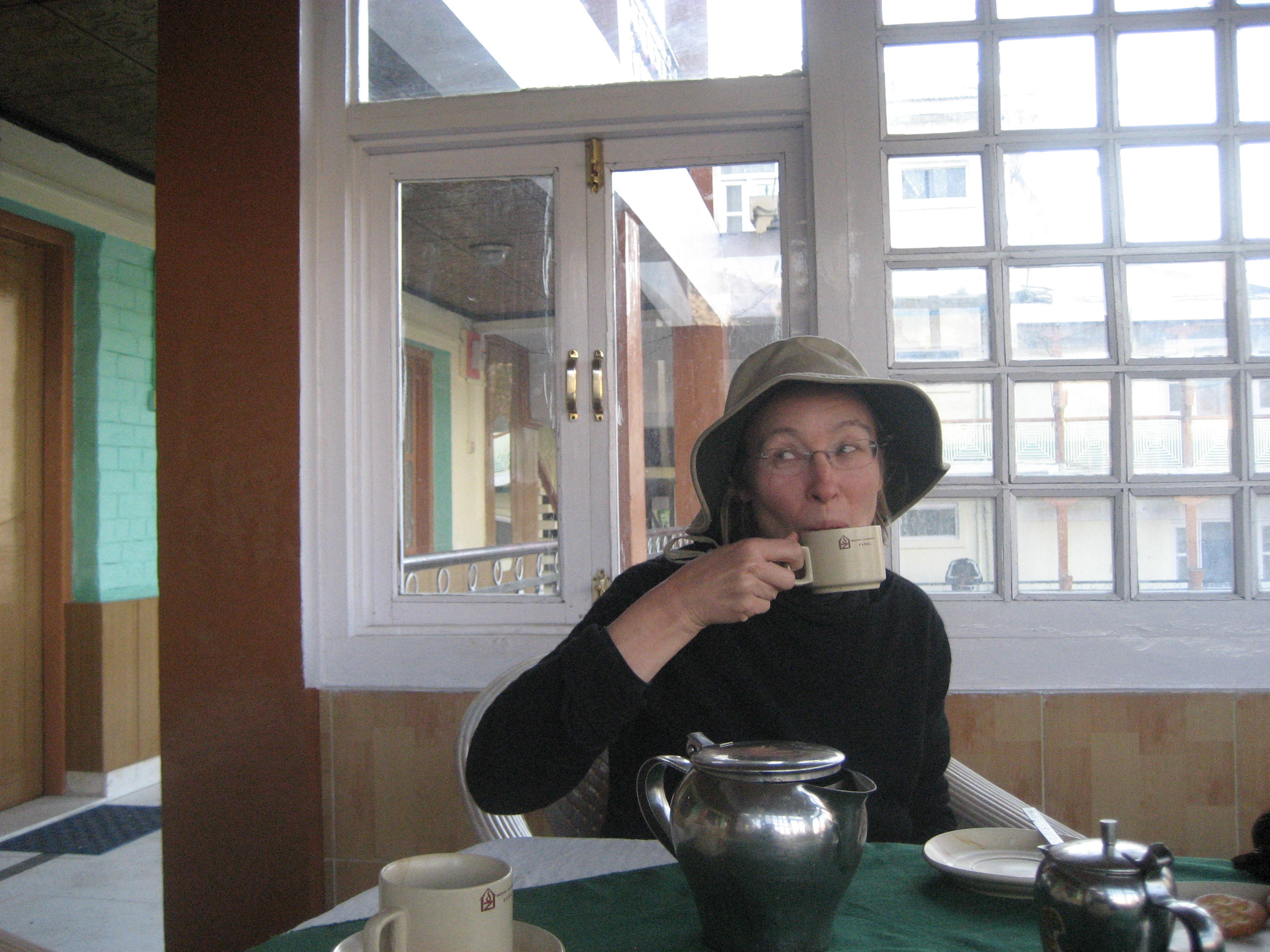
Drinking Tea in Kargill, India

Second up is poetess (am I still allowed to say “poetess”. I think so) I'll just let her introduce herself.
 
Karin Gustafson is a writer, lawyer, mother. Well, mainly a mother, lawyer, writer. I blog more or less daily as Manicddaily and drink a lot of good strong tea. My published books, published by my own imprint BackStroke Books, include Nose Dive, an extremely light-hearted mystery about teenagers, musicals, love, noses, New York (illustrated by Jonathan Segal); Going on Somewhere, a collection of poetry (illustrated by Diana Barco), and 1 Mississippi, a very cute counting book, heavy on elephants and gouache.

I also think a great idea. Truly, the first book that came to hand (stained on a coffee table) was my poetry book, "Going on Somewhere" by Karin Gustafson

Courbet

All I can say is that
it's a good thing we have museums
hanging Courbets,
Rubens,
Rembrandts,
the occasional Italian,
with their depictions of swelling bellies,
dimples gathered around spines, flesh rippling
like Aphrodite's birth foam,
the creep of pubic hair juxtaposed by coy hands
whose curved digits
pudge, slightly sunken cheeks (above, below),
spidery blood vessels
rooting beneath the patina.
All I can say, as I catch
my face in the glass,
glance down at my folio
of torso, is that
it's a good thing.

My Photo
The third submission came from Catherine, a literature teacher whose blog I’ve followed for a few years now and who’s a brilliant photographer, too.

well this one sure was a surprise and certainly has the element of randomness and serendipity you are seeking - picked out in a dark room on a shadowy Sunday afternoon (fortunately it was a poetry book) in the study of the apartment in Nice, France that I am currently renting. The owner has left her whole collection of books for me to peruse (as yet they have remained unperused as my kindle has become my own personal mobile library when travelling) so this is from Book 5 of William Wordsworth's Prelude Line 426 - 441 where the book fell open.... It struck a real chord as moving to France from Mexico City has stirred up my first real experience of homesickness - maybe I am on my way home and just need to hop across the Channel to the Lake District?? 

Well do I call to mind the very week

When I was first entrusted to the care

of that sweet Valley; when its paths, its shores,

And brooks were like a dream of novelty

To my half-infant thoughts; that very week

While I was roving up and down alone,

Seeking I knew not what, I chanced to cross

One of those open fields, which, shaped like ears,

Make green peninsulas on Esthwaite's Lake:

Twilight was coming on, yet through the gloom

Appeared distinctly on the opposite shore

A heap of garments, as if left by one

Who might have been bathing. Long I watched,

But no one owned them; meanwhile the calm lake

Grew dark with all the shadows on its breast,

And, now and then, a fish up-leaping snapped

The breathless stillness.

I haven't read Wordsworth for years and had forgotten the sheer beauty of his language - indeed the poem is about serendipity itself "I chanced to cross..." best wishes with the rest of this "project"

kind regards and greetings from Nice - www.smallfishinthebigtaco.blogspot.com  
My Photo

I’ve also followed the next blogger, Dominic Rivron, for a few good years and find his posts always interesting. I’m very pleased he took part in our game.
Great game. I tried it and came up with:

Upon Julia's Clothes
When as in silks my Julia goes,
Then, then, methinks, how sweetly flows
That liquefaction of her clothes!

Next, when I cast mine eyes and see
That brave vibration each way free ;
- O how that glittering taketh me !
Robert Herrick

As for a link to what I do, people can read my poetry here:
http://dominicrivron.blogspot.co.uk/p/poetry.html

There. I think I've followed the instructions right...
All the best,

Dominic (Rivron - "...made out of words")

My Photo

Lovely Lisa is from Malaysia, a country I’ve visited twice. I always enjoy her posts.

Hola Cuban, my fingers slide and tap and rest upon the Book of Poetry of Ed Pilolla and the page that opens up brings us:
"Breaking Ground", Ed Pilolla

 I saw a speck of yellow, way off into the rock and crust. When searching, track something worthwhile. Wait for the right season. Burrow deep into the earth and have a patient look around.
And what I saw was yellow. I sent out feelers. We did taste tests in every direction. We wanted to know where you came from because I’ve been around, and I don’t do rubbernecks often enough.

An ancient runoff flavored you. I browsed your red caverns, felt my way forward, chewed on a nook, and set up shop for a while.
I took a mere cell from your body, a ball of dirt from your rock pile, a spice flake from your kitchen. The substance was darker at your center. I packed the embers in a snowfall and filled my pockets. I smithed and lathed and bathed in you.

You are sunrise underground. You are color growing out of shadow. You are a pond surfacing, an oasis becoming. I see it.
Lisa, the world as i see it

My Photo
I still page through Rachel’s poetry collection, More About the Song. I’m chuffed to bits that she took part in our challenge, even if she did cheat slightly! J Never mind, Rachel, I loved the poem.
OK... I am playing but I'm never very good at playing by rules!

I did take a book (the faber 1996 anthology "Emergency Kit" ed. by Jo Shapcott and Matthew Sweeney) and opened to a random page.

The poem it hit was "The Man who Invented Pain" by Craig Raine... a war poem. Didn't do a whole lot for me so I tried to cheat and looked at the poem that finished on that page instead of the Raine one...

It was "The Woman on the Dump" by Elizabeth Spires. I looked up some stuff about her

http://poemsoutloud.net/poets/poet/elizabeth_spires/

but nothing was winning me round. I noticed online that there was a poem with a very similar title ("A Woman on the Dump" by Debora Greger)

http://www.poetryfoundation.org/bio/debora-greger#about

but no, that wasn't doing anything either. I am very fussy about poetry... like most people who write it i think.

Both of these poems refer to Wallace Stevens "The Man on the Dump"

http://www.poemhunter.com/poem/the-man-on-the-dump/

but no, I didn't want that one either!!!

So I flicked through the original book again until I came to "The Video Box: 25" by Scottish poet Edwin Morgan (1920-2010). It's here

http://www.poetryarchive.org/poetryarchive/singlePoem.do?poemId=1686

and that one you can have! Excellent piece and reminds me that I want to read the biography of Morgan ("Beyond the Last Dragon" by James McGonigal).


If you ask me what my favourite programme is
It has to be that strange world jigsaw final.
After the winner had defeated all his rivals
With harder and harder jigsaws, he had to prove his mettle
By completing one last absolute mind crusher
On his own, under the cameras, in less than a week.
We saw, but he did not, what the picture would be:
The mid-Atlantic, photographed from a plane.
As featureless a stretch as could be found
No weeds, no flotsam, no birds, no oil, no ships,
The surface neither stormy nor calm, but ordinary,
A light wind on a slowly rolling swell.
Hand-cut by a fiendish jigger to stimulate,
But not to have identical beaks and bays,
It seemed impossible, but the candidate –
He said he was a stateless person, called himself Smith –
Was impressive: small, dark, nimble, self-contained.
The thousands of little grey tortoises were scattered
On the floor of the studio; we saw the clock; he started.
His food was brought to him, but he hardly ate.
He had a bed, with the light only dimmed to a weird blue,
Never out. By the first day he had established
The edges, saw the picture was three metres long
And appeared to represent (dear God!) the sea.
Well, it was a man’s life, and the silence
(broken only by sighs, click of wood, plop of coffee
In paper cups) that kept me fascinated.
Even when one hand was picking the edge-pieces
I noticed his other hand was massing sets
Of distinguishing ripples or darker cross-hatchings or
Incipient wave-crests; his mind,
If not his face, worked like a sea.
It was when he suddenly rose from his bed
At two, on the third night, went straight over
To one piece and slotted it into a growing central patch,
Then back to bed, that I knew he would make it.
On the sixth day he looked haggard and slow,
With perhaps a hundred pieces left,
Of the most dreary and unmarked lifeless grey.
The camera showed the clock more frequently.
He roused himself and in a quickening burst
Of activity, with many false starts, began
To press that inhuman insolent remnant together.
He did it, on the evening of the sixth day.
People streamed onto the set. Bands played.
That was fine. But what I liked best
Was the last shot of the completed sea,
Filling the screen, then the saw-lines disappeared.
Till almost imperceptibly the surface moved
And it was again the real Atlantic, glad
To distraction to be released, raised
Above itself in growing gusts, allowed
To roar as rain drove down and darkened,
Allowed to blot, for a moment, the orderer’s hand.
All my stuff is via www.crowd-pleasers.net as ever.
blog http://slowlaneshuffle.blogspot.co.uk/

cheers

Rachel
x

My Photo
The Latin contribution comes all the way from Chile and sprinkled with cinnamon. Gracias, Gloria.
This is one of my favorites poems of Pablo Neruda

If you forget me

want you to know
one thing.

You know how this is:
if I look
at the crystal moon, at the red branch
of the slow autumn at my window,
if I touch
near the fire
the impalpable ash
or the wrinkled body of the log,
everything carries me to you,
as if everything that exists,
aromas, light, metals,
were little boats
that sail
toward those isles of yours that wait for me.

Well, now,
if little by little you stop loving me
I shall stop loving you little by little.

If suddenly
you forget me
do not look for me,
for I shall already have forgotten you.

If you think it long and mad,
the wind of banners
that passes through my life,
and you decide
to leave me at the shore
of the heart where I have roots,
remember
that on that day,
at that hour,
I shall lift my arms
and my roots will set off
to seek another land.

But
if each day,
each hour,
you feel that you are destined for me
with implacable sweetness,
if each day a flower
climbs up to your lips to seek me,
ah my love, ah my own,
in me all that fire is repeated,
in me nothing is extinguished or forgotten,
my love feeds on your love, beloved,
and as long as you live it will be in your arms
without leaving mine.

Pablo Neruda
OK dear here goes anything you need tell me.


My name is Gloria baker from Chile (you know)
 
My Photo
Sarah Laurence doesn’t just write brilliant blog posts, but also takes breathtaking photographs and is a superb artist. Visit her blog to be mesmerised by her creativity.
The Frost poem I found randomly fits the season, and it isn't one I'd readily recall. It is snowing right now. The links to my website and blog are below my signature. Robert Frost lived and wrote in New England. Looking forward to a weekend of poetry!

Stars

How countlessly they congregate
O'er our tumultuous snow,
Which flows in shapes as tall as trees
When wintry winds do blow!--

As if with keenness for our fate,
Our faltering few steps on
To white rest, and a place of rest
Invisible at dawn,--

And yet with neither love nor hate,
Those stars like some snow-white
Minerva's snow-white marble eyes
Without the gift of sight.

Robert Frost 1913
Sarah
website: http://sarahlaurence.com

blog: http://blog.sarahlaurence.com

My Photo
 
I came across Ygraine’s blog recently and became a regular visitor immediately. Go to her page and you’ll see why.

 STILLBORN

These poems do not live: it's a sad diagnosis.
They grow their toes and fingers well enough,
Their little foreheads bulged with concentration.
If they missed out on walking about like people
It wasn't for any lack of mother-love.

O I cannot understand what happened to them!
They are proper in shape and number in every part.
They sit so nicely in the pickling fluid!
They smile and smile and smile and smile at me.
And still the lungs won't fill and the heart won't start.

They are not pigs, they are not even fish,
Though they have a piggy and fishy air-
It would be better if they were alive, and that's what they were.
But they are dead, and their mother near dead with distraction,
And they stupidly stare, and do not speak of her.

By Sylvia Plath (June, 1960)

Ygraine Barrow
Poems & Perceptions
http://ygrainebarrow.blogspot.com
 
My Photo
Sara is the Cracker Jack Poet who’s married to a Cuban. But I swear to you all that that was not the reason why she’s featured here today! J I just love the warmth and camaraderie her blog conveys.
Hi!

I love this idea--and funny thing, this is one of my favorite poems, probably why the book opened to this page :-) The collection of poems is called "Reflections on the Gift of a Watermelon Pickle"

This is Just to Say

by William Carlos Williams 

I have eaten
the plums
that were in
the icebox
and which
you were probably
saving
for breakfast
Forgive me
they were delicious
so sweet
and so cold
 
Thank you for sharing this delicious poem (que rico!)
saravinas.blogspot.com (the Cracker Jack Poet)
All the best,

-Sara

No music today. Who needs music when we have the melodic incantations of this wild array of poems still playing in our ears? Many thanks to all the participants. I had a lot of fun reading your entries and learning about poets I knew nothing about.

© 2012

Next Post: “Living In a Bilingual World”, to be published on Wednesday 5th December at 11:59pm (GMT)

LinkWithin

Related Posts Plugin for WordPress, Blogger...