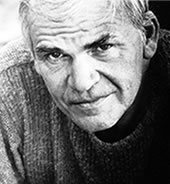
Showing posts with label Milan Kundera. Show all posts

Wednesday, 14 January 2015

Living in a Multilingual World (The One About Translation)

You have laughed or you have cried. You have perhaps indulged in hours of cogitation, your thoughts strongly interosculating and contaminating each other giving birth to random ideas which will only find a logical existence after even more deep reflection. Or maybe you have chosen the easy, accessible text, the one that helps you “unwind” and forget about modern life’s constant demands. Reading is like that, challenging or fun, or challenging and fun. Fiction is the epitome of this process, the semi- or pseudo-real world created for us, readers, whose key we might obtain at the beginning, middle or end of the book, according to the author’s wishes.

What is then, fiction in translation?

It is all of the above, plus an intrinsic search in the writer’s mind. It is the attempt to return to what happened before the first word was typed or handwritten on the page. Translation, and I mean literary ones, is not just a direct transposition from original text to target language. It is rather a more subtle process in which the translator’s own life experience comes into play through her/his interpretation of the work at hand.

The key to the world made for us. Will the translator make our passage easier or harder?

I have never translated a work of fiction officially. I have translated short fiction texts for family and friends, chiefly to throw some light on the subject matter. But, translating a whole book? No, I do not think I have that capacity. I am not selling myself short here; I just think that translating fiction works at a whole different level, almost superhuman level.

Sometimes I read a book in the original language it was written (mainly Spanish and French, although I just bought four novels in German by the same Austrian author, which means I’ll be going back to the Teutonic lexicon soon) and I think of someone who might like it, too. Then, I realise that it is quite likely they will read the book in translation and this poses a problem. What if the translation is not good? Will the book have the same effect on her/him?

The best translations I have read in my life reach all the way back to the pre-written language that gave the book its foundations and core. I have often mentioned here my devotion to the work of the Czech writer, Milan Kundera. It only dawned on me a few years ago when reading his novel Immortality that I have always read Kundera in translation, be it from Czech to Spanish, or Czech to English, or French (he has written a few short novels in that language, the result of living in France for several years) to English. Yet, I know that if I were to read him in the original Czech (impossible, as I know that I will never learn that language) the magical effect Kundera’s always had on me would still manifest itself.

Literary works that are based on a word-for-word translation are poor and rob the reader of the pleasure of reading. Even technical texts must be injected with some oomph every now and then. I remember years ago reading a book by the Chilean author Isabel Allende in the original Spanish and an English translation after and having mixed feelings about the outcome. If the act of writing fiction is the need to tell a story, the impulse to let the world know that this alternative reality must be known, then, if the translator fails to give us a believable version of this story, she or he will be validating the old Italian saying “traduttore, traditore” (translator, traitor). What the translator will be betraying is not just the mere transferral of ideas, syntax and grammar from the original language to the “host” language, but also the author’s life experience.

Whenever we are touched by a novel or a collection of short stories which was originally written in another language and which we are now reading in translation, let us pause for a second and think of the process. Let us place ourselves in the role of that translator and let us travel with her or him all the way back to the moment when the story was first conceived by the author. The feelings, emotions and situations that generated the desire to write those lines. Those lines that might have made us laugh or cry.

© 2015

Next Post: “Sunday Mornings: Coffee, Reflections and Music”, to be published on Sunday 18th January at 10am (GMT)

Tuesday, 6 April 2010

Greatest Hits - Track 3 'Jung Chang'

Still on holidays and this week song number three holds its long and slender neck quite elegantly above the water. I hope you enjoy this post, which first saw the light in March 2008.


My eyes collide head-on with stuffed graveyards
False gods, I scuff
At pettiness which plays so rough
Walk upside-down inside handcuffs
Kick my legs to crash it off
Say okay, I have had enough
What else can you show me?

And if my thought-dreams could be seen
They'd probably put my head in a guillotine
But it's alright, Ma, it's life, and life only.

'It's Alright, Ma (I'm Only Bleeding)'
Bringing It All Back Home
Bob Dylan (1965)


I close the book and shut my eyes. I clench my fists and open my soul. The tears in my eyes well up. My pulse races. My breathing increases. Outside, my body is inert. Inside, my body is a volcano about to erupt. But it's alright, Ma, I am just bleeding. I do not want to cry here, though. I am at the hairdresser's. My long single twists have not been touched for a few months and the untangling process is claiming my scalp as a victim. But my pain is not of the follicle variety. It has to do with the death of roughly 30 million people. 'Is it hurting?' 'No, it's fine'. 'You shouldn't leave your hair unattended for so long'. 'Yes, I know, but you know, lack of time'. 30 million people. Or maybe it was 20 or 40. Who cares? One man, supported by mainly an idea contributed to the demise of millions of his compatriots. What prices paradise? What prices Heaven? How can you measure a panacea in human lives? And is there a measure unit to assess how many humans are needed in order to achieve someone's utopia? 'I hope those watery eyes are not the result of my comb'. 'Oh no, don't worry, you have to do what you have to do and I have been too careless with my hair'. No, my watery eyes were the result of reading someone's story about worshipping a leader whose actions brought suffering and devastation on her family. For the next three hours as the hairdresser continues to do my hair I carry on reading (a different book now) but my mind wanders back to the one I have just closed. As soon as she finishes ('Well, remember, don't leave your hair tangle up so much, come back in six or seven weeks', 'OK, I will') I go out into the London night. It is drizzling (or spitting, as they say here), perfect weather to let out my tears. I switch the taps on and allow my feelings for those victims of utopias everywhere to show.

Certain books have the capacity to ask us questions, others, aim at providing answers. And then there are books that just open themselves to us, untroubled but with problems, blithe, yet serious. They deliver the content in ways we are unaccustomed to.

Wild Swans is one of those books.

Written by a Chinese woman, Jung Chang, the book traces the history of that Asian nation in the twentieth century through the eyes of three generations of Chinese women, Jung's grandmother, her mother and herself. From the time when concubines were still a commodity down to Mao's last years, Wild Swans is not just a memoir, but also a literary documentary with even a photographic feel to it. Jung Chang's descriptions of the Chinese countryside provide the book with a sentiment of infinity and vastness. The sheer size of the land serves as a background for all the political and economic battles that roll out in the fifty-odd years the memoir covers.

As the empire is overthrown in 1911, there follows a succession of historical events culminating in Mao's Cultural Revolution upon which the Chinese people have very little say and direct influence, yet bear the brunt of the fallout.

Needless to say it is the section that covers Mao's years where my attention focused the most. The reasons stemmed from a desire to know more about an event whose significance was hardly ever discussed in Cuba when I was younger, but there was also an appeal that felt more personal, since Jung's life and mine mirror each other up to a certain extent.

Chang left China when she was 26 in 1978. I left Cuba when I was twenty-six years old in 1997. Jung majored in English language. So did I. The Chinese author found her 'knight without armour' in Britain. Although I found my 'lady under no distress' in Cuba, I can identify myself with her feelings for her other half. From an early age she showed a passion for books and it was this zeal that kept her sane throughout her hardship. In the early to mid-nineties as the Cuban economy nose-dived I was commonly found on buses, backs of lorries and any other means of transport reading placidly a novel by Jane Austen or George Orwell (the latter, in secret for reasons we all know) whilst all around me the world collapsed.

En brèf, Wild Swans was a reminder of a bigger truth. Whether it be a socialist, fascist or theocratic state, people's oppression and the means to carry it through changes very little. One of the most telling moments in the book is when Jung Chang, still a firm believer in Mao Zedong's policies, wonders how it is possible to whip up the frenzy that most of her compatriots seem to suffer from and that leads them to carry out violent acts. What is it that turns normal, law-abiding citizens into beasts whose thirst for blood overcomes even the minutest sense of respect for fellow human beings?

The only possible answer I have is a cynical one. We already have those traits and provided the puppeteer is capable enough, he/she will be abel to trigger off a series of emotions and feelings that will act as a catalyst for us to carry out these hideous deeds. That will irremediably lead to chaos and destruction. Recent events support my theory. Sierra Leone, Kosovo, Rwanda. The situation is probably all the more despondent if the main colluding element is the state, the one body in charge of protecting us.

According to Jung Chang, Mao Zedong did not have a secret police, Stasi-, G2-, or KBG-style. He did not need to. His own people acted as both aggressor and defender at the same time. This fact reminded me of a comment made by Milan Kundera in his outstanding novel 'The Unbearable Lightness of Being', already quoted on my blog a few times. On referring to the events of 1968 in Czechoslovakia, when Soviet troops invaded the country and comitted all kinds of atrocities, the author says:

'Anyone who thinks that the Communist regimes of Central Europe are exclusively the work of criminals is overlooking a basic truth: the criminal regimes were made not by criminals but by enthusiasts convinced they had discovered the only road to paradise. They defended that road so valiantly that they executed many people. Later it became clear that there was no paradise, that the enthusiasts were therefore murderers.'

There is no doubt that Mao was a murderer. Whether he knew what was happening in China or not (the excuse that some apologists and revisionists like to hang on to) under his mandate, the truth is that many innocent people died as a result of his narrow-minded and totalitarian attitude. But what about those who helped him? Let's go back to Kundera:

'Whether they knew or not is not the main issue; the main issue is whether a man is innocent because he didn't know. Is a fool on the throne relieved of all responsibility merely because he is a fool?'

And now let's read Jung Chang's comment on Mao's 'success' as a leader:

'He was, it seemed to me, a really restless fight promoter by nature, and good at it. He understood ugly human instincts such as envy and resentment, and knew how to mobilise them for his ends. He ruled by getting people to hate each other. In doing so, he got ordinary Chinese to carry out any of the tasks undertaken in other dictatorships by professional elites. Mao had managed to turn the people into the ultimate weapon of dictatorship.'

From which my conclusion is, in the making of a dictator we all collude. Some, more passively than others, but we are all in it together. And no, this is not a pleasant thought. Because when I was reading Wild Swans (which I had to put aside a few times as there were parts too painful to read) I was suddenly reminded of the time when I could have done something. And yet, I remained silent. Or rather, I sat on the fence.

In 1992, on my way to my twenty-first birthday and half-way through my English course, I came across the subject Scientific Socialism, already downgraded from Scientific Communism, in uni. The lecturer was affable and friendly and we did not think much of the content of his classes. He was a joker and that was enough. One day, my classmate Luis Gustavo, who had been at El Saúl Delgado College with me and whom I knew very well, stood up to answer one of the teacher's questions: Was there freedom of speech in Cuba? Luis had a brilliant mind and he gave him a really thorough reply as to why he did not think that people in Cuba enjoyed the benefit of discussing and debating their ideas freely. The lecturer's reaction was curt and abrupt. I was called next to comment on Luis' remarks. Since year 12 when I spoke against one of my classmates' expulsion from college I had garnered a reputation for being something of an articulate and rational person. Now it was my big moment of showing the same capacity for oratory to defend my friend. However, I failed. I chickened out. At the eleventh hour I looked into my future and forgot his. I babbled incoherently about a different matter, thus, diverting attention from the real important issue my friend had just called attention to. The lecturer understood, my class understood, I think that even Luis Gustavo understood. There are many tales like mine in Wild Swans and this was partly the reason why Maoism triumphed where other systems had failed. Because they had people like me who put their personal interests above the ideals they cherished: the rule of law, independence of mind, rationality, accountability and respect for human and civic rights. As a consequence of his remarks, Luis Gustavo was expelled from uni. The lecturer was never the same again. I was never the same again, either. A sense of guilt overwhelmed me for a long time thereafter. After a while, though, that feeling of culpability subsided. Wild Swans brought to mind what happens when we all become bricks of the same wall. Our solid surface provides the façade against which everyone crashes. And those who crash today will probably be bricks tomorrow.

The ending of Wild Swans serves as a reminder that sometimes happiness is found elsewhere, even if one is separated from one's country of birth. Even if one, Ma, is still bleeding.

Copyright 2008

Wednesday, 4 February 2009

The Book of Laughter and Forgetting by Milan Kundera (Review)


Milan Kundera is a man on a mission. And his mission is simple yet arduous: to preserve his country’s collective memory.

In 1968 Soviet tanks rolled into Prague to quell the uprising led by progressive forces against the totalitarian, Moscow-backed Czech regime. The aftermath of this invasion saw Czechoslovakia remain occupied until 1990. ‘The Book of Laughter and Forgetting’ deals with what one of the characters in the novel calls ‘the struggle of man against power’.

At the time of the Prague Spring (as this period became known) Kundera’s first novel ‘The Joke’ and his collection of stories ‘Laughable Loves’ were being published in editions of 150,000. After the Soviet invasion the Czech writer was dismissed from his teaching post at the Prague Institute for Advanced Cinematographic Studies and his books banned. He has lived in France since 1975.

In ‘The Book of Laughter and Forgetting’ Kundera's targets were not just the Stalinist regime that was imposed in Czechoslovakia from 1948 until 1989 (minus that brief period of January to August 1968) but also the people who forgot the feeling of untruth they were being told. These were the people who enthusiastically joined the orgy of betrayal and self-betrayal, and became staunch defenders of the new system. Should a critic of the regime have pointed out an irregularity here or there, these cheerleaders of the totalitarian dictatorship would have shrugged their shoulders and claimed it was always supposed to be thus.

To the seasoned Kundera’s reader (and I count myself as one), ‘The Book of Laughter and Forgetting’ offers yet another spin on the same theme of Stalinist totalitarianism. Milan had already touched upon it in ‘The Joke’ and delved into more thoroughly in ‘The Unbearable Lightness of Being’. But far from being repetitive, in ‘The Book…’ Kundera focuses on the existence and loss of humour, on the various ways in which laughter manifests itself – the Devil’s laugh vs the angels’ laugh- and man’s metaphysical attitude to laughter. Above all, Milan resorts to what I have come to label ‘positive negativity’ (I’m sure there’s a technical term for it in literature) where by means of a series of positive phrases, sentences and expressions the opposite is implied. His allegory of Stalinism as the dream of paradise is spot on. Here’s a world where everybody could finally live in harmony, united by a common belief. And it is through this archetype that totalitarianism attracts so many followers, especially during the early years of its existence (Cuban Revolution anyone?). Once the dreams of paradise starts to turn into reality however, those who oppose this golden dream end up in a prison/concentration camp in the outskirts of Eden.

It is hard to define the plot of this novel as in Kundera's own words 'this book is a novel in the form of variations.'

Mirek travels to the countryside to meet Zdena, a woman he once had a fling with. Marketa and Karel have constant run-ins with the latter's mother and so decide to move out. Gabrielle and Michelle are two American girls who are doing an analysis on a play by Ionesco. Tamina, the main character in the novel, is a waitress in a small café which belongs to a married couple in some provincial town in the west of Europe. However, Kundera states that 'this is a novel about Tamina, and whenever Tamina is absent, it is a novel for Tamina. Tamina dies in Part Six of the book. In the meantime there's also an explanation of the word 'litost' in Czech, which, to a linguist like me, was a wonder to enjoy and behold. And as in many books by Kundera there's sex, a lot of it, uncompromised, unbridled and taboo-less.

How to read this novel, then? As an allegory? Nein, Herr Kundera seems to be saying. In an interview with the American author Philip Roth that appears at the end of the book, almost like an epilogue, Kundera states what constitutes a novel for him and what to me would serve as a good guide for first-time readers of this important, contemporary Czech writer's oeuvre:

'A novel is a long piece of synthetic prose based on play with invented characters. These are the only limits. By the term synthetic I have in mind the novelist's desire to grasp his subject from all sides and in the fullest possible completeness. Ironic essay, novelistic narrative, autobiographical fragment, historic fact, flight of fantasy. The synthetic power of the novel is capable of combining everything into a unified whole like the voices of polyphonic music. The unity of the book need not stem from the plot, but can be provided by the theme. In my latest book, there are two such themes: laughter and forgetting.'

Copyright 2009

Sunday, 26 October 2008

Living in a Bilingual World (Allegro)


'Tomas came to this conclusion: making love with a woman and sleeping with a woman are two separate passions, not merely different but opposite. Love does not make itself felt in the desire for copulation (a desire that extends to an infinite number of women) but in the desire for shared sleep (a desire limited to one woman)'

'The Unbearable Lightness of Being' by Milan Kundera


The first time I read this novel by the famous Czech writer it was a Spanish translation that did the rounds when I was still in Uni in Cuba. In those days the country was entering a recession that became an economic crisis and texts by writers such as Kundera were avidly devoured by literature lovers like me, desperate to find an alternative to the political dogma we were living at the time (and still live now). The queue to read the novel was long which meant that I had to rush through the book as quick as Usain Bolt ran the 100 metres at the Beijing Olympics last summer. However, I got the gist of it and liked it enough to give it another read as soon as I had a chance.

That opportunity arrived a few years later after I finished my intensive course at the French Alliance in Havana. The level I obtained was high enough to enable me to read in that language without resorting to a bilingual dictionary the whole time, although I still carried one with me, just in case. The novel was available at the resources centre in the building. This time around I had no need to disguise the book because it was very unlikely that I would get stopped on the street for reading 'L'Insoutenable Légèreté de l'Être' (Note: in both French and Spanish the translation of the novel's title does not correspond to that in English. In Spanish it is 'La Insoportable Levedad del Ser' which renders the book a different meaning, but that's another post for the near future). With more time in hands and not a single person queuing up to borrow the novel after me, I took longer to attempt to decipher Kundera's symbolisms and as a consequence I was able to enjoy the nuances in the narrative more.

Fast forward a couple of years later and when I relocated to the UK in 1997, two of the first books I purchased were 'The Joke', Milan's first novel and 'The Unbearable Lightness of Being'. Apart from noticing that the translation was very good, I also spotted a couple of details: one was the difference between the titles in Spanish/French and English already referred to above and the other one was the passage I quoted at the beginning of this post.

Both in the Spanish and French versions the verbs used in the quote were 'dormir' and 'acostarse' ('to sleep') in that order, so instead of inferring that the person was engaging in coital activity the image I got was rather of someone enjoying another person's company in bed.

Why this disparity? And by no means understand the nature of my confusion as a contentious line of enquiry. It is just that there's a massive gulf between both acts in the languages I mentioned previously. However, it is the English version that makes more sense at first as someone who has read the book will aver.

The plot centres on the aforementioned Tomas, a Czech doctor who begins a relationship with Tereza, a waitress at a hotel. After Tomas spends the night at the hotel Tereza follows him to Prague the next day. Tomas is a serious philanderer and this is when the above quote rears its head. At this point in the novel, the doctor violates his unwritten contract of erotic friendships that stipulates that he should exclude all love from his life. In order to achieve this, he never sleeps with the women he conquers. This, according to him, is the corpus delicti of love.

The passage quoted before appears in chapter 6 of the 1st Part, 'Lightness and Weight', page 14. By then, Tereza has managed to get a strong grip on him (literally, as she squeezes his hand tightly whilst sleeping) and he surprisingly finds himself warming to her. This is where my linguistic confusion appears. As Tomas runs through the previous few hours spent together making love, 'he began to sense an aura of hitherto unknown happines emanating from them'. So, the English version is very succinct and to the point on this. Or is it?

The next paragraph chucks this notion out of the window. 'From that time on they both looked forward to sleeping together. I might even say that the goal of their lovemaking was not so much pleasure as the sleep that followed it'. It is at this point where both Spanish and French have the upper hand over English. Whereas we have two main words (amongst others) to describe the act of rest afforded by a suspension of voluntary bodily functions and the natural suspension, complete or partial, of consciousness, in English the boundaries are more blurred. Can you say or write 'to sleep with someone' without implying a carnal liaison? Note that we're dealing with strangers or acquaintances. Of course, I have slept with friends of mine and no one has every thought anything of it. But how about when we step out of our friends and relatives' circle? Does it still have the same innocent meaning?

And yes, that's a question for you my dear reader. Because, despite having a good command of and being very keen on this lovely lexicon, English sometimes has the reputable rabbit tucked well inside its hat and makes it appear when I least expect it.

In order to clarify this conundrum, I e-mailed the translator who transposed the novel from Czech to English. And no, I was not and I am not questioning his credentials at all. This is not a post about translation. I wrote one about that subject just the other day. This is a post about the confusion that sets in when Romance languages go to battle against the Germanic ones. No losers, just winners, mind.

The translator, Professor Michael Henry Haim, first came to Kundera's attention when the former published a very good translation of two passages of 'The Joke'. Milan was touched by the professor's gesture because previously Kundera's debut novel had been translated without taking into account his opinion at all, especially in the structuring of the chapters. The result was a literary piece of work almost completely divorced from its creator's original idea. It was professor Haim who carried out the translation of 'The Unbearable Lightness of Being' and it's because of him that I was able to enjoy the novel once more, this time in English.

Mr Haim has not replied to my e-mail so far and I can only speculate as to why there's such a stark difference between the versions in Spanish, French and that in English. I can't speak Czech, in fact Slavic languages are not my forte and therefore my conclusion is that for want of a better word in English to sum up the act of sleeping with someone without implying sexual intercourse, the professor had to resort to the better-known phrase 'make love', which in reality does not fully express what Tereza feels for Tomas, and what he himself experiences in return.

I would be really grateful to you, readers and fellow bloggers, if you could give me your opinion on this subject. Although I do think in English (it would be a funny old world for me if I was to translate each and every thought of mine) I am not a native and maybe I am wrong in assuming that English cannot provide a fitting equivalent to those two words in Spanish and French (dormir/acostarse con) and (dormir/se coucher) respectively besides the conspicuous 'to sleep'. This cyber-conversation will be continued in future posts.

Thanks, and now, if you all excuse me, it is time for me to go to bed to sleep with my other half. Good night.

Copyright 2008

Wednesday, 5 March 2008

Wild Swans (Étude)

My eyes collide head-on with stuffed graveyards
False gods, I scuff
At pettiness which plays so rough
Walk upside-down inside handcuffs
Kick my legs to crash it off
Say okay, I have had enough
What else can you show me?

And if my thought-dreams could be seen
They'd probably put my head in a guillotine
But it's alright, Ma, it's life, and life only.

'It's Alright, Ma (I'm Only Bleeding)'
Bringing It All Back Home
Bob Dylan (1965)


I close the book and shut my eyes. I clench my fists and open my soul. The tears in my eyes well up. My pulse races. My breathing increases. Outside, my body is inert. Inside, my body is a volcano about to erupt. But it's alright, Ma, I am just bleeding. I do not want to cry here, though. I am at the hairdresser's. My long single twists have not been touched for a few months and the untangling process is claiming my scalp as a victim. But my pain is not of the follicle variety. It has to do with the death of roughly 30 million people. 'Is it hurting?' 'No, it's fine'. 'You shouldn't leave your hair unattended for so long'. 'Yes, I know, but you know, lack of time'. 30 million people. Or maybe it was 20 or 40. Who cares? One man, supported by mainly an idea contributed to the demise of millions of his compatriots. What prices paradise? What prices Heaven? How can you measure a panacea in human lives? And is there a measure unit to assess how many humans are needed in order to achieve someone's utopia? 'I hope those watery eyes are not the result of my comb'. 'Oh no, don't worry, you have to do what you have to do and I have been too careless with my hair'. No, my watery eyes were the result of reading someone's story about worshipping a leader whose actions brought suffering and devastation on her family. For the next three hours as the hairdresser continues to do my hair I carry on reading (a different book now) but my mind wanders back to the one I have just closed. As soon as she finishes ('Well, remember, don't leave your hair tangle up so much, come back in six or seven weeks', 'OK, I will') I go out into the London night. It is drizzling (or spitting, as they say here), perfect weather to let out my tears. I switch the taps on and allow my feelings for those victims of utopias everywhere to show.

Certain books have the capacity to ask us questions, others, aim at providing answers. And then there are books that just open themselves to us, untroubled but with problems, blithe, yet serious. They deliver the content in ways we are unaccustomed to.

Wild Swans is one of those books.

Written by a Chinese woman, Jung Chang, the book traces the history of that Asian nation in the twentieth century through the eyes of three generations of Chinese women, Jung's grandmother, her mother and herself. From the time when concubines were still a commodity down to Mao's last years, Wild Swans is not just a memoir, but also a literary documentary with even a photographic feel to it. Jung Chang's descriptions of the Chinese countryside provide the book with a sentiment of infinity and vastness. The sheer size of the land serves as a background for all the political and economic battles that roll out in the fifty-odd years the memoir covers.

As the empire is overthrown in 1911, there follows a succession of historical events culminating in Mao's Cultural Revolution upon which the Chinese people have very little say and direct influence, yet bear the brunt of the fallout.

Needless to say it is the section that covers Mao's years where my attention focused the most. The reasons stemmed from a desire to know more about an event whose significance was hardly ever discussed in Cuba when I was younger, but there was also an appeal that felt more personal, since Jung's life and mine mirror each other up to a certain extent.

Chang left China when she was 26 in 1978. I left Cuba when I was twenty-six years old in 1997. Jung majored in English language. So did I. The Chinese author found her 'knight without armour' in Britain. Although I found my 'lady under no distress' in Cuba, I can identify myself with her feelings for her other half. From an early age she showed a passion for books and it was this zeal that kept her sane throughout her hardship. In the early to mid-nineties as the Cuban economy nose-dived I was commonly found on buses, backs of lorries and any other means of transport reading placidly a novel by Jane Austen or George Orwell (the latter, in secret for reasons we all know) whilst all around me the world collapsed.

En brèf, Wild Swans was a reminder of a bigger truth. Whether it be a socialist, fascist or theocratic state, people's oppression and the means to carry it through changes very little. One of the most telling moments in the book is when Jung Chang, still a firm believer in Mao Zedong's policies, wonders how it is possible to whip up the frenzy that most of her compatriots seem to suffer from and that leads them to carry out violent acts. What is it that turns normal, law-abiding citizens into beasts whose thirst for blood overcomes even the minutest sense of respect for fellow human beings?

The only possible answer I have is a cynical one. We already have those traits and provided the puppeteer is capable enough, he/she will be abel to trigger off a series of emotions and feelings that will act as a catalyst for us to carry out these hideous deeds. That will irremediably lead to chaos and destruction. Recent events support my theory. Sierra Leone, Kosovo, Rwanda. The situation is probably all the more despondent if the main colluding element is the state, the one body in charge of protecting us.

According to Jung Chang, Mao Zedong did not have a secret police, Stasi-, G2-, or KBG-style. He did not need to. His own people acted as both aggressor and defender at the same time. This fact reminded me of a comment made by Milan Kundera in his outstanding novel 'The Unbearable Lightness of Being', already quoted on my blog a few times. On referring to the events of 1968 in Czechoslovakia, when Soviet troops invaded the country and comitted all kinds of atrocities, the author says:

'Anyone who thinks that the Communist regimes of Central Europe are exclusively the work of criminals is overlooking a basic truth: the criminal regimes were made not by criminals but by enthusiasts convinced they had discovered the only road to paradise. They defended that road so valiantly that they executed many people. Later it became clear that there was no paradise, that the enthusiasts were therefore murderers.'

There is no doubt that Mao was a murderer. Whether he knew what was happening in China or not (the excuse that some apologists and revisionists like to hang on to) under his mandate, the truth is that many innocent people died as a result of his narrow-minded and totalitarian attitude. But what about those who helped him? Let's go back to Kundera:

'Whether they knew or not is not the main issue; the main issue is whether a man is innocent because he didn't know. Is a fool on the throne relieved of all responsibility merely because he is a fool?'

And now let's read Jung Chang's comment on Mao's 'success' as a leader:

'He was, it seemed to me, a really restless fight promoter by nature, and good at it. He understood ugly human instincts such as envy and resentment, and knew how to mobilise them for his ends. He ruled by getting people to hate each other. In doing so, he got ordinary Chinese to carry out any of the tasks undertaken in other dictatorships by professional elites. Mao had managed to turn the people into the ultimate weapon of dictatorship.'

From which my conclusion is, in the making of a dictator we all collude. Some, more passively than others, but we are all in it together. And no, this is not a pleasant thought. Because when I was reading Wild Swans (which I had to put aside a few times as there were parts too painful to read) I was suddenly reminded of the time when I could have done something. And yet, I remained silent. Or rather, I sat on the fence.

In 1992, on my way to my twenty-first birthday and half-way through my English course, I came across the subject Scientific Socialism, already downgraded from Scientific Communism, in uni. The lecturer was affable and friendly and we did not think much of the content of his classes. He was a joker and that was enough. One day, my classmate Luis Gustavo, who had been at El Saúl Delgado College with me and whom I knew very well, stood up to answer one of the teacher's questions: Was there freedom of speech in Cuba? Luis had a brilliant mind and he gave him a really thorough reply as to why he did not think that people in Cuba enjoyed the benefit of discussing and debating their ideas freely. The lecturer's reaction was curt and abrupt. I was called next to comment on Luis' remarks. Since year 12 when I spoke against one of my classmates' expulsion from college I had garnered a reputation for being something of an articulate and rational person. Now it was my big moment of showing the same capacity for oratory to defend my friend. However, I failed. I chickened out. At the eleventh hour I looked into my future and forgot his. I babbled incoherently about a different matter, thus, diverting attention from the real important issue my friend had just called attention to. The lecturer understood, my class understood, I think that even Luis Gustavo understood. There are many tales like mine in Wild Swans and this was partly the reason why Maoism triumphed where other systems had failed. Because they had people like me who put their personal interests above the ideals they cherished: the rule of law, independence of mind, rationality, accountability and respect for human and civic rights. As a consequence of his remarks, Luis Gustavo was expelled from uni. The lecturer was never the same again. I was never the same again, either. A sense of guilt overwhelmed me for a long time thereafter. After a while, though, that feeling of culpability subsided. Wild Swans brought to mind what happens when we all become bricks of the same wall. Our solid surface provides the façade against which everyone crashes. And those who crash today will probably be bricks tomorrow.

The ending of Wild Swans serves as a reminder that sometimes happiness is found elsewhere, even if one is separated from one's country of birth. Even if one, Ma, is still bleeding.

Copyright 2008

Wednesday, 13 February 2008

Road Songs (Allegro)


In his remarkable novel, 'The Unbearable Lightness of Being', Milan Kundera tells us how six fortuitous events brought Tereza and Tomas together. It was only a complex neurological case that led Tomas to Tereza's town, when he had to replace the chief surgeon at his hospital due to the latter suffering from sciatica. Although the town had several hotels, Tomas happened to end up at the one where Tereza was employed. He also happened to have enough time to kill before his train was due to depart, thus dropping by the restaurant where Tereza worked to have something to eat. Tereza happened to be working on that night and also happened to be serving Tomas' table.

The trivia game 'Six Degrees of Kevin Bacon' states that any actor can be linked through their film roles to the Hollywood star.

The Roman street system, based on the 'all roads lead to Rome' principle, aims at establishing a symmetrical system whereby most main avenues and roads will lead to a main point, easily recognisable to the motorist, pedestrian or cyclist.

Now, tell that to a Londoner.

Whereas in Havana most main streets will lead to El Malecón (seawall), based mainly on this Roman system adopted in most European countries and some in Latin America, in London, on the other hand, the road system seems to have been concocted to confuse the foreigner. Take the wrong turning and rather than heading for south London you'll end up in Canary Wharf in the eastern part of the city. Forget to check the A-Z before you set off and you will be contemplating endless one-way streets, multiple cul-de-sacs and mind-blowing round-abouts that will drive you nuts. What is it that makes it so hard to drive in London? The answer is that this city is the result of the union of two cities. So you can imagine how huge it is. And this aspect also renders London a marvellous place to drive in, contradictorily. Because when you do get it right, use your A-Z and as many shortcuts and back streets as you possibly can, you will end up with a succession of 'coincidences' like the ones featured in Kundera's novel and Bacon's game that will make your journey a pleasant and satisfying experience.
Music is like that sometimes. Certain artists' oeuvre can be analysed through the musicians they collaborate with, pretty much à la Bacon. The result is as eye-catching and stimulating as Tomas and Tereza's 'six coincidences.
For instance, Al Di Meola is an acoustic guitarist who has played with some of the greater performers ever. One of them was Paco de Lucia. Paco de Lucia has shared the stage with many musicians, one of them Larry Coryell, the brilliant jazz fusion guitarist. Larry Coryell has collaborated with people like Miles Davies, who used John McLoughlin's services on his album 'In A Silent Way'. John Mc Loughlin has played alongside Al Di Meola occasionally. We come back full circle.
And we also come to the end of the road this week. Or musical road I should say. The only reason why Tomas and Tereza died together was because six fortuitous incidents linked their lives forever. Kevin Bacon continues to be an extraordinary actor, 'six degrees' theory notwithstanding, most main roads, at least in Havana, still lead to Rome, or El Malecón for that matter, and in London, sometimes streets will not drive you round the bend, because you will happen to find the important left turning before it is too late.
Copyright 2008

Thursday, 19 July 2007

Immortality (contains spoilers)


I'm in Kundera's territory now. And I had to swim to get here. There I was, tormented by my recent reading of Richard Wright's book, The Native Son (more to follow) when I caught myself looking quite attentively at Mr Kundera's 1991 effort to explain the theory behind immortality. Or should I say, to ask us questions about it. Because that's what Messieur Kundera enjoys doing. I was the hopeful and confident reader sitting comfortably on my beach, when up in the distance there appeared this thoughtful piece of work. I knew that in order to reach that opposite coast, I would have to get wet, and reader, I am soaked.

Soaked but happy. Kundera starts the novel in the same fashion as he did in 'The Unbearable Lightness of Being' and 'The Joke'. A casual observation becomes a philosophical dictum, in this case, the intrinsic relation between who we are as human beings and how we want to be seen and remembered as... icons, despots, poets? No, reader, dictum is actually the wrong word as Kundera does not so much impose his views on us as he asks us to re-consider the ancient question as to how we would like to be remembered. He already assumes that that is as much a human trait as sleeping or farting. For Kundera, the plot, as usual, is nothing but a means to get to an end. In this case, his end is to explore the nature of of human relationships, amongst ourselves, and with ourselves, and also with our selves. Very important the last one. No wonder the man got a degree in philosophy. But he doesn't preach, he teases. 'Immortality' is full of playful moments and it's always a joy to find a writer having fun whilst writing. You might think that sentence an oxymoron. 'I thought that writers always had fun when writing'. Well, no, the majority of writers want to write the perfect novel and when they finally realise (either after finishing writing it or handing it in to the publisher) that all they have is a simulacrum, and a poor simulacrum at that of their dream, they fall into despair.

Because the novel must be true to itself, and Milan Kundera understands this better than most people. Like a good sculptor who concentrates their efforts on first, to make and then erect a statue, the process is everything Kundera cares about. Immortality is divided in seven different stories and each one of them deals with this concept in various ways, but throughout them all the thread is the same, I want to be remembered.

There's repetition in Kundera's oeuvre, but he'd already made it clear in his masterpiece 'The Unbearable Lightness of Being' (by the way in both Spanish and French, the title is 'The Unbearable Lightness of the Being' and I think this semantic difference is important) when he proclaims his famous 'Es muss sein'. Actually, it's not him, it's Beethoven, but let's not get picky, shall we? At times, I feel like asking him the question: 'Muss es sein?', only for his answer to surely be: 'Ja, es muss sein'. And it makes sense. Through his repetition of phrases and ideas, he shows the evolution and the interrelation of the situations he describes. But, then again, Kundera is like marmite, either you like him, or you don't. As a writer, he's a agressively intelligent and in countries like the UK, where self-effacement and self- deprecation are national sports, this seriously damages the relationship between reader and writer. This novel, Immortality, whose central theme seem to focus (I have not finished reading it yet) on both the individual's immortality and that of the novel, or art, broadly speaking, defies the very idea of collectivisation lauded so much in the first few decades of the 20th century. Also, historical figures, like Napoleon and Goethe, get given walk-on roles, not so much for what they achieved in their lifetime but for how they went about trying to achieve their immortal status, Napoleon by sticking his right hand through his coat, Goethe by rejecting and accepting later a former paramour. It's similar to the chapter in 'The Unbearable...' where Kundera equates divine powers with excrement. It's hilarious, but the laugh is inside, it's a knowing giggle. And it stays.

I'm in Kundera's territory and I'm enjoying every single minute of it.

Copyright 2007

LinkWithin

Related Posts Plugin for WordPress, Blogger...