Showing posts with label Africa. Show all posts

Wednesday, 14 July 2021

Meals on (Two) Wheels

Andu Cafe: the flavour of Ethiopia in Dalston


Some of us have kept the high street food economy going with occasional takeaway orders during these lockdown times.

It was my girlfriend who told me about Andu Café in Dalston, east London. This is an area well known to both of us. We’ve been to The Arcola Theatre, just down the road and to gigs at the Dalston Eastern Curve, on Dalston Lane.

However, I knew nothing about Andu, an Ethiopian vegan restaurant on Kingsland Road. Already this is another place to add to Meal on (Two) Wheels’ ever-increasing list of must-visit cafes and eateries in the Big Smoke.

Andu’s success is a combination of low-price, high-quality food, friendly service and cash-only policy. The punters outside (some of whom looked like regulars) were evidence of this.
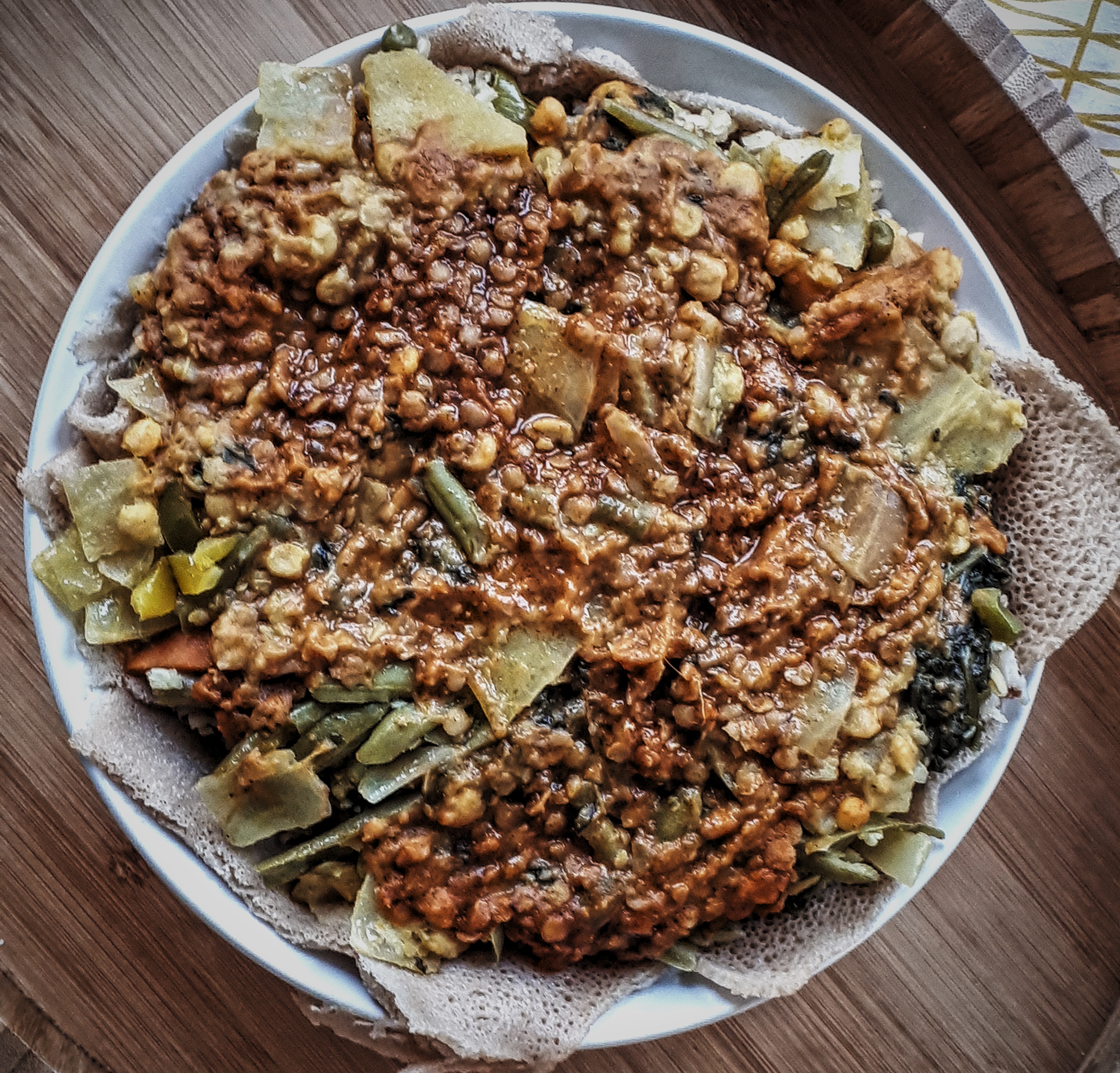
Beautiful, tasty and well-presented food
(photo by the author)
The menu’s simplicity betrays its tastiness. There’s only the sampler platter to try. This is a six-dish mix of spicy lentil stew, greens, spiced potatoes and onion, two split peas and some vegetables. This is usually served with either rice or injera, the traditional Ethiopian bread. I would strongly recommend choosing the latter.

I’ve written in this section before about Ethiopian food. Andu’s food is as good as Mesi’s Kitchen’s, even though the latter’s menu is far more varied.


The gomen were nice and crunchy. The yesimir wot (lentil stew cooked in a Berbere sauce) was well seasoned. The lightly curried mix of cabbage, potatoes and onions (tikil gomen) was tender and well cooked.

This is street food the way it should taste: gloriously satisfying and cheap. As London prepares to open up the doors of its cafes, restaurants and pubs, Andu’s should be on everyone’s list. Whether to sit in or take away, it won’t matter, the grub will still be good.

Wednesday, 30 June 2021

Meals on (Two) Wheels: Accra Palace in Upper Clapton

Who cares where jollof rice comes from when the food is this good?


The Third World War – if ever there is another one, that is – won’t start over oil or territories. No, the next world conflict will probably kick off over the provenance of one of Africa’s most delicious and emblematic dishes: jollof rice.

The coordinates we can agree on: West Africa. We can also trace its roots back to the Senegambia region, in the ancient Wolof or Jolof (see?) empire. But that’s about it. Things get a bit murky thereafter. Senegalese, Gambians, Cameroonians, Liberians, Nigerians and Ghanaians all claim ownership of this iconic recipe.

Accra Palace on Upper Clapton Road is not interested in murkiness. Its business is food. And food – good food – is what it delivers. Over time I’ve become a regular, especially when my former favourite Ghanaian restaurant, Rebecca’s in Edmonton (Enfield), is no longer within easy reach.

The dish in question (photo by the author)
The restaurant’s location is excellent. Sandwiched between Stamford Hill’s long-established Orthodox Jewish community and an already hipster-driven, gentrified Hackney, Accra Palace adds a multicultural touch to what used to be a rather drab, drive-through area.

What I love about Accra Palace is both its service and grub. Both come with a smile. My usual fix is jollof rice, fried chicken and plantain. The rice is loose and soft. I once asked one of the staff at Accra Palace what type of rice they used and she told me that they favoured long grain rice (Thai or jasmine).


The other element that makes jollof rice such a distinctive West African staple is its spice mix. In the Ghanaian version warm spices are used most of the time. This means clove, nutmeg or cinnamon. Something else that sets Ghanaians apart from other jollof rice-consuming West African countries is their use of the same protein stock (beef or chicken, for instance) to simmer their dish.

None of the above answers the one million-dollar question: where does jollof rice come from? But as long as we have places like Accra Palace, the provenance is irrelevant. Only the food – and good food at that – matters.

Wednesday, 12 October 2011

Bamako (Review)


I still remember the first and only time I watched the movie Waiting for Happiness, Abderrahmane Sissako's meditation on migration. It was at an African film festival I had curated and managed and the feature was amongst a number of obscure submissions over whose reception I was fretting somewhat. Yet, I, and the rest of the audience were blown away by the director's subtle images of sand and sea, juxtaposed with a feeling of otherness and a state of limbo.

Whereas in Waiting for Happiness the setting is all whitewashed buildings and almost total tranquillity, Bamako is the opposite. The movie centres on a court case in the Malian capital where the plaintiff seems to be Africa itself and the accused are the World Bank, the IMF and other corporations. Beyond the premises there's the hustle-bustle that characterises an African city. However, to say that the court case is at the centre of the film is somewhat misleading because there are other subplots that are as interesting as, if not more interesting than, the main one. There're the marriage problems between a nightclub singer and her unemployed husband. There's also a photographer, who works part-time for the police, and who records marriages and funerals, choosing the latter over the former because they're 'more real'. There's even an out-of-this-world (and some might think totally unrelated) scene where people are watching a spaghetti western called Death in Timbuktu, starring Danny Glover and the Palestinian film-maker Elia Suleiman.

Sissako's achievement is in presenting an Africa that speaks with its own voice and in its own language. His intention is to celebrate the dignity of those who have very little but without displaying any kind of self-pity. At the same time he avoids the usual pitfalls of laying all the blame at the doors of those who are better off. During the court proceedings we hear stories from both sides. Some of the witnesses are very articulate and others aren't. The magic of the film lies in the combination of an off-the-cuff approach (Sissako has a reputation for hiring non-actors) and a calculated and sophisticated one, especially when it comes to the photography and setting.

The result is a stunning film where the viewer is challenged to come up with his or her own answers and where the protagonist, Africa, gets one of those rare chances to speak its mind. Another one not to miss.

© 2011

Next Post: “Sunday Mornings: Coffee, Reflections, Music and Dance”, to be posted on Sunday 16th October at 10am (GMT)


Thursday, 11 September 2008

Killer Opening Songs (Habib Koité - Batoumambé)


After the onslaught of Anglo-Saxon music we had last weekend (with some Spanish thrown in for good measure) as part of Radio Freekinternational, Killer Opening Songs will be focusing mainly on instrumental music, as well as performers from non-English speaking nations for the next few days.

And what better way to make this wish come true than to start with Malian guitarist Habib Koité?

Habib is one of Africa’s most popular and recognized musicians. Born in 1958 in Thiès, a Senegalese town situated on the railway line connecting Dakar to Niger, Koité comes from a noble line of Khassonké griots, traditional troubadors who provide wit, wisdom and musical entertainment at social gatherings and special events. He grew up surrounded by seventeen brothers and sisters, and developed his unique guitar style accompanying his griot mother. He inherited his passion for music from his paternal grandfather who played the kamele n’goni, a traditional four-stringed instrument associated with hunters from theWassolou region of Mali. His sound sometimes is very close to the blues or flamenco, two styles he studied under Khalilou Traoré a veteran of the legendary Afro-Cuban band Maravillas du Mali (hmm... you see? There's an expression of interest here). Habib's uniqueness lies in the fact that he brings together different styles, thus, creating a new pan-Malian approach that reflects his open-minded interest in all types of music. Koité has played at most of Europe’s major venues and festivals, including the Montreux Jazz Festival, WOMAD, and the World Roots Festival.

The track Killer Opening Songs brings you this week appeared in his 2001 album, 'Baro', a musical crusade on behalf of traditional Malian instruments like the harp-like kora, the lute-like ngoni, the balafon and the wooden xylophone. 'Batoumambé' is a beautiful melody by an impressive performer with one of the most enthralling voices I've ever heard. Enjoy.


Copyright 2008

LinkWithin

Related Posts Plugin for WordPress, Blogger...