In the opening paragraph of 'The Mystery of Marie Rogêt', Edgar Allan Poe writes: 'There are few persons even among the calmest thinkers, who have not occasionally been startled into a vague yet thrillingly half-credence in the supernatural, by coincidences of so seemingly marvellous a character that, as mere coincidences, the intellect has been unable to receive them. Such sentiments - for the half-credences of which I speak have never the full force of thought - such sentiments are seldom thoroughly stifled unless by reference to the doctrine of chance, or, as it is technically termed, the Calculus of Probabilities. Now this Calculus is, in its essence, purely mathematical; and thus we have the anomaly of the most rigidly exact in science applied to the shadow and spirituality of the most intangible speculation'.
Of course, Poe was chiefly referring to the phenomenon that Chevalier C. Auguste Dupin, the mastermind behind the solutions to puzzles such as The Murders of the The Rue Morgue, scrutinised, analysed and broke down into pieces. But coincidences, if well used, can be and are the backbone of many great novels.
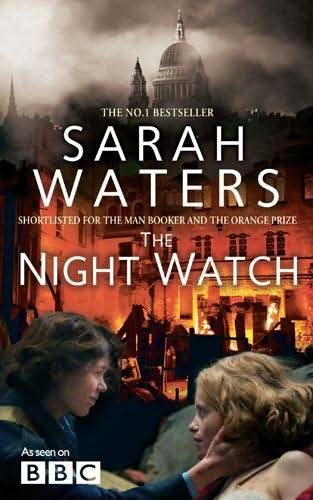
In 'The Night Watch', for instance, Sarah Water tells the story of four characters who are linked to one another by their experiences in wartime London. The way she weaves their personal stories together reminded me of Poe's words, only that in this instance this happenstance is more cause-and-effect than random, as there is a war going on and naturally people gravitate to wherever safety beckons.
'The Night Watch' is an interesting novel in that it uses reverse chronology. It travels from 1947 (first chapter) back through the heavy bombardments of 1944 (second part) to the end-of-the-world atmosphere of 1941 (final episode). Thus we meet the characters through the consequences of their actions, and journey back to what caused them.
The book opens with Kay, one of the main characters, being observed by Duncan - another leading personage - and the latter thinking her a left-over from the global conflict that has just finished. It is chiefly Kay's man's clothes and alertness that lead him to see her in this light. But it's not just Duncan who has this opinion of Kay; passersby, too, jeer at her appearance. Unfortunately they cannot read her thoughts, nor realise that it was during the war that her finest hour had come. Driving an ambulance through bombed-out streets, Kay became alive; she got to write the script of her own novel. Now, all she has left in her life are lonely walks through the very same streets whose devastation she witnessed first-hand and cinemas which she often enters halfway through the film.
The other two main characters that make up the leading quartet are Viv and Helen. The former is Duncan's devoted sister and the latter Kay's former girlfriend's lover. Viv is having an affair with a married man, Reggie, whilst Helen feels anxious about her own relationship with Julia, Kay's ex.
Waters's chaotic narrative is an excellent vehicle through which to witness the sense of dislocation of both the leading and supporting dramatis personae. Through Duncan we are introduced to Mr Mundy, an enigmatic 'uncle', who turns out to be a former warden in the prison where Duncan served time for his role in another man's death. Each incident, no matter how minute, is turned into a piece of the gigantic jigsaw puzzle Sarah has made for the reader. At times, 'The Night Watch' reads like a mystery novel; revelation after revelation lets us know how each character's frame of mind came to be.
It would be simplistic to call this book a gay novel, although the narrative centres around the Kay/Julia/Helen emotional hodgepodge. And Duncan's sexuality is also remarked upon. But 'The Night Watch' goes beyond sexual orientation. It is about class - Fraser, the posh man vs Duncan, the working-class one -, friendship (Mickey and Kay driving an ambulance through war-torn London) and above all about moral attitudes. Viv's abortion scene is harrowing; the secrecy surrounding it all the more unbearable to read when one takes into consideration that in 1947, in the UK, a woman interrupting her own pregnancy ran the risk of being prosecuted. Helen's desire to hold Julia's hand in a park and the latter's reluctance and fear to display any kind of feelings towards her girlfriend, shows how far the gay community has come since the Sexual Offenses Act was amended in the 60s and homosexuality decriminalised.
It felt somewhat strange, at least for me, to read a novel that is preceded by three others I have not read yet. It is almost like arriving at a dinner party as the dessert is being served. But Sarah Waters is a compelling writer. Passages like the following one (Duncan and Fraser in prison after another night air raid has finished and the latter winds up in the former's bed) render the novel its humane and affectionate nature: 'They moved closer together, not further apart. Duncan put up his arm and Fraser raised himself so that the arm could go beneath his head. They settled back into an embrace - as if it were nothing, as if it were easy; as if it weren't two boys, in a prison, in a city being blown and shot to bits; as if it were the most natural thing in the world.'
Copyright 2009
Next Post: 'Sunday Mornings: Coffee, Reflections and Music' to be published on Sunday 1st November at 10am (GMT)


