Showing posts with label Wolf Hall. Show all posts

Saturday, 7 March 2015

Saturday Evenings: Stay In, Sit Up and Switch On

The mumbling is gone. The dark lighting has faded. The slow-paced action is no more. The queen’s head has kissed the neck goodbye and rolled down. To the relief of some, Wolf Hall has ended.

Count me out of that group, please. I loved the series.
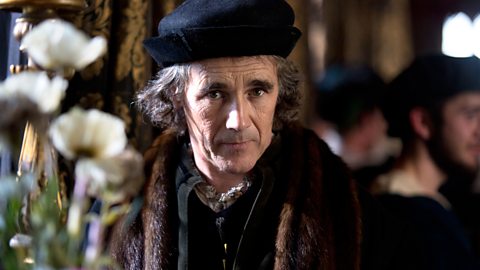
Mumbling? Moi?

For those who do not reside on the British Isles and who are therefore not familiar with the recent six-week-long BBC programme, let me explain. Wolf Hall is based on the first part of a trilogy of historical novels by the British writer Hilary Mantel. The author, currently working on the third and final instalment, stands to score a hat-trick of Booker Prizes after Wolf Hall and its follow-up Bring Up the Bodies won her the award.

I had my doubts about the series, if I am being honest. There has already been one adaptation for theatre, so when the BBC version was announced, I somehow conjured up the words “cow” and “milk(ing)” unconsciously. How wrong I was.

I no longer judge literary adaptations for television, film or theatre in the same way I did twenty years ago. Each medium has its own language and deserves to be seen and analysed in its own right. That is how I approached Wolf Hall and I was handsomely rewarded.

The reworking of novel to series did not follow the original text to the letter and I know I was not the only one who appreciated this. There is a way in which the main character, Thomas Cromwell, is introduced by Mantel that is unique and unrepeatable. She feeds us titbits. Instead screenwriter Peter Kosminsky brings in a foreword in each episode in order to provide a historical context. Rather than dwelling on Cromwell’s past, he goes straight in to present-day Henry VIII’s court and gives us flashbacks to Cromwell’s previous life as a way of explaining how he arrived at the position he occupies now.

Along the way we have excellent performances. Mark Rylance, of whom I had already heard a lot due to his role in Jerusalem, is outstanding. His is a masterclass on the art of “less is more”. The way he acts out his part is like a tiger, crawling, stalking, hiding, until the moment comes to jump upon its prey. His manner is understated in Henry’s presence. Away from him, he is all alpha male. Daniel Lewis, playing Henry VIII gives us a nuanced performance. I cannot remember the last time I saw a Henry VIII that was not a caricature of the famous king. Lewis’s Henry, on the other hand, is vulnerable but irascible. Claire Foy as, the first plotting and later on hapless, Anne Boleyn, also rises to the challenge. Her encounters with Cromwell are full of the intrigue and back-stabbing so common in European courts at the time. Her transition from English to French and back to English is flawless and effortless. The fact that we all know the queen’s fate does not detract from a suspense-ridden finale. I confess I had to divert my eyes away from the screen as the executioner hoisted the sword above his head.

It is not just the performances that make Wolf Hall a must-see. The lighting is top-notch, too. An example of this is Cardinal Wolsey’s glowing red silk robe against the dark corridors of his residence.

Some viewers complained of too much mumbling and poor articulation. My thoughts on that are that when you are plotting against Rome or the king of England, the less audible you are the longer you live. The dim lighting took a battering as well. Yet, how to recreate 16th century England, or for that matter France, without resulting to natural light, or the lack of it thereof?

It is a paradox that a lot of people lay into the Beeb and question the TV licence most of us pay annually to keep Auntie going. Yet, when the BBC produces an outstanding series like Wolf Hall, many slag it off.

Final word from me. As long as you churn out programmes like Wolf Hall, keep up the mumbling, Auntie!

I recently went to see Selma with my wife on what turned out to be a double date on Valentine’s Day. One of my wife’s brothers came along with his partner and their daughter stayed home with our daughter; the two cousins catching up together.

Selma was a lot better than I expected. The performances from both leading and supporting actors were excellent. They carried the emotions that their roles demanded. What stood out for me the most was to see three British actors portraying one of the more significant moments in the history of the US and pulling it off. David Oyelowo as Martin Luther King, Tom Wilkinson as President Lyndon B. Johnson and Tim Roth (in a smaller role) as Governor George Wallace made me forget completely that the three men on screen had been born in Oxford, Leeds and London respectively, so convincing were their accents.

And would you believe it? Hardly any mumbling at all.


© 2015

Next Post: “Piece of Me, Pieces of Havana”, to be published on Wednesday 11th March at 11:59m (GMT)

Wednesday, 23 March 2011

Of Literature and Other Abstract Thoughts

"... Home, where my thoughts escape, at home, where my music's playin'
Home, where my love lies waitin' silently for me..."

'Homeward Bound' (Simon and Garfunkel)

Everytime I come back to my London home from a trip abroad there are a handful a songs I have to play as soon as I saunter through my front door. These are tunes that exude domesticity, comfort and warmth. One of them is that timeless classic by Art and Paul, 'Homeward Bound'. The melody works at several levels for me but it is in the chorus where it takes on a special meaning. The 'thoughts' that 'escape' in the track, represent my memories, both conscious and unconscious (it also works when I go back to Cuba; that's also 'home', obviously). The 'music' stands for my domestic surroundings: the familiar sounds, the ordinary lights and the instantly recognisable furniture. Finally that 'love' of which Simon and Garfunkel sing is my next-of-kin; both in Cuba and here in GB.

However, away from the world of D minor chords and C majors, that song also represents how I feel sometimes about certain books. Especially those penned by authors whose works I have never read before and yet they immediately make me feel 'at home'. Have you ever come across a writer whose name might have caught your attention but of whose oeuvre you are unaware? Maybe you've even read the odd little non-fiction piece in a newspaper or magazine, but still, you have not quite got around to dig into their proper opus. When that happens, I tread carefully, especially if the work in question comes with a few awards attached. What if I don't like it?

Nevertheless, that initial apprehension is soon overcome because of the way the writing reflects my preferences. This is not to say that the author's writing is a replica of someone else's. It's based, rather, on how the writer taps into areas of my brain that lead me to that 'homely' feeling. One of them is the one labelled 'humour'.

There's a difference between comic novels/short stories and novels or tales that contain a high level of facetiousness. I rarely come across the former (unless I'm reading Woody Allen, then again, that's almost like an extended version of his erstwhile stand-up act), but I absolutely love the latter. The late Virgilio Piñera, Chimamanda Ngozi, Borges and Kundera are good examples of how serious works of fiction needn't be po-faced. These writers, and many others, achieve hilarity without compromising their narrative. In Ngozi's 'Half of a Yellow Sun' there's plenty of tragedy since the novel is set during the Biafran war. At the same time there are moments of pure mirthfulness that render the piece effortlessly graceful. Not having been exposed to her work before, I finished reading 'Half of...' thinking of delving into her previous novel 'Purple Hibiscus' as soon as possible. Part of the motivation was based on her sense of humour.

When I mention humour in novels and short stories, I don't mean the thousand-laughs-a-minute type. In my case I prefer the slow-cooking, thoughtful kind. It is comicality not as buffoonery, but as wit. Especially when you decode references in a passage that might otherwise be irrelevant. This is the sort of humour that breeds a strong intimacy between reader and writer.

The most recent example I've come across lately is Hilary Mantel's 'Wolf Hall', a historical novel of gargantuan ambitions. What makes Hilary's work so enjoyable is her unconventional approach. She writes about a historical period well covered in schools: Henry VIII's kingdom, his lack of a male heir and his tussle with the pope. However, she injects each character with a believable and dynamic personality. And one of the key elements in making her story believable is her use of humour to convey the deep changes occurring in England in the 1520s.

Recently, the author Howard Jacobson, winner of the Booker prize 2010, wrote "Show me a novel that's not comic and I'll show you a novel that's not doing its job." I half-agree with him and half-disagree. 'Wolf Hall' is not a comic novel per se, and yet it contains many laugh-inducing moments. These become more poignant as we learn of Thomas Cromwell's difficult childhood (he had an abusive father) and the misfortunes that befall him and his family when he loses both his wife and his two daughters. Cromwell's dry and warped sense of humour match his no-nonsense approach to life and it is this fortitude of character that ultimately leads him to become Henry VIII's chief operator. What I think Jacobson is saying in his essay is that novels that lack humour, fail to convey what I call the 'plausibility of life', that fine line between accepting what's happening in a book as an alternative reality (albeit a temporary one) and an outright impossible scenario. We're all aware that it's very unlikely that cars will ever be possessed by supernatural forces, but still that won't deter people from reading Stephen King's 'Christine' and sympathising with Leigh Cabot, the vehicle's main target. Incidentally, if my memory serves me correctly there's hardly any humour in that novel. Come to think of it, after reading my fair share of King's books, I don't recall much mirth in them. Something to consider.

I do agree with Howard that fun should be as much part of a novel's DNA as a strong plot and credible characters. It won't hurt anyone, let alone publishers, in these times of distress and economic uncertainty to include a caption like 'this book is seriously amusing' in the novel's cover. However, a piece of fiction where you're reading jokes from beginning to end is neither taking itself too seriously nor the reader. If I want unadulturated comedy, I'll tune into 'Never Mind the Buzzcocks' on a Monday evening, thank you very much.

Hilary follows in the footsteps of many novelists who have used, or used in the case of those who are no longer amongst the living, humour as an incidental tool. Cervantes did it with 'Don Quijote de la Mancha'. In fact, most people remember the magnum opus of Spanish letters more for its delusional protagonist, his illiterate squire and the absurd adventures they encounter on their way than they do for its groundbreaking literary approach.

In the same way that Simon and Garfunkel's song always reminds me of the comfort I find back home when I return from a trip abroad, humour in a novel, especially one that first introduces me to an author's work, feels as cosy as a quilt on a winter night. Silently cosy.

© 2011

Next Post: ‘Sunday Mornings: Coffee, Reflections and Music’, to be posted on Sunday 27th March at 10am (GMT)

LinkWithin

Related Posts Plugin for WordPress, Blogger...