Showing posts with label Radiohead. Show all posts

Sunday, 7 July 2013

Sunday Mornings: Coffee, Reflections and Music

The question is: what to do when you like an artist but strongly dislike her/his political naiveté? Or when you agree with their political stand but don’t rate them highly as a creative power?

I was musing over this dilemma recently after I chanced upon a column by the Chinese artist Ai Weiwei. His subject was the recent NSA scandal and how, in his opinion, the US was beginning to behave like China. I wrote about that subject myself a few weeks ago and in my opinion Ai Weiwei should change that “beginning to” with immediate effect. The West has behaved like the totalitarian regimes it criticises whenever it has been convenient for its interests.

But that’s not the point I am trying to make. The point is that Ai Weiwei’s article was well-written and balanced. I was not surprised about it. I have read similar features by him about his homeland in the past and he always comes across as a very rational and intelligent person.

Would you like some art with your seeds, please?
I can’t, however, say the same about his art. I know that this is my personal opinion and that art is subjective most of the time. Nevertheless, whenever I am confronted by one of Ai Weiwei’s pieces or installations my initial reaction is one of froideur. The one exception was a couple of years ago when I went to see his “Sunflower Seeds” exhibition at Tate Modern. Though befuddled at first I got the concept fairly quick. The “seeds” were nothing but unique, small porcelain works, that sought to explain, through their similarity, the notion of the “Made in China” phenomenon. Here was a strong, social message. Just like his articles. I, too, liked his Remembering installation. This work was made up of 9000 children’s rucksacks with the caption on each of them “She lived happily for seven years”, a quote from the mother of one of the children who died in the Sichuan earthquake in 2008.  Fair to him, most of Ai Weiwei’s artistic output is focused on China and its domestic problems. But would we pay attention to his writing if his fame as an artist (he has had exhibitions in Australia, Europe, North and South America) didn’t precede him? That’s the key issue for me. It’s not whether an artist has or hasn’t got the right to debate difficult topics, especially when they have first-hand knowledge of them, but whether the public would value their opinion if it were not supported by a fine reputation as creators.

At least Ai Weiwei concerns himself with China mainly. Bono (no need to explain who he is and what he does) wants to change the west’s attitude about a whole continent: Africa. But the way he is going about it makes it hard for pragmatists like me to believe him. Here’s a man whose music with his band U2 I worship, especially the earlier albums. However, ever since he became missionary-Bono, saviour-of-Africa Bono and new-Jesus-in-town Bono, his stand as a musician has taken a knock, in my view. He still fills up stadiums, of course, but those who come to U2 for the I Still Haven’t Found What I’m Looking For and Sunday Bloody Sunday melodies feel let down by this change of trajectory. The problem with Bono is that he has lent credibility to statesmen who had lost theirs. For instance the architects of the invasion to Iraq, George Bush and Tony Blair. Bono has made corporate power cooler and funkier (it even wears shades). Unlike Ai Weiwei, who finds very little resistance to his stand against the Chinese government (except for the actual Chinese government, obviously) from those who also admire his art, Bono has polarised his followers. There are those who think that his patronising tone towards Africans has done more harm than good, yet still rate him as a very talented singer. Others believe that his role in raising awareness of Africa and its problems has been vital. I belong to the former camp.

Perhaps I am being a tad bit unfair on the U2 frontman. After all, we know from what we see on telly during the BBC Children In Need’s donathon that if celebrities don’t endorse a particular cause, it’s unlikely the public will cough up for it. In that sense Bono is useful. Furthermore, the flipside of a famous artist campaigning on behalf of a nation – or continent – is an egocentric, dumb celebrity for whom the world of news is only the one that revolves around them.

So, what to do when you like an artist but strongly dislike her/his political naiveté? I focus on what made that person notorious in the first place. In the case of Bono, it was U2, its music and its power to convey a message that was primarily musical and on occasions, social. It makes it less difficult to ignore his sanctimonious attitude (and don't even get me started on his tax affairs). How about when you agree with an artist’s political stand but don’t rate them highly as a creative power? I honestly don’t know the answer to that question. Most of Ai Weiwei’s art still leaves me cold, which means that paradoxically, I look at him as a social activist first and as an artist second. I have never spoken to Ai Weiwei but I reckon he would like me and others to flip that view around. His writing, however, remains incendiary. And may it continue to be so.

© 2013

Next Post: “Urban Diary”, to be published on Wednesday 10th July at 11:59pm (GMT)


Sunday, 8 May 2011

Sunday Mornings: Coffee, Reflections and Music

Imagine the following scenario:

You meet someone who makes you feel special. From the word go there's that little spark, that magic that comes as a consequence of falling head over heels for their eyes, their accent or their laughter. Years later, when you look back on that relationship, long dead, you remember how at first he/she 'moved like the sunset'. Let's also add that he or she comes from up north, wherever that north might be in your country of residence. You think you'll be OK.

But OK, you're not. The relationship with your 'northern lad' (lass?) turns out to be a half-baked cake affair. An unmoistened liaison that leaves you 'only wet because of the rain'. Tucked under your duvet you lose hope little by little, craving warmth and companionship but knowing that outside "it's gets so fucking cold..."

I can see why Tori Amos uses the 'f' word in 'Northern Lad'. It's one of those rare examples where swearing is perfectly justified and understandable. You offer your whole self to another person, warts and all, only for your partner to throw it back at you, highlighting flaw after flaw after flaw. Or what he/she might are your flaws and in reality they're just your quirks. And don't we all have quirks?

I've always hated lazy and mindless cussing in songs. The kind that seems to spring up when inspiration and talent are not abundant. Too much contemporary music comes across as a ready-to-drive vehicle for profanity. The type you might find in the discounts section at your local supermarket. Get two swearwords for the price of one.

But occasionally, you find certain passages in melodies in which only a strong word, or one that is not normally used in polite conversation, will do. Queen's "Death on Two Legs" would not be the hard-rock, top-quality ranting it is were it not for Freddie's "But now you can kiss my ass goodbye". It's done angrily but with élan. The same finesse is found in another record by the same band, "Let Me Entertain You", from their 1978 album 'Jazz':"We'll have a son of a bitch of a time". It's all to do with context. This is a song about a group that are "Gonna rock you gonna roll you/Get you dancing in the aisles/Jazz you razzmatazz you/With a little bit of style". Very different from 50 Cent's 'Candy Shop' where his promise (or should that be a threat?) to 'take you to the candy shop/I'll let you lick the lollypop' is enough to pull out a gun and blow your brains off. His reference to oral sex is as subtle as an anti-monarchist ripping a picture of Wills'n'Kate into shreds in the middle of the Mall and calling it a 'nuanced republican statement'.

Pop songs are so brief (only between three and three and half minutes long) that if you want to include a couple of 'naughty' words, you'd better hit the right spot quick and effectively. Radiohead's 'Creep' is a good example. In this paean to a woman (methinks it's a lady the object of the singer's affection), Thom Yorke plays the oddball who falls for an 'angel'. All the signs of infatuation are there: her skin makes him cry, he thinks that she floats like a feather in a beautiful world. That's why he wishes he was special. But he isn't, and then Thom and co. deliver the masterstroke. In talking to the woman (probably when she isn't looking), Mr Yorke cries out: "You're so fucking special". What makes the 'f' word stand out is that it sits at odds with the beautiful and poetic language Radiohead uses in the rest of the song. Moreover, this swear term is only ever utilised as a refrain, thus, creating a chorus of disappointment and despair. Finally, unlike Tori's 'Northern Lad', in 'Creep', the protagonist is not interested in his lover's faults; on the contrary, he idolises her.

Another way of interpreting the profanity in 'Creep' and the reasons for it, is to analyse the second verse: "I don't care if it hurts/I want to have control/I want a perfect body/I want a perfect soul". In those desperate lines there lies probably one of the strongest criticisms against the bodyfascism that has come to rule over our contemporary world in recent years. Alternatively, Radiohead was just taking the piss. And given the theme of today's column, I feel more than justified in using that kind of language. Have a brilliant week!

© 2011

Next Post: ‘Food, Music, Food, Music, Food, Music… Ad Infinitum’, to be published on Wednesday 11th May at 11:59pm (GMT)


Sunday, 28 February 2010

Sunday Mornings: Coffee, Reflections and Music

Appropriate size? Tick. Flat-panel display? Done. Variety of brands from where to choose? Mais, bien sûr! Colour images like those found in LCD technology? Hmm... let me get back to you on that one.

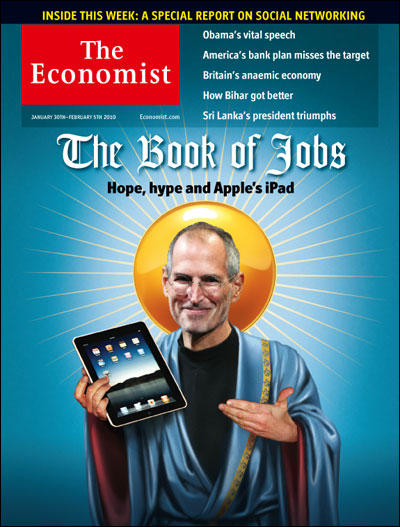
Who would have guessed it? That at the eleventh hour and after Steve Jobbs's hagiographic treatment on the cover of The Economist recently, e-readers devotees would be so glib so as to quibble over colour preferences. Or lack of them thereof.

As users of modern reading gadgets such as Kindle and Nook have discovered, their new toys are far from the Avatar-like sophistication which trumpeted their arrival. I guess someone forgot to update the bugle's App. And if you note a dollop of Schadenfreude in my post today it's because I am still sceptical of the e-book phenomenon.

With a self-assurance more commonly found in cocky roosters, new reading devices arrived en masse almost at once. And straight after, police were called to the scene of the crime (or 'launch', as many still prefer to call it) to declare the traditional book dead. No autopsy, no second opinion. Dead. Asphyxiated by paper surplus. However, little did the experts know that some of us, real literature lovers - as in palpable, touchable literature -, were just getting ready for the long battle ahead. Oh, boy, and what a battle! Tony Blair and George W Bush still wonder where Saddam Hussein's WMDs are. They're under my bed! And they are already aiming at a few targets: Kindle, Sony e-reader and STAReBOOK to name but some.

And would you believe it? Before we've even shot the first salvo of this literary epic war, the e-book camp has had its first casualty: colour.

Unlike mobile phones and laptops where the latest LCD technology makes it easy for the reader to view content, e-books are dependent on E Ink displays. The biggest downside is (rubs hands in glee) slow updates as you turn the pages and colours; they are hard on the reader's eye. Well, change to LCD, I hear your beautiful chorus sing. Not so quick, my chiquilines. LCD gadgets are battery-hungry monsters that could harm your eyesight if you expose yourself to them for a long period. Other technologies are simply beyond financial reach.

According to Steve Haber, president of Sony's digital reading division, 'the ideal e-reader display would combine excellent battery life, a paper-like reading experience, full colour and a response-time fast enough to suppport video - while also being affordable' (The Economist, 12th December 2009). Wise words, but my response to his comment is: Paper-like reading experience? Whatever happened to real paper?

Luddite I'm not, just in case the image of a caveman struggling to make fire with two sticks flashes suddenly in your mind. My approach is more from the variety angle. I'm all for the e-book if it means wider choice, not if it comes bearing a hood and leading the traditional book by the elbow to the guillotine. And yet it's the latter example the one that'll become the likelier scenario. On the one hand, the e-book is easier to carry around (I bet you'll miss dog-eared novels and pages yellowed by the passage of time) and more financially viable in the long term, especially for students (Really? One word, well, two compound ones, second-hand bookshops). It is also a quicker and more approachable format for scholars to access content since it accommodates more text (that'll put antique furniture stores out of business. Plus IKEA. No more bookshelves). On the other hand the history of display technologies is not awash with successess. Only a handful of them have satisfied the market.

However, it seems that there's been a breakthrough. Mirasol is a new electronic display developed by Qualcomm, one of the leading companies in the mobile phone industry. It is similar to E Ink in reflecting ambient light but it uses two layers of mirrors instead.

Fine, I see you gathering your troops, e-reading gadgets. I, in the meantime, will sharpen my lance and sword, saddle up my old Rocinante and call upon my loyal Sancho Panza. Windmills, here we come!

Copyright 2010


Next Post: 'Living in a Bilingual World', to be published on Tuesday 2nd March at 11:59pm (GMT)

Tuesday, 4 March 2008

Road Songs (Langsam)


Back in the summer as we were making our way back home from sunny Dorset (although it did rain cats and dogs during our first three or fours days there) my mind wandered off into a territory of its own, as it sometimes does. When my mind does this I never try to reel it back as the outcome of its escapades is often very pleasant thoughts. And so it was on this occasion. The minivan we were in fitted roughly just over a dozen of people and after stopping at the Winchester Motorway Services, we headed off again back to London, some reading, others in a stupor, I, thinking. It was then that my wife asked me if I felt like returning to our house to which my reply was yes. Next, she asked me what I fancied doing most once back in our lair and my response was once again succinct: listening to some music.

During our stay at summer camp as every year we had a lot of fun; we went on walks, swam in the ocean and built bonfires in the evenings. But as it is also customary during this time there was no music blaring out from stereos. Recorded music is not allowed and it has always been a ground rule that I unwittingly challenged the first time I went when I decided to listen to my CD player on my own. No one said anything except for my wife who called this matter to my attention.

Cue three years later and our fourth stay and I was really craving C minors and arpeggios by the time we were about to come back to London. So, whilst I was sat there on the minivan I pondered upon the songs that would have accompanied me on this musical odyssey if I had been driving the same route. Several traffic jams helped me reach my decision and I feel tempted to write about them, too, but I think that these phenomena deserve a post themselves.

So, here they are, songs to listen to whilst driving back from summer camp.


Copyright 2008

LinkWithin

Related Posts Plugin for WordPress, Blogger...