- Pardon? - ¿Qué es esto para? - Hmmm... I don't understand, nena.
- ¿Qué. Es. Esto. Para?
- I. Do. Not. Understand.
I did understand, mind, but I was playing dumb. Because the mistake Daughter was making was the same slip-up I had often borne witness to whenever I was in the presence of British children speaking either Spanish or French.
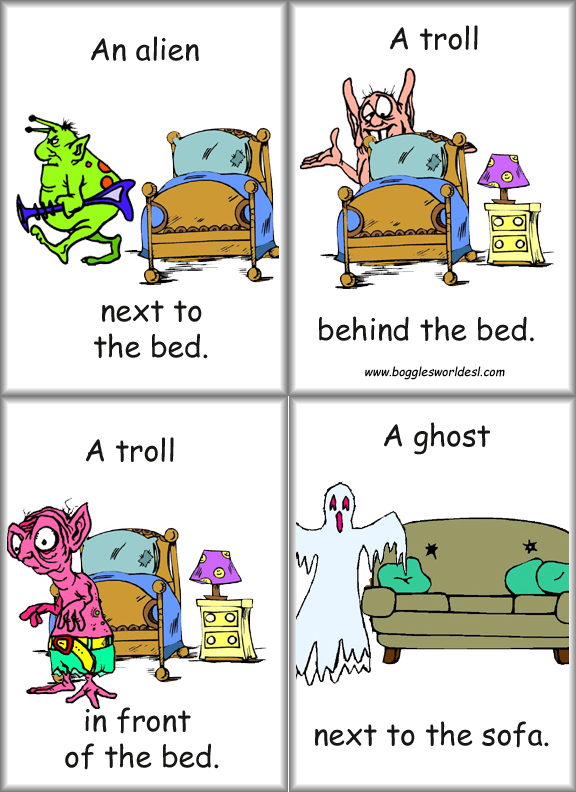
To be honest with you, my dear fellow bloggers and readers, Daughter's error was a baby blunder. Daughter was placing the preposition 'para' at the end of the sentence rather than at the beginning. Whereas that would be common practice for an Anglo-Saxon speaker, in romance languages we keep to a strict structure whereby prepositions are usually placed before nouns, pronouns and other substantives to form phrases functioning as modifiers of verbs, nouns, or adjectives.
In English, as well as German, prepositions can be used at the beginning of a sentence (For whom are we waiting?) or at the end (Who are we waiting for?). Note the difference of 'whom' and 'who'. That's another post. In Spanish the question Daughter was asking me made no sense whatsoever because that 'para' must be placed at the beginning of the sentence. That's why I did not translate the phrase; it would have made sense to an English-speaker. I know for a fact that there are some exceptions in French (any Francophone reading this post, please do get in touch) but I cannot vouch for either Italian or Portuguese; I think it's the same structure as in Spanish.
However Daughter was not totally wrong.
Apparently this habit of ending sentences with a preposition in English is not very old. Schoolchildren used to be told by their teachers (probably influenced by Latin) that finishing their phrases with a preposition was a no-no. This was famoulsy satirised by Winston Churchill who said: 'this is the sort of English up with which I will not put'.
And if we analyse the etymology of this word, preposition, we see that in Latin (praepositiōn) the term meant 'a putting before'. What happened, in my humble opinion, was that English syntax, lax as it's always been, allowed for final placement of the preposition, as in 'We have much to be thankful for' or 'I asked her which course she had signed up for'. A little Teutonic influence should not be ignored as in German 'split verbs' are very common and they tend to place the preposition at the end: 'Wen wartest du auf?' (Who are you waiting for?)
So, yes, Daughter was not totally incorrect. She just chose the wrong language.
There are words in some languages that are enticingly built for pleasure. These are terms that roll off the tip of our tongue with no brakes on, falling blithely into a realm of self-indulgence and hedonism.
The Portuguese word saudade is the only term I know of whose meaning escapes the borders of linguistics and enters the kingdom of emotions and feelings. For starters it is an ambiguous term, as in it hasn't a definite meaning. Depending on the context it is used in it can convey different ideas. I have seen it translated as 'longing' in English, but even that is rather misleading as it can also signify 'joy'. Everytime I hear it, it catches me unawares in the same way someone who steps on the back of my shoe in the underground does.
In order to write this post I e-mailed my dance students (many of which speak Portuguese) and fellow dance tutors (some of which come from Brazil, Angola and Portugal) and asked them to give me their definition of saudade. I have included some of their replies below (no contribution has been altered or edited). As you will see their responses are not clear-cut and exact. And how can you be with a word whose significance is chiefly affirmed by the speakers who utilise it? And by those of us who, though not able to speak the language fluently, appreciate the feelings evoked by one of its linguistic jewels.
This is from Mireilla, a long-standing dance pupil of mine:
What about nostalgia or a yearning,nostalgic longing?
Francesca, on the other hand, has one of her co-workers help her out with my enquiry:
My Brazilian colleague says: it can mean positive but also negative feelings, such as missing somebody or something from the past, feeling blue or nostalgic. There is no such word in English.
Mariana could hardly contain her enthusiasm when she received my electronic missive:
hello, what a lovely email to receive
i'm half brazilian and half english, born in sao paulo raised in london, bilingual and work in theatre and dance. i think you touch on the wonders of bilingualism. i think i once read or someone once told me that with every new language we learn a new way to see and experience life, new ways to live and as a theatre practioner interested in multi lingual performance i discover something new in this way every day, but the best thing about it is that there is no absolute. language changes according to the meaning needed at the point in time, by who speaks it and where they are, and how beautiful is that!
anyway im sure you know or have you own views on this as a linguist, but i thought id write these words down as i feel the beauty of what you hit upon is that we dont always need to rely on one definition, conflicting and differing ones can also be valid.
Saudades Carinho and Companero are my favourite words in portuguese. Saudades to me in brief is the feeling you feel when you miss someone, therefore it can be however that feeling manifests to you.We dont have a descriptive word for that feeling in english, we have the past action i missed or i am missing which suggests the action that occurs now, and we understand the feeling associated in this way, but we dont actually have a word for the feeling, i dont think. Perhpas longing? but thats not exactly it cos it applies want, and is perhaps melancholy, with sad notionsSaudades is an arduous feeling, we love and hate, i think saudades cements what you feel for someone, your love you friendship you concern with another morfs into another version of itself whilst the other is distant. another one for you just for the hell of it, i thought i understand companero but i was being too literal.an alternative is 'the one you part bread with', few of my english, conservative, capitalist extreme friends could not get their heads around that. i guess our lived experiences no longer reflect that action so much. thank you for a lovely email and giving me an outlet to rant about something im passionate about.
Zela, though not fluent in Portuguese, contributed to the discussion:
I have never spoken a word of Portuguese but now that you share this with me I think its great to know that one word could mean so much that it cannot be explained in English except that we accept it for what it is/ the feeling it brings you when you say it .....The true meaning of love is ultimately the great feelings of joy and prosperity and divine inspiration that comes with so much more that you cant quite put your finger on defining it. Maybe it is the thought that love (Saudade) if it stands for all those things; tenderness, affection and care it is most definately overwhelmingly magnificent! I have left for the end the reply I got from Iris de Brito, an Angolan choreographer and fellow tutor who describes this Portuguese word thus:
Saudade- You are right, its quite difficult to describe in one word.I would say it describes the act of missing someone or something, but it can also be implying a certain melancholy mixed with tenderness and love for the familiar and things we hold most dear.Its present in many songs of Fado in Lisbon, Morna in Cabo-Verde or Kilapanda in Angola, it became a word that described a longing, a sentiment deep set in our hearts.At school we were also told that this word/feeling evolved from the time of the Portuguese Discoveries when women lost their man to the sea and were waiting for them to come back indefinitely.
And in order to demonstrate with images what this word cannot explain in writing I shall leave you with a clip by the Portuguese singer Mariza singing 'Meu Fado Meu'. This is also this week's 'Song for a Winter Sunday Morning. Enjoy, com muita saudade.
'No te pares frente a mi, con esa mirada tan hiriente, puedo entender estrechez de mente, soportar la falta de experiencia, pero no puedo aguantar estrechez de corazon'
Thus sang, not the 80s Southamerican pop rockers Los Prisioneros, but my two children in the car recently with perfectly rolled 'Rs'. They've taken to Latin pop and rock like fish to the water. It all started with Daughter humming and then actually saying the words to Charly García's Raros Peinados Nuevos, one of the anthems that defined my teenage years. Currently Daughter has the lyrics pinned to the walls of her bedroom and once in a while we give it a good go; Charly would be proud. Son followed suit and now we have Los Prisioneros onin the car most of the time.
Today and, according to the Times Education Supplement, it's European Day of Languages, yet, I've not heard anything about it, have you, my dear fellow bloggers/readers/posters? Wouldn't it be a wonder if we could tune in to the good ol' BBC Morning News and see a presenter telling us about recent events in French? Or how about a John Humphreys-like figure (I'm still with the Beeb) roasting a politician in German?
Because I've seen up close and personal how learning Spanish has made my two children brighter, smarter and more culturally aware, it's harder to understand why this is not a priority in the government agenda, especially in the modern and globalised world we live in today. Lest we forget, let's recall that just scarcely a few years ago, David Blunkett, whilst still Home Secretary, called upon foreign parents (yep, that's me, then!), to give up talking to their children in their own language at home and switch to English instead. Yeah, right, Dave, well, if I was to follow your advice, matey, my children wouldn't understand a word of what's being said when we travel to both Spain and Cuba. How do you think one learns a foreign language, Dave? By osmosis? But it's not just the linguistic element that one absorbs when devoted to this activity. It's the cultural one attached to it. Language and culture journey together through the annals of a nation. The mere existence of a particular phrase or word can take you back on a historical voyage to a time and context that you were unaware of to begin with. My son, who translates texts from Spanish to English at present, although reluctantly, has discovered a world of talking rats and honest elephants. Daughter, on the other hand, immerses herself in a realm populated by capricious queens and magical whales. All in all, both, with support from my wife, who speaks Spanish fluently, have found an alternative world that they can flee to and where they feel welcome. In the meantime, they have both taken to singing Chico Buarque's 'Cáliceand learning the words. Portuguese, now, so soon?
 - ¿Qué es esto para?

.JPG)
