Wednesday, 4 June 2014

Of Literature and Other Abstract Thoughts

Not gone, never gone
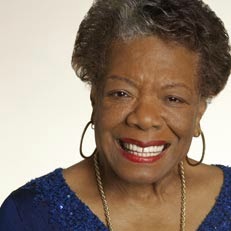
If you were to freeze halfway through the poem Still I Rise and try to define its significance there and then you would be lost in a sea of superlatives. And each one of these superlatives would be as good as if not better than the one you used before: Does my haughtiness offend you?/Don’t you take it awful hard/’Cause I laugh like I’ve got gold mines/Diggin’ in my own backyard. Let those lines slip off your tongue. Let those lines be the slogan on your T-shirt the next morning. Clad in the type of language that shouts out: I’m proud and I’m saying it out loud! Maya Angelou’s anthemic verses have a reach beyond gender, race, sexual orientation, age, creed and (dis)ability.

Maya Angelou died last 28th May. I say “died”. What I really meant was that her body stopped moving, human functions such as breathing, laughing, crying, talking and smelling stopped happening. Maya, however, has not died. How can she? When even non-native English-speaking blokes like me have adopted Phenomenal Woman as one of their favourite incantations? A magical way to scare away the evil spirits of pessimism, machismo and bigotry.

If I were to freeze the moment when I discovered Maya I would have to take you back seventeen years. You and I would have to get on a DeLoran-like time machine and go back to the summer of 1997. Then you would see a twenty-five, almost twenty-six year-old man making his way to a flat in the leafy neighbourhood of Playa. That’s where one of his friends lives. Follow him now leaving his friend’s house with a letter in his hand. Watch him ripping the letter open (it’s from his then-girlfriend, now wife) whilst keeping an eye on the uneven pavement. Look at how he cuts across back streets, jumping over puddles of dirty water streaming its way downhill. And now, see his face. Freeze this frame for it will become a long-lasting memory in his life. His girlfriend is pregnant with their first child, she is in London and he is in Havana. She has included a poem by a poet of whom he has never heard before. Yet, from the word go he feels as if this poet has just dispossessed him of his armour, removed his mask, bared his soul. The opening lines go like this: You may write me down in history/With your bitter, twisted lies,/You may trod me in the very dirt/But still, like dust, I'll rise. Who is she? How dare she?  How does she know...? Questions, questions, questions. But all is in vain. In the presence of greatness we all become momentarily pious. This one altar, we don’t mind worshipping to. This is the altar steeped in antiquity and like a universal language that has been passed down from generation to generation, a language that respects no linguistic barriers (all foreigners welcome!), this altar summons those who give rationality the heave-ho and adopt feeling as their travelling companion in the ocean of Poetry.

If I were to freeze that moment you would see red ice-cold eyes, rock-solid tears caught mid-journey down my visage. That moment would be a snapshot of a discovery. The discovery of a new (at least to me) voice, one who sings out verses that sound as if they have been made of the same material as the leather of a drum or the bow of a fiddle.  Still I Rise ends in what I can only describe as a rapturous, symphonic crescendo. Each preceding stanza is a steady increase in the rhythm, a gradual build-up towards the end: oil wells pumping, hopes springing high, diamonds at the meeting of my thighs.

Maya Angelou did not die last 28th May. She is still asking people to rise. And I, for one, Maya, will never stop doing that.

© 2014

Next Post: “Sunday Mornings: Coffee, Reflections and Music”, to be published on Sunday 9th June (GMT)

Sunday, 1 June 2014

Sunday Mornings: Coffee, Reflections and Music

I once was called an f***ing Cuban n****r. That was about twelve or thirteen years ago when I still worked as a tour-operator in West Hampstead, London. I didn’t bother to file in a complaint. There was only another witness in the room and she was a friend of the person who had insulted me. About a decade before that a friend of mine (or someone I considered to be my friend) called me a “negro de mierda” whilst we were doing our work experience in the Cuban countryside (the phrase translates roughly as f***ing n****r into English because there’s no direct equivalent to the “n” word in Spanish). On both occasions the reason for the racist outbursts was the same: I was the person in command asking someone nicely to get on with their work. In the latter case I had to rouse my “friend” from a deep, post-lunch snooze. I did it ever so gently and yet I still got racially abused.

However, these two examples – amongst a few others – have never been the worst type of racism I have faced in my life. As bad as they sound I knew what to expect from these two racist bigots. My ex-colleague had already shown her (voluntary) ignorance in various subjects to do with race and culture. In the case of my friend who turned out not to be a real friend, there were signs that seemed to indicate that a situation like that would occur one day. I chose to brush off those signs. But no, that was certainly not the worst type of racism I have come across. The worst type has often arrived unannounced and unbidden. It is the kind that comes wrapped in gift paper with little, cute, light-blue laced-up notes that read: “Oh, you can speak four languages! I would have never thought it. I don’t mean to be... uh, err, rac... awkward, but you just don’t look like a polyglot”. Or: “oh, you like classical music? I don’t know why but I had you down more as a hip hop/rap type of guy”. Hmmm... Yep, I love the Tribe (that’s A Tribe Called Quest, by the way) but... I also listen to... oh, well, why do I bother? The other person has cleared.

That is why I wasn’t surprised about the recent findings by a survey conducted by the British Social Attitudes which showed that the percentage of people who describe themselves as prejudiced had risen. What I was surprised about was that people still equate racism to racial prejudice.


But should it not read: why racism?
 
What my ex-colleague did to me was racist. What my former friend did to me was racist. Pure and simple. They based their outbursts on nothing more than an illogical and ignorant belief that the person standing in front of them, asking them to carry on with their work, had no right to do so. This belief was probably rooted in some kind of colour hierarchy that in their bigoted heads had me either close to or at the bottom of it. However, the well-meaning folk who churn out phrases such as the ones I mentioned before operate under a different type of mindset. It’s a pre-arranged, pre-labelled mindset that believes that we all fit into a category. This category is normally determined by traits such as culture, creed, sexual orientation, gender, age and, of course, skin colour. That’s how racial prejudice usually starts. The assumption, for instance, that a white person can’t dance salsa because she/he has two left feet and no sense of rhythm, whereas for a black or mixed race person, especially one from a “hot” country, salsa (please, replace salsa with any other “exotic” dance: samba, calypso, reggae, cumbia) is as natural as breathing. It follows then that the white person is better equipped for other activities, perhaps of a more intellectual nature whilst her/his dark-skinned counterpart is more suitable for the physical ones.

I wasn’t surprised about the figures thrown up by this survey but then, again, the UK is not alone in this phenomenon. Wherever there’s been racial mix and migration, you will come across a similar situation. And let’s be fair, at least Brits are honest enough to acknowledge that racial prejudices are still rife in our country less than two years after the London Olympics, with the ubiquitously beaming faces of Mo Farah and Jessica Ennis, had somehow managed to talk people into believing (How? Why?) that we had entered a post-racial era in Great Britain.

When analysing the BSA survey there was one element that caught my attention: once again the finger is being pointed at white van man. To quote from the article linked to above: “Older men in economically deprived areas are most likely to admit to racial prejudice”. Well, as much as I hate their bigotry, these men are being honest. Again, that word, honest. Honesty.  Precisely what is usually missing from any debate about race and racism.

If we want to lessen the impact of racial prejudice on society (notice the word “lessen”, not “get rid of”. Sadly, I don’t think we can get rid of racial prejudice) we need to start acknowledging some uncomfortable truths about ourselves and that is not easy. Ore Oduba is one of BBC Breakfast News sports presenters. I still remember the first time I saw him on telly: I almost had a heart attack. So used I was to the likes of Sally Nugent, Chris Hollins and Mike Bushell (all white) reporting on sports events that I’d forgot that black people can also do sports in front of a camera as well as they can do it on the football pitch or running track. This is the assumption to which I referred to before. Remove that barrier and many of the walls erected as a consequence of racial prejudice will come down like domino tiles.

Two questions arise from my theory. Who is responsible for this change? And are those affected by racial prejudice passive victims? The answer to the first question is that as much as we want to change the system and make black and Asian people more visible, we still depend on the willingness of a channel controller or magazine editor to take the chance. Media outlets, politics and the publishing industry, to mention three prominent sectors, work on what I call “fixed cultural mindset”. A “fixed cultural mindset”, broadly speaking, is the type of thinking we develop very early in life and which, under the influence of family, friends and society in general, leads us to think in stereotypes. If we set our minds to believe the notion that black boys struggle with reading more than any other ethnic group, for instance, it follows that if we hear of someone discussing the legacy of the late Irish writer James Joyce in contemporary literature on a late-night book show we will immediately imagine the speaker as a white person as opposed to someone who is darker than blue, to quote Curtis Mayfield. This, to me, is the real story in the BSA survey. Not white van man being racist (that’s still relevant and real enough to merit attention), but white, middle-class, middle-aged man being racially prejudiced. We need to engage the former as much as the latter. But it is harder to get the latter to commit to our cause by dint of his pole position in society. Some people might suggest affirmative action or positive discrimination. I can see their point but there are so many minuses and so few pluses in that approach. For starters, how long should positive discrimination last? And are we not risking alienating those who are on our side by asking them to provide us with crumbs from the big table ad infinitum?

As for the second question, a “fixed cultural mindset” is not just the province of those with racial prejudices but also of those who are at the receiving end of these racial prejudices. The person discussing Joyce on that late-night book show might turn out to be a black academic; however the likelihood is that she/he will not be thought of as black enough by their own community. Only because on talking about the legacy of an Irish writer they are doing something that is not considered to be black or pertaining to the black culture. Whatever the elements of this so-called black culture are, a self-selected group has already chosen them. What they seem to forget is that human culture is above black culture, gay culture, Latin culture or Irish culture. This “that ain’t black” attitude plays in the hands of the (mainly white) CEOs, managing directors, party leaders and editors-in-chief who, then, do not have to worry about demographics, who watches what and what effect this policy will have on this or that group, because, guess what, we have done the job for them. I’m sure that the figure of 26% in the survey (professional employers and managers who say they have some level of prejudice) is much higher. But, because overt racism as a sort of career move leads most of the time towards professional suicide nowadays (unless you are Jeremy Clarkson, of course, who only gets a slap on the wrist from Auntie), they opt for a softer (and my less cynical self would like to believe unconscious and unintentional) form of prejudice. Instead of calling someone an f***ing Cuban n****r, they choose to play him salsa because, after all, does he really understand classical music?

This post could go on forever. I haven’t even mentioned historical, political and socioeconomic factors that have an impact on racial prejudice. To me the real question from that survey is not whether the UK is more racially prejudiced or not, but why. That, sadly, is not a question whose answer we are desperate to provide any time soon.


© 2014

Photo taken from bbc.co.uk

Next Post: “Of Literature and Other Abstract Thoughts”, to be published on Wednesday 4th June at 11:59pm (GMT)

LinkWithin

Related Posts Plugin for WordPress, Blogger...