Showing posts with label Writing. Show all posts

Tuesday, 12 April 2022

Time to Press 'Pause'

 I'm not quitting, just taking a break

In my natural habitat (photo by Deborah Jaffe)


I started this blog in June 2007. After an uncertain beginning, it pretty soon became a space where I could let my creativity run wild. Unsurprisingly, many of the pieces I wrote here made it to my first book, "Cuban, Immigrant, and Londoner". The experience of blogging and the (mostly) positive feedback I received as a blogger, gave me the confidence to approach publishers.

However, as many of you, fellow bloggers and readers, have noticed, I don't post here often. That's because in between holding two jobs (teaching English as a foreign language and delivering cycling training, in addition to promoting my book when possible) I find it difficult to update this much-cherished space of mine. That's why I have decided to pause for the time being. I won't be idle, though. In fact, I haven't been idle. One of the reasons why I'm taking a break from Blogger is that for the last seven years I have become more established on Medium. As a platform for writers, Medium felt like home as soon as I signed up to it. Becoming a member years later was the next logical step. What that meant was that I suddenly had access to a wide range of contributors, writing on anything from relationships to food. I also loved the sense of community we all created.

You, too, have the chance to access similar content (including my own posts) and become part of the Medium community. By clicking on the link below, you can sign up, become a member, start reading stories on your favourite topics and even write your own posts.

Don't delay. I'll be waiting for you.  Hear that sound? That's the sound of the kettle. I've just put it on.

Become a Medium member today

Thursday, 3 March 2022

Four Ways in Which Writers Can Support Independent Bookshops

And why I, as a first-time published author, will be promoting my book at them

Photo by Deborah Jaffe

What have Irish poet Seamus Heaney and African-American novelist Toni Morrison got in common? Their books are amongst many I have bought at independent bookshops over the years.

Newly arrived in Britain more than two decades ago, I remember the excitement of venturing into an indie bookshop on West End Lane, in then chic-becoming West Hampstead. West End Lane Books is still there, its green exterior welcoming book lovers, both local and beyond.

Since then my love affair with these offbeat, unique and occasionally architecturally whimsical buildings has intensified. Some boast neatly arranged shelves. Others are jungles of higgledy-piggledy nooks and crannies. They all, however, offer a friendly hand to the visitor, inviting us to get lost in a volume’s open pages for hours.

It wasn’t long after I’d fallen for independent bookshops’ charm that the first threat appeared on the horizon. Behemoth Amazon arrived in the bookselling world and changed its business model overnight.

I confess that at the time I was as guilty as the next person of moving my custom online and using Amazon as my go-to for cheap music and literature purchases. Yet, at the same time I still frequented independent bookshops. It’s just that I did it less often.

Perhaps it’s because of more maturity on my part or the effects of an eighteen-month-long pandemic and its knock-on effect on socialising, but I have lately felt the urge to visit more indie bookshops. To amble in and ask the staff how they’re faring, how the business is doing and how the current situation is affecting them. As a newly published author whose book, Cuban, Immigrant, and Londoner, is being marketed and sold in all major retailers including Waterstones, WH Smith and, yes, you guessed it, online, on Amazon, I want to focus more on indie bookstores and its eclectic clientele.

An independent sector in such a crowded and commercially-driven world like bookselling is a precious resource to hold dear. Not every author has the backing of a big publishing house. That’s why I’ve come up with four ways (amongst many more. Please, feel free to leave your own suggestions in the comments box) in which we, writers and readers, can help keep indie bookshops afloat.

1-    If you move into an area where you’re planning to stay long, have a look online and check where your local indie bookshop is. Many are difficult to find. High rents and overheads mean that sometimes bookstores have to share the space with other venue users. Hoxton Books sits on a busy thoroughfare in trendy Hoxton, but unless you know where to look, you’ll miss it. Have a walk around. Who knows? It might even inspire your next post, or even book.

2-    Find out if they support other causes. Many independent bookshops link up with other creatives and support them in various ways. I’ve been to nights of poetry and music, where the money collected is split evenly between venue and performers. Again, have a butcher’s* online. That tenner you coughed up for the new edition of Shakespeare’s sonnets and Sujata Bhatt’s Augatora? It goes towards supporting the free performance you’ll attend next time.

3-    Join a book club. Many independent bookshops run them. Part of me feels funny in suggesting this one because when it comes to reading, I’m a lone wolf. But at the same time I understand the importance of analysing certain literary works with a group of like-minded readers, even if they don’t all agree.

4-    Bookshops nowadays double up as cafés, a trend that would have had fictional character Bernard Black (of Black Books notoriety) in a fit. But they do. If you can spare some time (and money) enjoying the homemade cakes on offer and drinking the freshly brewed coffee, you will still be supporting independent bookshops’ survival.

Independent bookstores are more than retailers. Many are community hubs, beating hearts of a neighbourhood, town or village, challenges to readers of all ages to broaden their horizons. Let’s hope these hives of creative power are still kicking around in years to come. Let’s get behind them.

*Cockney rhyming slang: “look”, from “butcher’s hook”


Wednesday, 29 December 2021

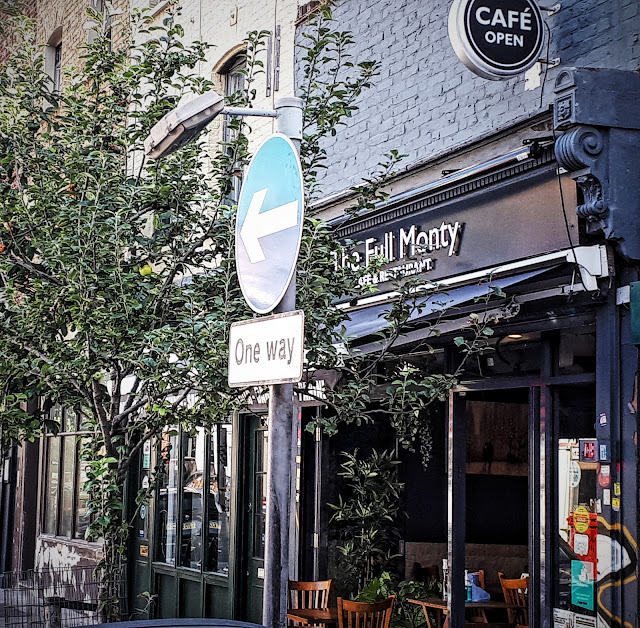
Meals On (Two) Wheels: The Full Monty

A culinary wonder in London’s East End


It’d been a while since I’d gone on one of my long cycling jaunts around London. This time around, with the temperature reaching the late 20s (really, September? I thought you were supposed to usher in autumn), I decided to tour the Magnificent Seven. These are seven, Victorian-era cemeteries built on the outskirts of the capital to ease the overcrowding of the existing burial grounds at the time.

I knew I was looking at a 30-mile-plus journey, so stocking up on good, belly-filling food was essential. My first stop was at one of my favourite cafes in London, The Full Monty.

One of the elements The Full Monty (formerly known as The Workers’ Café) has in its favour is its location. It sits far enough from the overpriced restaurants and eateries in Shoreditch, Hackney and Hoxton. Yet, it’s not off the beaten track completely. Situated on Globe Road, it is right next door to the London Buddhist Centre. East End legend, Ray Winstone was born in nearby Plaistow. West Ham United Football Club’s London Stadium is roughly ten to fifteen minutes away on two-wheels.

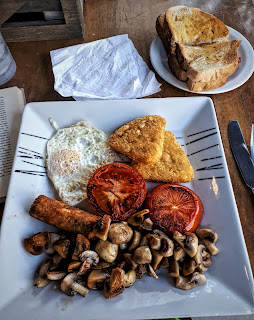
I was feeling hungry. The ride from Abney Park (where I’d started my seven-cemetery tour) had worked up an appetite in me. I’d have usually gone for the full English, but this time I opted for the full veggie instead. I wasn’t disappointed.


A generous portion of mushrooms, with fried eggs and tomatoes, two hash browns, one vegetarian sausage and two pieces of toast was all I needed to refuel. I belong to the “really well done” brigade, so I chastised myself for not telling the lovely and smiling staff to cook my egg well. Still, it was nice.

Having lived in London for close to 24 years now, I’m always on the lookout for local characters. I’ve never been afraid to strike up conversations with complete strangers, especially when these interactions help me understand an area’s culture better. On this occasion a man turned up dressed in a suit, waistcoat, shirt and tie. He also wore smart shoes. Despite the already-rising temperature, this gentleman seemed at ease with his choice of wardrobe. The way he just strolled into the café, sat at a table and shot a cursory glance at the menu, told me he was a regular. Later on, as I was unlocking my bicycle and getting ready to go, I noticed that he, too, was a cyclist. His frame was parked next to mine. Although we did exchange a few pleasantries (he was having a smoke outside), only when I was riding towards Tower Bridge later on, it occurred to me that I could have stayed behind a while longer and found out a bit about his life.

The total bill at The Full Monty came at £6.50. A snip when you have similar establishments just a mile and a half away, on Cambridge Heath Road that will charge three or four quid more for a similar meal. Although I didn’t have any beverage this time, I’d strongly recommend the mocha here. I’ve had it before and it’s the way I like my mochas: strong (double shot of espresso) and milky. I’ll certainly come back to The Full Monty again. And this time, if Mr Dapper-Man-on-a-Bicycle happens to be there as well, I’ll have my phone ready. There are some stories that need to be recorded and told.

Cuban, Immigrant, and Londoner is on sale now


Friday, 29 October 2021

Why I Wrote "Cuban, Immigrant, and Londoner"

 My book is a call to strengthen the bonds that unite us

Photo by Deborah Jaffe

Published by Austin Macauley, supported by an Arts Council England grant and with photographs by the excellent Deborah Jaffe, my first book, “Cuban, Immigrant, and Londoner” hits the shelves this week.

Somewhere towards the end of my book, I write “This is what writing from an EAL immigrant’s perspective represents. Shards of glass that amount to nothing more and nothing else than the imperfect creation of a glimpse into the life we’ve lived, the one we have yet to live and the experience that has accompanied this process.” The “shards of glass” are a reference to an image produced by the photographer Gillian Allard in 2017 for one of her challenges on the Sky Arts show “Master of Photography” (Gillian went on to win the competition).

Shards tend to be seen mainly as broken pieces of glass and therefore they have a negative connotation. For instance, you can get cut if you walk on them barefoot. For me, though, shards and the distorted image they return, represent the various ways in which our lives as immigrants play out.

That’s why I decided to split “Cuban, Immigrant, and Londoner” into five different chapters. They each deal with five different identity markers. Cuban, Immigrant, and Londoner was the trigger to write the book from a self-proclaimed Londoner’s perspective. A Cuban in London and London in a Cuban is a collection of 250-/300-word light-hearted vignettes depicting those little moments that enrich an immigrant’s life. As the Land is the Language is a reflection on our relationship with the English language as immigrants. From Here and There is a compilation of the articles I’ve published in newspapers and magazines in the last fifteen years. The closing chapter, An EAL Immigrant Writes, seeks to explore the ways in which we, non-native speakers, express our ideas and thoughts in our adopted country’s language, in this case, English.

The main aim of the book “Cuban, Immigrant, and Londoner” is to serve as a platform for fellow immigrants to share our experiences. Furthermore, through the book I would like to start a much-needed conversation with the wider public in the UK on the contributions made by immigrants to this country.

The ideas behind this book have long been in gestation. Some come from my professional life. An example of this was a First Light-funded, EAL children-supporting project I managed at two primary schools in 2009. Another film-related project I managed years later, in 2014, sought to delve into issues related to identity and belonging.

Above all “Cuban, Immigrant, and Londoner” is part memoir, part autobiography and part reflection on an Afro-Latin Caribbean immigrant’s life in London for more than 20 years. It’s a journey that’s barely begun. Welcome aboard and enjoy the ride.

Thursday, 20 May 2021

A Visit to Batsford Arboretum in Gloucestershire


Was it a hawk, a buzzard or a kite? All I know is that it was a bird of prey


Mighty oaks from little acorns grow (photo by the blog author)

I only noticed it when we were walking towards the exit. It hovered just above us, as if to show off its aerial skills. Was it a kite, a hawk or a similar bird of prey? I don’t know. The sky was a dull grey and fascinated though I usually am by wildlife, I can’t tell a buzzard from a sparrowhawk that far.

We were at Batsford Arboretum, in Gloucestershire. Home to one of the UK’s largest private tree collections, we’d just spent a good hour walking among cherry blossoms and oak trees.

With 56 acres of wild gardens, paths and streams, the arboretum offers something to everyone. Set up as a charity, the Batsford Foundation (the body that oversees the venue’s management and maintenance) aims to promote education, conservation and research into gardens and historic landscapes.

Originally the estate belonged to Algernon Bertram Freeman-Mitford, who had worked for the Foreign Office in Russia, Japan and China in the 1860s. A passionate lover of the oriental landscape, this was the sort of design Mitford had in mind for the arboretum.

A cedar tree (photo by the blog author)

Sadly, during the Second World War and the years that followed the grounds became wild and fell into neglect. It wasn’t until Frederick Anthony Hamilton Wills, 2nd Lord Dulverton, succeeded the previous owner that the garden was returned to its former glory.

Once we left the arboretum I realised there was another building next to it. It was a falconry, where many birds of prey can be seen daily in free-flying demonstrations. I spotted another couple of birds up in the air with the one I’d seen before.

But hard as I tried, I still couldn’t tell them apart.

Saturday, 1 May 2021

Walking In the Cotswolds With a Song In My Head

Gorse and limestone, but where’s my snake?


Climbing up on Solsbury Hill/I could see thecity light/Wind was blowing, time stood still/Eagle flew out of the night

I’ve no idea why I was singing and humming (the latter, when words failed me) Peter Gabriel’s tune in my head, other than it seemed appropriate as we went up Cleeve Common, in Gloucestershire. This is a habit I’ve had for many years now. Serenading myself quietly. I think I’ve taken after my dad in that respect. He always had a melody on his lips. Sometimes it was a well-known song played endlessly on the radio. Other times it was a piece he was working on, ready to be finished on the upright piano we had back then in my house.

Geology- and archaeology-rich Cleeve Common sits in one-thousand acres of agriculturally unimproved limestone grassland, in the Cotswolds. Quarries and gorse thickets add to the variety of wildlife habitats.

Untouched by the plough or fertiliser, the area is home to a wide range of wild flowers, many of which would have been familiar throughout Britain before the post-war intensification of farming.

However, despite the presence of three Scheduled Ancient Monuments (the Cross Dyke, the Hill Fort and the Ring), what I really wanted to see was an adder.

I’d heard so much about Britain’s only venomous snake. The presence of meadow pipits was a welcome sign as I knew that adders liked hunting ground-nesting birds. Also, the high-rising temperature would have tempted this usually shy reptile to leave its hideout in order to seek the warmth of the sun.

Yet, after walking for just over an hour there was no slithering, dark zig-zag pattern to spot. We got back to the car, my heart “going boom, boom, boom”, but I guess you already knew that. After all, I’m used to serenading myself.

Thursday, 22 April 2021

Belas Knap Long Barrow: a Piece of British History

A culture-rich walk in Gloucestershire and dressing for April

 
Chamber D (photo by author)

They told me it was a steep climb, but in the end it wasn’t much of an effort. The main issue was how to dress. TS Elliot got it wrong. April is not the cruellest month, but the most weather-uncertain one. Layer-shedding is what I call the fourth month of the year. And so it proved to be today.

I started uphill with a jumper, a hoodie and a jacket. Belas Knap, our destination, beckoned further up ahead. Going through a couple of fields, I realised that lambing season had already started. The evidence was the little, Easter-picture-perfect lambs gambolling about, not too far from the ewes’ watchful gaze.

Belas Knap Long Barrow, in Gloucestershire, is one of those sites that connects you to history straight away. It’s over 5,500 years old and it was built by prehistoric people, early Neolithic period. It was a burial place. At least the remains of 38 people were found within the four chambers that make up the mound.

The site was first excavated in the 1860s. However the barrow was left in ruins until 1928 when more digging and restoration took place. There are four burial chambers and a “false portal” (picture below). The latter might have been built to deter robbers, even though not many valuables have been found in the tomb chambers. Another theory suggests that the false entrance was a “spirit door”, making it easy for the dead to come and take offerings..

False entrance known as portal setting (photo by the author)

By the time we initiated our descent, my hoodie was wrapped around my waist and I was holding my jacket. I was also wishing I had at least put on a T-shirt underneath, instead of a thick top. It wasn’t the climb that was the problem but my sartorial choice.

Monday, 1 February 2021

Living with Covid (in the house)


Sorry, guys, but the test has come back positive”. The words felt like a hammer blow.

Covid-19 had just arrived home.

Worldwide, 2020 has already been an annus horribilisCoronavirus has swept through every single country, regardless of GDP or religion. As an English language teacher, I was one of the first ones to be made aware of the devastation wreaked by this most unwelcome visitor. My school, like all the others in the UK, closed down in late March.

Yet, deep within my psyche (and I only came to this conclusion after reading and re-reading the text from my landlord to both my housemate and me letting us know that he’d contracted the virus) was the thought that all this was happening somewhere else. How reality-defying must one be before reality imposes itself? Sometimes in the most unaccommodating of circumstances.

(Click here to continue reading)

Tuesday, 5 January 2021

Urban Diary


Thursday, 3 September 2020

Being John Malkovich


The world doesn’t need more ego-driven individualism, the consequence of which is uncertainty, both economic and political. The world needs more consistency. The world needs more John Malkovichs (or should that be Malkoviches?).

Consistency has been key to Malkovich’s output. This does not always translate as quality, but the actor is renowned for going where few of his peers dare to.

In a success-focused, happiness-chasing society where we are taught from an early age to try for the summit, it is useful to know that some people are just as content with soul-enriching projects, even if they are less financially remunerative. In Malkovich’s case, this scenario has played out in films where the process of building a character and exploring the depth of it has been more important than the amount of zeroes on the cheque.

(Continue reading here)

Thursday, 20 August 2020

My Introduction as one of Illumination Writers


For the last few months I have been writing for an online publication called Illumination. Here’s my formal introduction to both fellow writers and readers alike. If you have been a member of this parish for a long time, you might remember that I wrote a similar post to celebrate one of my birthdays. Well, the green revolution is here. Recycle and reuse!

Continue reading here.


Saturday, 1 August 2020

What Makes a Good Writer? (originally written by Zadie Smith)


Third part now.

What writers know

First things first: writers do not have perfect or even superior knowledge about the quality or otherwise of their own work — God knows, most writers are quite deluded about the nature of their own talent. But writers do have a different kind of knowledge than either professors or critics. Occasionally it’s worth listening to. The insight of the practitioner is, for better or worse, unique.

(Click here to continue reading)


Thursday, 9 July 2020

What Makes a Good Writer? (originally written by Zadie Smith)


Still from the archive. 2nd part.
The craft that defies craftsmanship
That is the end of the tale of Clive. Its purpose was to suggest that somewhere between a critic’s necessary superficiality and a writer’s natural dishonesty, the truth of how we judge literary success or failure is lost. It is very hard to get writers to speak frankly about their own work, particularly in a literary market where they are required to be not only writers, but also hucksters selling product. It is always easier to depersonalise the question. In preparation for this essay I emailed many writers (under the promise of anonymity) to ask how they judge their own work. One writer, of a naturally analytical and philosophical bent, replied by refining my simple question into a series of more interesting ones: I’ve often thought it would be fascinating to ask living writers: “Never mind critics, what do you yourself think is wrong with your writing? How did you dream of your book before it was created? What were your best hopes? How have you let yourself down?” A map of disappointments — that would be a revelation.
(Click here to continue reading)

Thursday, 2 July 2020

What Makes a Good Writer? (originally written by Zadie Smith)


From the archive.

The tale of Clive

Wednesday, 17 June 2020

3 Tips to Develop a More I-Based Writing Style


Can there be a more powerful artistic statement than Rachelle Ferrell’s album Individuality (Can I Be Me?)? The American singer had already shown her vocal prowess on her debut, First Instrument (especially her own take on famous melodies such as You Don’t Know What Love Is and My Funny Valentine). Yet, brilliant as that record was, it felt lacking, as if Rachelle’s creative output were not being totally showcased. Enter Individuality, Ferrell’s opportunity to put her “I” centre stage.
Similarly, in writing (more specifically the non-fiction variety), “I” is an unashamed attempt to establish character and voice. By character I mean our personality, and by voice our inner thoughts.
(continue reading here).

Friday, 1 May 2020

Dawn

The story of two people longing for each other, yet limited by their circumstances. I first posted a draft on this blog many years ago and in 2012 it was published in The Voice.


“Is he asleep?” he asks.
“Of course,” she snaps. But should there be an “of course”? After all, many a night she has been up until the small hours consoling her husband after a fit. It’s not the convulsions she fears, she’s got used to those; it’s the aftermath, his sense of disorientation. Her voice softens. “Yes, he is asleep, sorry.”
“You don’t have to say sorry. It’s not easy. I understand.”
“Do you?”
“Well, I try. I know it’s difficult to put myself in your place.”
“I wonder if anyone could put themselves in my place. I wonder if even I want to be in my place.”
Silence. The unsayable is usually followed by quietness. This is not what she’s come here for, however. She saw the balcony light on, heard the soft, mellow notes of Miles Davis’s A Kind of Blue playing and knew he was out there. She found him with a glass of wine in one hand and a cigarette in the other one.
Their eyes kiss. It’s a lingering, embracing kiss, the type they know they’ll never be able to replicate with their lips.
(Continue reading here)

Sunday, 12 April 2020

Top Tips for Editing Your Writing During the Time of COVID-19


There’s a beautiful scene in High Fidelity, Stephen Frears’ 2000’s film adaptation of Nick Hornby’s novel, that I never tire of watching. Facing the camera, Rob Gordon, the character played superbly by John Cusack, shares his top tips in making the ultimate mixtape:
The making of a book, regardless of its future standing in literature’s canon, is equally hard to do and it also takes ages to complete.
Continue reading here.

Sunday, 5 April 2020

Writing in the Time of COVID-19


The reporter, staff writer and non-fiction author Deneen L Brown has an invaluable piece of advice for writers. She says “The hardest thing about the beginning is the blank screen. Writing is like scraping off a piece of yourself, people can see beneath your skin.

Continue reading by clicking here.

Sunday, 29 March 2020

Writing in the Time of COVID-19

A deserted Long Acre, Covent Garden, London


In my previous column, I wrote about freeing up our creativity while self-isolating. This one will deal with what happens when we’ve managed to complete that much-longed-for first draft.
Imagine your name IS NOT Steve. Or Martha. Imagine you are the editor of a prestigious publication. And now imagine a freelance writer submitting a piece addressed to Editor-in-Chief Steve. Or Martha.
Yeah. You, aspiring writer, cocked up big time.
(Continue reading here)

Sunday, 22 March 2020

Writing in the Time of COVID-19


After all, Fermina Daza and Florentino Ariza were just two characters in Garcia Marquez’s novel Love in the Time of Cholera. You, fellow writer, on the other hand, are the only character in your own life’s novel. And you’re coming back to port now.
Continue reading here

© 2020

LinkWithin

Related Posts Plugin for WordPress, Blogger...