 Am I not a Man and a Brother?
Original design of the seal of the Society for the Abolition of Slavery in England in the 1780s.
You're a maverick, Yasmina Khadra, or should I call you by your real name, Mohammed Moulessehoul?. You are a maverick. But, no hard feelings from me, mate. Because you are also a very good writer. Correction, you're an excellent writer.
'L'Attentat' (in English, 'The Attack') deals with the aftermath of a suicide bomber's strike on a busy restaurant in Tel-Aviv. Dr Amine Jaafari, the main character, spends the next twenty-four hours on duty, operating on victim after victim until, completely exhausted he goes back home. A hard knock on the door in the small hours of the morning wakes him up and it is from that moment on that his restful sleep is replaced by a nightmare he could never have envisaged before. The police, on entering his apartment, tell him that he must come to the hospital immediately to identify one of the bodies found at the restaurant. Back at the hospital, amidst the pile of corpses, Dr Amine is told that the suicide bomber, the kamikaze who wreaked havoc in that busy restaurant in Tel-Aviv is his wife, Sihem, and that's why he has been asked to identify her body. Did I mention the word 'nightmare'? Nah, more like hell on earth.
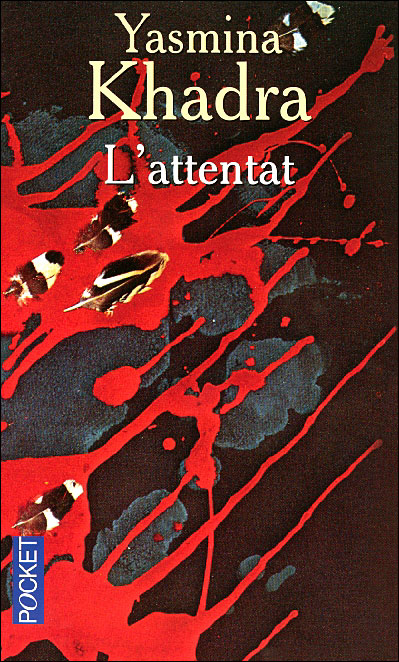 There are three main issues this novel addresses, in my opinion. And they are all inextricably linked. The first one is the relationship between husband and wife, the second one is the Arab-Israeli situation and the last one is modern-day terrorism and its definition.
By making Dr Amine a Bedouin, Yasmina is already placing his main character in a sub-category, or as my journalist friend Yvonne Osorio put it all those years ago in the short-lived gay publication in mid-90s Havana, 'Huellas' (Footprints), he is the 'difference within the difference'. The difference here is the minority vs the majority. Dr Amine is an Israeli of Arabic origin. But he is also one of the 160,000 Bedouin who live in 'unrecognised' villages in Israel. He is the difference within the difference. His aspirations and ambitions are framed against this background and early in the novel we are witness to the prejudices and abuse he is subjected to by his colleagues at the hospital, by the police and ultimately by his neighbours when word goes around that it was his wife who perpetrated the attack at the restaurant.
Dr Amine refuses at first to believe that his spouse had anything to do with this violent act. He believes fervently in their relationship. He blames the coppers, the Israelis, society. Until he receives a letter:
'À qoui sert le bonheur quand il n’est partagé, Amine, mon amour? Mes joies s’éteignaient chaque fois que les tiennes se suivaient pas. Tu voulais des enfants. Je voulais les mériter. Aucun enfant n’est tout à fait a l’abri si’l n’a pas de patrie… Ne m’en veux pas. Sihem.'*
This missive, dated a few days before the sabotage, is the condemning proof that his wife was actually the assassin. Dr Amine's world is suddenly turned upside down. It's not just the fact that his wife led a double life that affects him but also the fact that she was capable of killing other human beings.
With the help of a fellow doctor, Kim, Dr Amine sets off to Bethlehem - the place where his wife was allegedly headed for before she immolated herself at the restaurant- to find out the roots of Sihem's conversion. Once there his arrival elicits a wide range of feelings and emotions from both relatives and locals; from warm effusion to downright hostility. In various places he is congratulated on his wife's heroic deed, a passage that for me brought back sad memories of seeing crowds in the Middle East cheering and chanting after the attack on the Twin Towers in September 2001. This outpuring of well-meaning solidarity only heightens Dr Amine's frustration and on trying to explain to a next of kin that he'd rather his wife was alive than dead, he is given a lecture on the plight of the Palestinians. Events take a turn for the worse when his enquiries on his wife involvement with the local terrorist group lead him to the Grande Mosquée where he is made to wait for several hours after he asks to talk to the imam. His request being denied, he is given the first of two warnings of what will happen to him if he doesn't toe the local mob's line. Stubborn as he is, Dr Amine insists that he must talk to the imam, and unfortunately he is shown, physically, what happens to those who want to know too much. Even if they are only interestd in finding out about their consorts' role in murdering people.
Throughout the boook Dr Amine keeps questioning a person's right to maim others even if they have been affronted. Not all his encounters are with extremists, though. In Janin he runs into Shlomi Hirsh, a Jew whose opening sentence is: 'Sharon est en train de lire la Torah à l’envers'*, and later on he says: 'Il croit préserver l’Israël de ses ennemis et ne fait que l’enfermer dans un autre ghetto, moins terrifiant certes mais tout aussi injuste'*.
Yasmina's biggest achievement as a writer is to create a nuanced main character. At some point I expected Dr Amine to join, or at least show support for the Palestinian suicide bombers, especially after Israeli troops raze one of his relatives' house in front of his eyes. But no, he steadfastly refuses to condone the killing of another human being even when his ancestors' home is turned into rubble. The fact that we see the action developing from Dr Amine's perspective is a powerful tool that Khadra utilises effectively. For example his encounter with and imprisonment by one of the terrorist phalanges gives us a detailed account on the various types of Islamist groups operating in the Middle East and how they relate to each other. Another example of Yasmina's careful approach to this very sensitive issue is his use of flashbacks to narrate Dr Amine's relationship with his wife, Sihem.
However, it's the third issue I pointed out before, modern-day terrorism, which Yasmina nails down. And to analyse this, we ought to dig into the author's background. For some time Yasmina Khadra was considered the authentic voice of the Arab woman, mainly in France. When he 'came out' as a 'he' in 2001, there was a public outcry and his military past (he was an Algerian army officer with more than thirty years of service in the armed forces under his belt) came to the fore. Mohammed Moulessehoul remained unrepentant, though. In an interview with The Guardian in June 2005 he said that 'You see, I wrote six books under my real name in Algeria. I was happy with that until 1988, when they imposed on me conditions that were abominable. Unacceptable. The army required henceforth that I submitted my manuscripts to a committee who could censor my work. I refused and so I risked having to stop writing, but what could I do? It was my wife who proposed to write under her first two names - Yasmina Khadra.'
It is from his eight-year experience of fighting Islamist radicals where Mohammed draws most of his philosophy. A philosophy that not only condemns Islamic extremism but also Israeli state-sponsored terrorism (at the time of writing the child death toll in Gaza is close to the 300 mark). Because to Yasmina Khadra terrorism is not just a bunch of men speaking Arabic, but also the tanks and bulldozers marching into the Bedouin enclaves.
It is ultimately to religious fanaticism that the author directs his most acerbic criticism. Throughout the novel he presents us a series of characters who are slaves to a dogma and use that article of faith to carry out barbaric acts. However, it is through Dr Amine's voice that we hear Yasmina's loud cry for understanding, for appreciating that which makes us humans: Am I not a man and a brother?
* Apologies for not translating the passages quoted in my post into French. Although I am a translator/interpreter/linguist by trade my especiality is English to Spanish translation and viceversa. Had I attempted to transpose the scenes quoted in my post into English, I would have felt that I was letting French speakers down. Many thanks.
Copyright 2009


